I once burned 60,000 Chase Ultimate Rewards points on a round-trip to Lisbon. I felt like a genius until I checked FlightKitten three days later and saw TAP Air Portugal had dropped the same route — JFK to LIS — to $389 round-trip. That's roughly 0.65 cents per point. The so-called "sweet spot" redemption I was proud of turned out to be barely better than paying cash on a bad day.
This is the article I wish existed before I made that call.
The baseline: what is a point actually worth?
Every points currency has a floating real-world value, and the travel influencer industrial complex has a vested interest in making you think yours are worth more than they are. Let's be blunt about the numbers.
The most commonly cited valuations — from outlets that make money when you apply for credit cards — tend to run optimistic. Here's a more grounded look at what you can realistically expect when redeeming for economy flights:
| Points currency | Optimistic estimate | Realistic economy redemption |
|---|---|---|
| Chase Ultimate Rewards | 2.0 cpp | 1.1–1.4 cpp |
| American Express Membership Rewards | 2.0 cpp | 1.0–1.3 cpp |
| Capital One Miles | 1.7 cpp | 1.0 cpp (fixed) |
| United MileagePlus | 1.5 cpp | 0.8–1.2 cpp |
| Delta SkyMiles | 1.2 cpp | 0.7–1.1 cpp |
| Southwest Rapid Rewards | 1.5 cpp | 1.3–1.5 cpp (consistent) |
Delta SkyMiles deserves special attention here. Delta dynamic pricing means the same ATL-CDG route that costs $650 cash might run you 95,000 SkyMiles — that's 0.68 cpp. You're better off just paying. I've seen this happen repeatedly and it still surprises people.
When cash is obviously the right answer

There are entire categories of flights where cash wins and the math isn't close.
Budget carrier routes. If Spirit is flying ORD to FLL for $59 one-way, there is no points redemption on earth that competes with that. Spirit doesn't even have a meaningful frequent flyer program worth engaging with. Same goes for Frontier, Allegiant, and most Ryanair/Wizz Air routes in Europe. These carriers price so aggressively that the opportunity cost of using points — which you could save for a longer haul — makes no sense. Sale fares on legacy carriers. When United runs a sale and you can grab EWR to MAD for $420 round-trip, that's roughly 42,000 miles at 1.0 cpp. But United would likely charge you 60,000+ MileagePlus miles for the same route at standard pricing. You're better off paying cash and keeping the miles for a route that doesn't go on sale. Last-minute economy tickets. Points programs often have lousy last-minute availability in economy because airlines want to sell those seats for cash. You'll either find nothing, or find the "saver" award space has been replaced with a "standard" award at 2x the miles. Cash wins by default.A good rule of thumb: if a one-way economy ticket is under $200 domestic or under $400 transatlantic, pay cash and bank the points.
When points genuinely beat cash
Okay, points aren't useless. There are real scenarios where they win.
Partner award space on Star Alliance/Oneworld. This is where transfer points shine. You can transfer Chase UR to Air Canada Aeroplan and book Lufthansa economy from YYZ to FRA for around 30,000 Aeroplan points one-way. The cash price for the same seat regularly sits at $700–900. That's 2.3–3.0 cpp — genuinely good. ANA round-the-world or long-haul redemptions. ANA Miles (transferable from Amex MR) have some of the most underpriced long-haul economy awards in the game. A round-trip in economy from the US West Coast to Tokyo on ANA runs about 55,000 miles. Cash fares on that route (LAX-NRT) average $900–1,200 round-trip. You're looking at 1.6–2.2 cpp, and the availability is actually decent outside of peak season. Southwest when you have the Companion Pass. This is the single best deal in domestic US points travel, full stop. The Companion Pass lets a designated person fly with you for just taxes on every Rapid Rewards redemption. Since Southwest points are worth a consistent ~1.4 cpp, the Companion Pass effectively doubles that value to 2.8 cpp on every redemption. It's the one case where I'll tell someone to actively chase a points strategy. Iberia Avios for transatlantic. Iberia has a distance-based award chart that prices MAD-JFK or MAD-BOS at just 34,000 Avios round-trip in economy during off-peak periods. Cash fares on those routes run $500–800. Transfer from Amex MR or Chase UR to British Airways Executive Club (which pools with Iberia), then move to Iberia Plus. Yes, it's annoying. Yes, it's worth the 20 minutes.Pro Tip: Aeroplan's distance-based pricing is one of the last remaining charts that rewards short-to-medium haul partner redemptions fairly. A one-way economy redemption on United metal from ORD to LHR can run as low as 35,000 points, versus 60,000+ MileagePlus miles for the same seat.
The hidden costs nobody talks about
Points math gets ugly when you factor in what the glossy travel blogs skip.
Carrier-imposed surcharges. British Airways Avios redemptions on BA metal are notoriously loaded with fuel surcharges. A "free" business class ticket from JFK to LHR can carry $700+ in fees. Economy is better — usually $150–250 in fees — but it still eats into your effective cpp. Book Avios on American Airlines metal instead (same Oneworld alliance, no fuel surcharges) and you sidestep this entirely. The opportunity cost of earning. If you're spending $1,500/month on a travel credit card earning 1.5x points, you're accumulating roughly 27,000 points per year from that spend alone. At 1.2 cpp, that's $324 in flight value annually. A 2% cash-back card on the same spend returns $360 in hard cash. The points card loses unless you're maximizing category bonuses or hitting a sign-up bonus. Devaluations. Delta devalued SkyMiles so aggressively between 2019 and 2024 that points sitting in accounts lost meaningful value while people waited for the "right" redemption. United has done the same. Points are a depreciating asset. Cash doesn't randomly become worth 20% less because an airline had a bad quarter. Award search friction. I've spent three hours hunting for Saver award space on a United partner route that I eventually gave up on. That time has value. Sometimes paying $480 cash and spending zero hours on it is the right call, especially for shorter trips where the points savings wouldn't be dramatic anyway.How to actually run the math before you book
Here's the framework I use. It takes about four minutes.
- Find the cash price for your route. Use Google Flights, then check FlightKitten to see if that price is historically low or if it's likely to drop further.
- Find the best points redemption for the same route and dates. Check the airline's own program first, then transfer partners.
- Divide the cash price (in cents) by the points required. That's your cpp.
- If the cpp is above 1.4, lean toward points. Below 1.0, pay cash. Between 1.0–1.4, it depends on how many points you have and how soon you'll use them.
Example: LAX to BCN, round-trip. Cash price: $680 on Iberia via Google Flights. Iberia Avios off-peak redemption: 34,000 points round-trip plus ~$120 in taxes. Effective value of the points: $680 - $120 = $560 in flight value from 34,000 points. That's 1.65 cpp. Use the points.
Second example: BOS to MIA, round-trip. Cash price on JetBlue: $178. United MileagePlus would want 25,000 miles for the same route. That's 0.71 cpp. Pay cash, keep the miles.
| Route | Cash price | Points needed | Effective cpp | Verdict |
|---|---|---|---|---|
| LAX-NRT (ANA) | $1,050 RT | 55,000 ANA Miles | 1.91 cpp | Use points |
| JFK-LIS (TAP) | $389 RT | 60,000 Chase UR via transfer | 0.65 cpp | Pay cash |
| ORD-LHR (United) | $820 RT | 35,000 Aeroplan | 2.34 cpp | Use points |
| ATL-CDG (Delta) | $650 RT | 95,000 SkyMiles | 0.68 cpp | Pay cash |
| BOS-MIA (JetBlue) | $178 RT | 25,000 TrueBlue | 0.71 cpp | Pay cash |
| NYC-MAD (Iberia) | $620 RT | 34,000 Avios | 1.47 cpp | Use points |
The programs actually worth your attention in 2026
Not all loyalty programs are created equal, and some have gotten dramatically worse. Here's where I'd actually focus energy:
Worth building: Aeroplan (Air Canada), Iberia Plus/British Airways Executive Club (Avios), ANA Mileage Club, Southwest Rapid Rewards (especially with Companion Pass), Alaska Mileage Plan. Approach with caution: Delta SkyMiles (dynamic pricing makes value unpredictable), United MileagePlus (award chart eliminated in 2024, now fully dynamic), American AAdvantage (partner availability has gotten stingy). Transferable currencies over airline-specific: If you're only going to optimize one thing, hold Chase Ultimate Rewards or Amex Membership Rewards instead of parking miles in a single airline program. Flexibility is worth more than a slightly higher published valuation for a program that might devalue next quarter.Pro Tip: Set up FlightKitten hunts on your target routes before you commit to a points redemption. If a route regularly drops to $400 and you were about to burn 60,000 points for a $580 ticket, you'd want to know that before clicking confirm.
The one thing points people get wrong
The biggest mistake I see — and I've made it myself — is treating points like a savings account that needs to be protected. People hoard SkyMiles for years waiting for the perfect redemption while Delta quietly devalues them. Points are not savings. They're coupons with an expiration date that the issuer controls.
The right move is to earn points intentionally (sign-up bonuses are where the real value is, not ongoing spend), have a specific redemption target in mind before you apply for a card, and execute within 12–18 months. Don't let points sit for three years hoping business class award space opens up on the route you've been dreaming about.
For economy travelers — which is most of us — the math often points toward cash on shorter routes and points on longer hauls where the cash price is genuinely painful. That's not a revolutionary insight, but it's more honest than the "points are always worth it" narrative that conveniently aligns with affiliate commission structures.
The bottom line
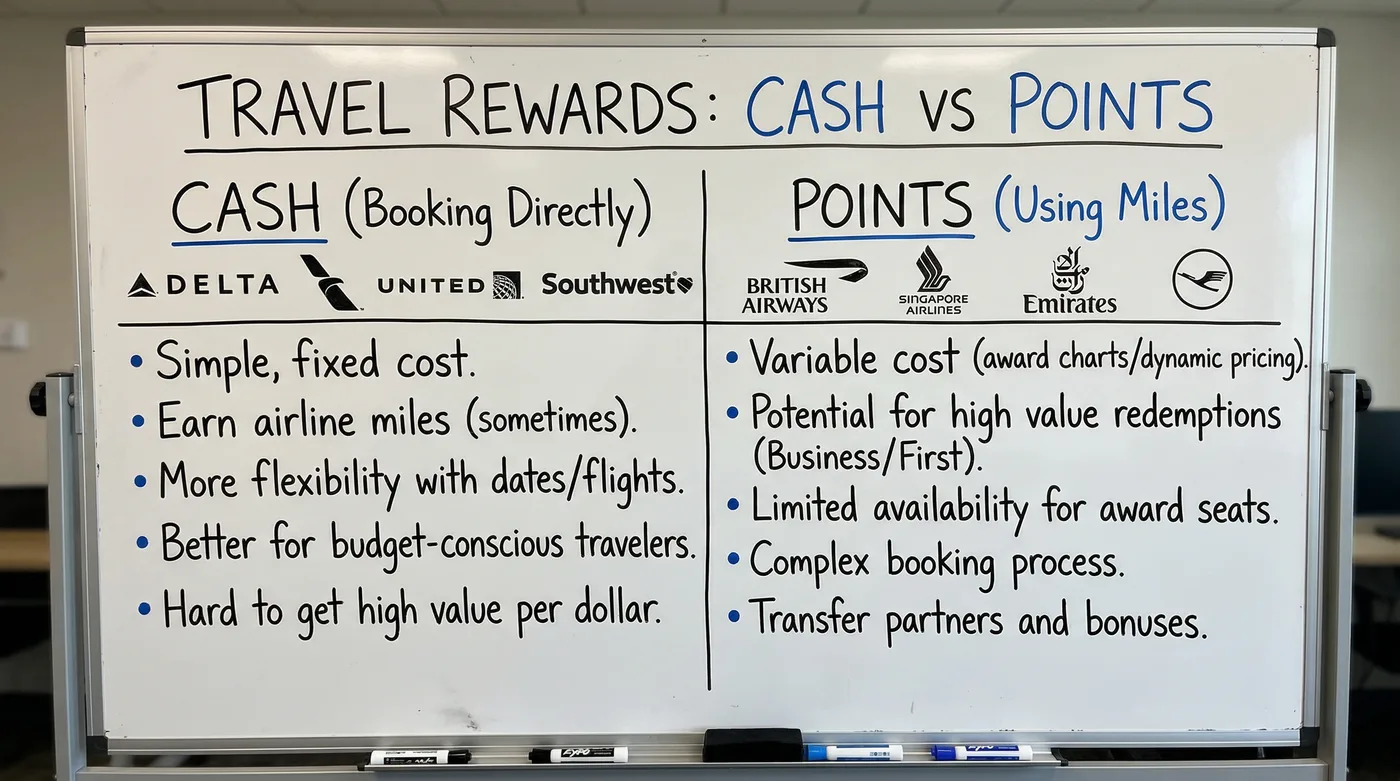
Points beat cash when: you're flying long-haul, you have access to a genuinely underpriced award program (Aeroplan, ANA, Iberia Avios), and you've done the cpp math to confirm you're getting above 1.4 cents per point.
Cash beats points when: the fare is already cheap, you're flying a budget carrier, it's a short domestic hop, or the award chart has been nuked by dynamic pricing (looking at you, Delta).
The most useful thing you can do right now is pull up your points balances, pick two routes you actually want to fly in the next year, and run the four-minute framework above. You'll either find a legitimately good redemption or confirm that the $410 cash fare FlightKitten caught last Tuesday was the right call all along.
Set up your hunts, watch the cash prices, and don't let anyone — including a travel blogger with a credit card referral link — tell you points are always the answer.