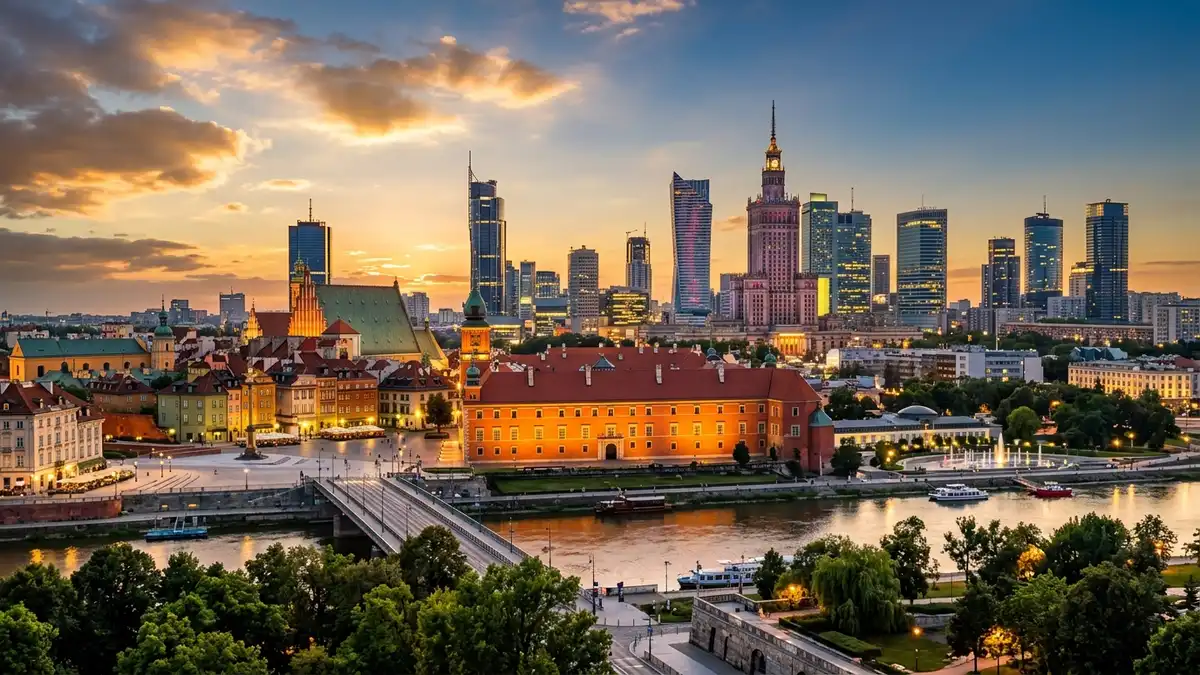



Route Briefing: Atlanta to Warsaw
Few American cities have a direct cultural pipeline to Poland quite like Atlanta, home to one of the largest Polish-American communities in the Southeast. That connection makes the roughly eleven-and-a-half-hour journey to Warsaw feel less like a leap into the unknown and more like a long-overdue reunion with a city that genuinely rewards the curious traveler.
Warsaw is one of Europe's great comeback stories. Almost completely leveled during World War II, the city was painstakingly rebuilt from old paintings, photographs, and sheer collective will. The result is a place that carries its history with unusual honesty — you can walk through the reconstructed Old Town, a UNESCO World Heritage Site, knowing that what you're seeing represents an act of national defiance as much as architectural restoration. That emotional weight gives Warsaw a depth that more polished European capitals sometimes lack.
Beyond the history, Warsaw has quietly become one of the continent's most exciting food cities. Polish cuisine has shed its heavy, meat-and-potatoes reputation and evolved into something genuinely inventive, with chefs reimagining traditional ingredients in ways that feel both rooted and modern. Pierogi, żurek, and bigos remain beloved staples, but the dining scene now stretches well beyond them. And because Warsaw hasn't been fully discovered by mass tourism yet, you're getting all of this at prices that feel almost embarrassingly reasonable compared to Paris or Amsterdam.
For the flight itself, LOT Polish Airlines is worth checking first — as Poland's national carrier flying directly into Warsaw Chopin Airport, they frequently offer competitive fares and often require just a single connection. Lufthansa and Delta round out your options with solid service. A good roundtrip deal comes in under $650, while standard fares typically run $900 to $1,200 or more, so booking two to four months ahead gives you the best shot at the lower end.
From Warsaw Chopin Airport, the city center is easily reachable by train — a fast, affordable, and straightforward option that drops you close to the heart of the city without the unpredictability of traffic.
Timing matters here. June through August is peak season, when Warsaw is lively, green, and buzzing with outdoor events. But shoulder seasons — particularly late spring and early autumn — offer milder crowds, comfortable temperatures, and often softer prices on both flights and accommodation.
The one tip worth underlining: don't sleep on Warsaw's Praga district, the east-bank neighborhood that survived the war largely intact. It's grittier, more authentic, and gives you a glimpse of the city that tourists moving between the Old Town and the Palace of Culture and Science often miss entirely. That contrast — the rebuilt and the original — is really what makes Warsaw unlike anywhere else in Europe.