


Route Briefing: Dallas to Washington D.C.
Flying from Dallas to Washington D.C. is one of those routes that genuinely rewards the traveler who times it right. At just over three hours in the air, it's short enough to feel like a quick hop but lands you somewhere with enough depth to fill a week without ever pulling out your wallet for the big stuff — because the Smithsonian museums, the National Mall, and the monuments are all completely free.
That's the thing about D.C. that surprises first-timers: this is one of the most culturally rich cities in the world, and the barrier to entry is essentially zero. You can spend a full day moving between the National Air and Space Museum, the National Museum of Natural History, and the National Gallery of Art without spending a dime on admission. The monuments along the Mall — the Lincoln Memorial, the Washington Monument, the Vietnam Veterans Memorial — are open around the clock, and seeing them lit up at night is genuinely one of the great American travel experiences.
On the practical side, American Airlines, United, and Southwest all fly this corridor regularly, keeping competition healthy and fares honest. A roundtrip under $200 is a genuinely good deal here, while standard fares tend to sit above $350. Because this is a heavily trafficked business route, the timing of your booking matters more than usual. Aim to lock in tickets four to six weeks out, and steer clear of Monday morning and Friday evening flights — that's when corporate travelers flood the route and prices climb accordingly. Mid-week departures are your friend.
If you're flying into Reagan National (DCA), you're in luck — it's connected directly to the D.C. Metro system, making it one of the easiest airport-to-city transfers in the country. Dulles (IAD) is farther out but also has Metro access via the Silver Line, so either way you can skip the cab and ride straight into the heart of the city affordably.
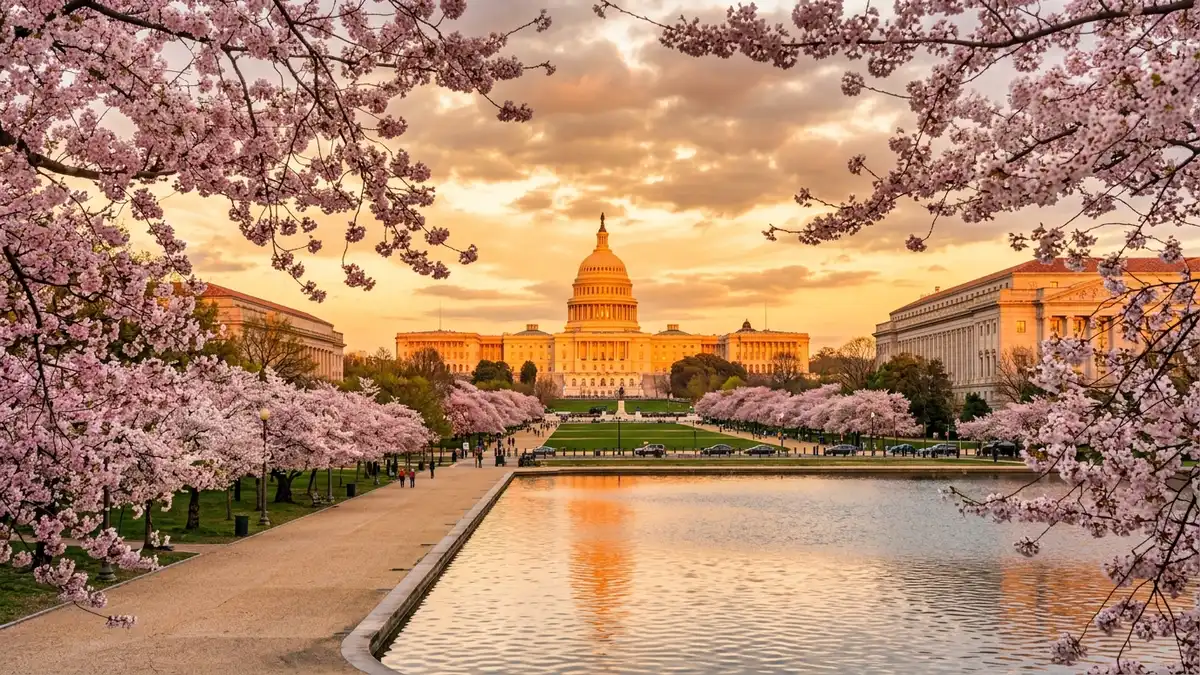
Timing your visit matters too. Late March through early April brings the famous cherry blossoms around the Tidal Basin — one of the most photographed natural events in the country, and worth planning around if you can. Summer is peak season and the city gets busy and humid, while late November and December see another surge around the holidays. For a quieter, more comfortable visit with lower fares, shoulder seasons in spring and fall are the sweet spot.
D.C. rewards the curious and the unhurried. Come with comfortable shoes, a Metro card, and a flexible itinerary, and this city will consistently give you more than you expected.