


Route Briefing: Dubai to Bora Bora
Few routes in the world ask quite so much of a traveller — 20-plus hours, at least two stops, a journey that hops continents and time zones — and yet the moment you step off the small Air Tahiti prop plane onto Bora Bora's tiny Motu Mute airport and see that lagoon stretching out in impossible shades of jade and sapphire, every hour in transit dissolves completely. This is one of those rare destinations that genuinely earns its reputation.
From Dubai, you'll most likely connect through Paris Charles de Gaulle or Los Angeles, with Air Tahiti Nui, Air France, and Corsair covering the major legs. It's a complex itinerary, which is exactly why booking four to six months ahead is non-negotiable here — you're essentially stitching together a long-haul international flight with a transpacific crossing and a final island hop, and good seat combinations at reasonable prices disappear fast. A roundtrip under $2,500 is a genuine find on this route; standard fares climb to $3,500 and well beyond, so patience during the booking phase pays real dividends.
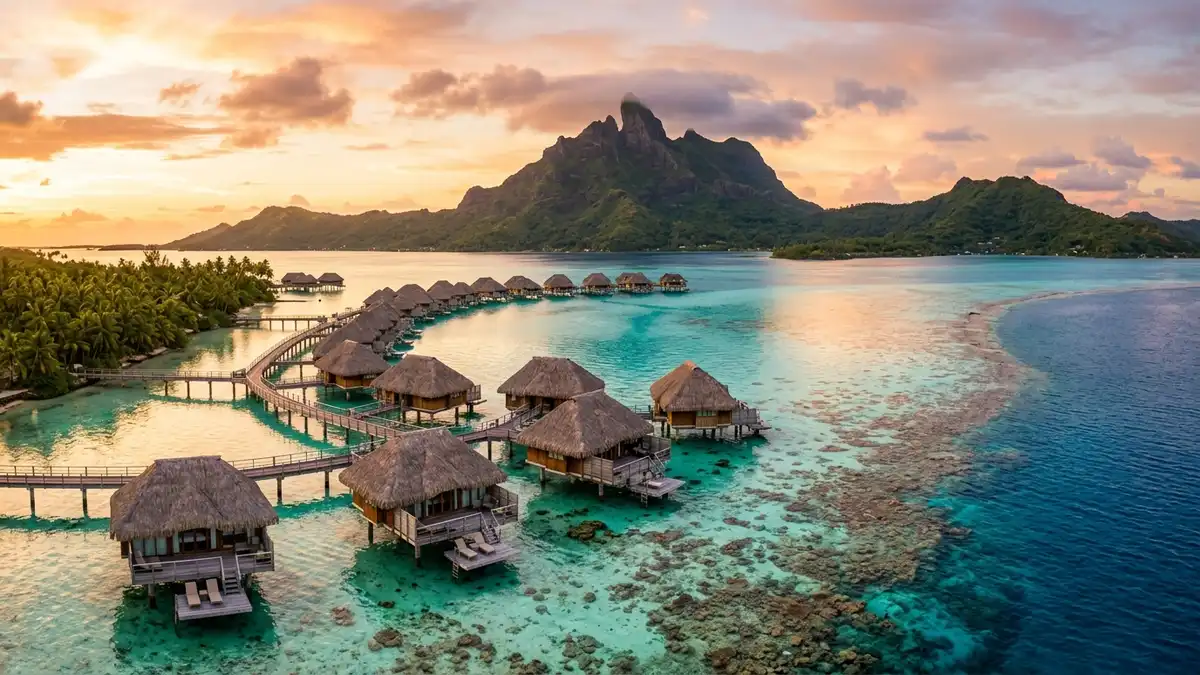
Because the airport sits on a separate islet from the main island, arrival involves a short boat transfer to reach your accommodation — most resorts handle this directly, so confirm the arrangement when you book. It's actually a lovely introduction, gliding across the lagoon with the dramatic silhouette of Mount Otemanu rising ahead of you.
Bora Bora's magic is centred almost entirely on that lagoon. Snorkelling and diving with rays and reef sharks in the coral gardens, kayaking at sunrise before the day-trippers arrive, and simply floating in water so clear it barely seems real — these are the experiences that define the island. The overwater bungalow, that iconic image, is very much the local accommodation standard, and waking up to a glass floor panel revealing the reef below never gets ordinary.
Peak season runs July through August and again over December and January, when honeymooners and holiday travellers push both prices and crowds to their highest. If your schedule allows, the shoulder months on either side of these windows offer meaningfully lower fares and a quieter, more intimate version of the island. The climate remains warm and tropical year-round, so you're not sacrificing weather by travelling outside peak periods.
The one tip worth carrying with you: French Polynesia is famously expensive on the ground, so front-loading your experiences — booking excursions directly through local operators rather than resort desks — can stretch your budget considerably without touching the quality of what you actually do out on that water.