


Route Briefing: Toronto to Ljubljana
Ljubljana might just be Europe's best-kept secret, and flying there from Toronto is far more straightforward than most Canadians realize. The journey clocks in around 13 hours and 30 minutes with one stop, typically connecting through Frankfurt, Vienna, or Paris — three of Europe's most reliable hub airports. Lufthansa, Austrian Airlines, and Air France all serve this route well, and the choice of connection city is worth thinking about: Austrian Airlines through Vienna feels particularly fitting, given how naturally Slovenia sits within that Central European cultural orbit.
On pricing, patience genuinely pays off here. Standard fares run between $1,000 and $1,400 or more roundtrip, but if you book three to five months ahead for summer travel, you can realistically find deals under $700 — a remarkable value for a transatlantic trip into one of Europe's most underrated capitals. The route skews heavily toward summer, so June through August is peak season, meaning early planning isn't just smart, it's essential.
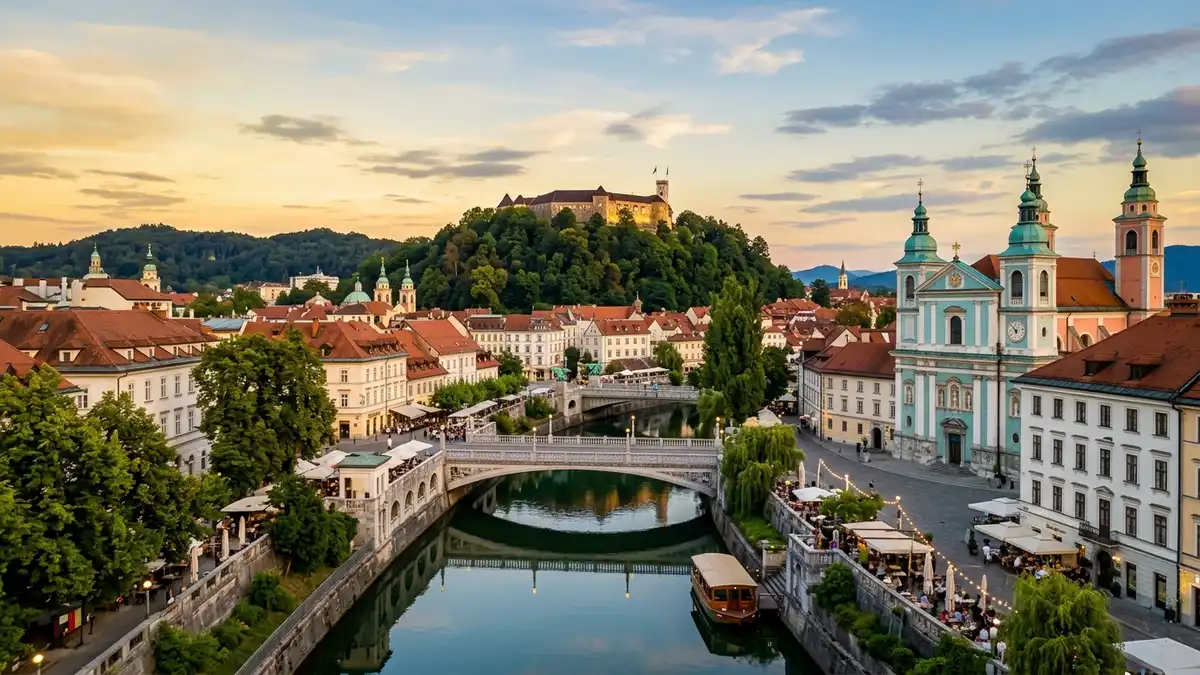
Now, about Ljubljana itself. The city is compact, walkable, and almost absurdly livable. The old town clusters around a hilltop castle, and the Ljubljanica River winds through the centre, lined with café terraces that fill up from late morning until well past midnight in summer. The famous Dragon Bridge — guarded by four bronze dragons — has become the city's unofficial symbol, and it's every bit as photogenic as you'd hope. The whole place has an easy, unhurried energy that feels genuinely rare in a European capital.
Ljubljana's greatest practical advantage is its size: you can absorb the city in a day or two, then use it as a launchpad. Lake Bled, with its island church and clifftop castle reflected in impossibly blue-green water, is roughly an hour away and absolutely worth the trip. The Slovenian coast and the Postojna Cave system are similarly accessible.
From Ljubljana's Jože Pučnik Airport, the city centre is reachable by shuttle bus or taxi — the airport sits about 25 kilometres north of downtown, so factor in some transfer time when planning your first day.
The one tip worth underlining: Slovenia uses the euro, is generally more affordable than Western Europe, and rewards travellers who linger rather than rush. If you can extend your stay beyond a long weekend, do it. The country is small enough to feel manageable but rich enough in landscapes and food culture — think hearty Central European cooking with Adriatic and Balkan influences — that a week disappears quickly and happily.