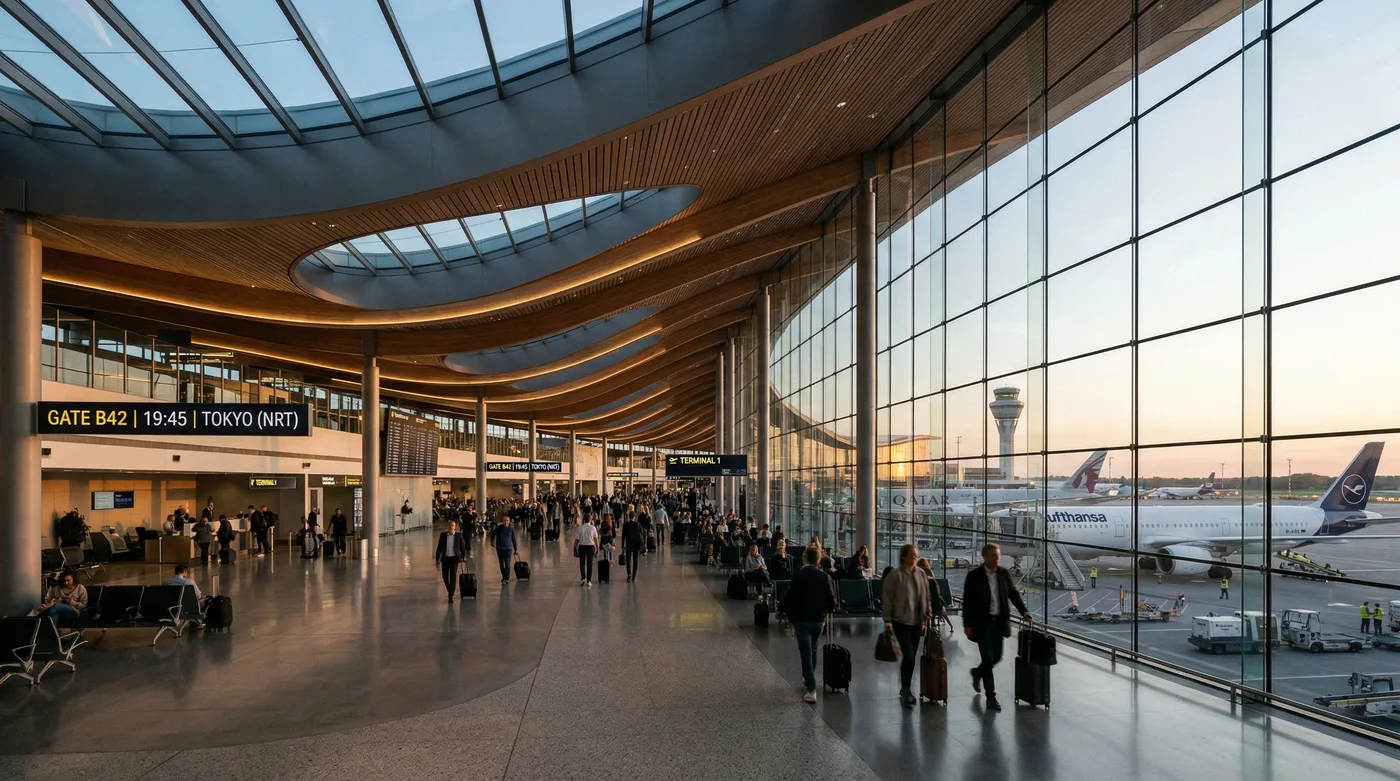
I once spent nine hours in Frankfurt Airport because I thought a $340 saving over a direct flight was worth it. Spoiler: at hour six, sitting on a carpet tile outside Gate B44 eating a €14 pretzel, I was less convinced.
But here's the thing — that layover didn't have to be awful. I just hadn't prepared. Now I treat long connections like a mini-game with actual rules, and I almost always come out ahead. Whether you're staring down a 4-hour stop in Doha or a 10-hour odyssey in Istanbul, this guide will tell you exactly what to do with that time.
Why budget travelers end up with long layovers in the first place
Let's be honest about the math. A nonstop JFK to Bangkok on any carrier right now is going to run you $900–$1,200 in economy. Book JFK–Doha–Bangkok on Qatar Airways with a 7-hour layover in DOH and you're looking at $560–$680 depending on the season. That's a real gap. FlightKitten users catch these kinds of itineraries regularly — the algorithm doesn't care how long the connection is, only whether the price is worth a pounce alert.
The savings are real. The discomfort is also real. The goal is to close that gap.
The layover length spectrum: what you're actually dealing with
Not all layovers are created equal, and the strategy changes completely depending on the clock.
Under 2 hours: Don't think about the city. Think about your gate. This is a connection, not a layover. If it's an international-to-international transfer, you're clearing security again in many airports. Two hours can evaporate. 2–5 hours: Enough time to eat a real meal, shower if the airport has facilities, and maybe hit a lounge. Not enough time to leave the airport without serious stress. 5–10 hours: The interesting zone. Leaving the airport becomes viable depending on visa rules and the city's proximity. This is where preparation pays off. 10+ hours: Plan it like a day trip. You're basically visiting the city whether you want to or not — you might as well do it properly.
Which airports are actually worth being stuck in
Some airports make a long layover genuinely pleasant. Others make you question your life choices. Here's the unvarnished breakdown.
Singapore Changi (SIN) — The gold standard. Free city tours for transiting passengers (seriously, Singapore Airlines and Changi offer complimentary 2.5-hour city tours if you have 5.5–24 hours between flights). There's a rooftop pool, a butterfly garden, a cinema showing free films, and showers that don't cost a fortune. A 9-hour layover here feels like a reward. Doha Hamad (DOH) — Qatar Airways has heavily invested in this airport and it shows. The Al Mourjan Business Lounge is legendary, but even economy passengers can pay ~$60 for day-use access to the Oryx Airport Hotel's pool and facilities. The airport itself has a 24-hour food court, a squash court, and art installations that are genuinely worth walking around. Istanbul (IST) — Turkish Airlines offers a free hotel stay for layovers over 6 hours if you're flying with them. That's not a typo. A free hotel. You do need to check eligibility at the transfer desk, but thousands of travelers use this every year and it's a legitimate program. Dubai (DXB) — Big, efficient, and relentlessly commercial. The malls are a 20-minute metro ride away. Lounge access is expensive unless you have a card that covers it. Frankfurt (FRA) — Functional. Clean. Deeply, profoundly boring after hour three. The train to the city center is 11 minutes and costs about €5, which saves you from the pretzel situation I described above. Amsterdam Schiphol (AMS) — Underrated. There's a free Rijksmuseum outpost inside the airport, a casino, and the city center is 17 minutes by direct train for around €5.50. One of the best airports in Europe for a long layover.| Airport | Free facilities | Lounge day-pass cost | City access |
|---|---|---|---|
| Singapore (SIN) | Cinema, pool, city tour | ~$40 SATS Premier | 30 min by MRT |
| Doha (DOH) | Art, food court, squash | ~$60 hotel day-use | 30 min by taxi |
| Istanbul (IST) | Free hotel (TK passengers) | ~$50 independent | 45 min by metro |
| Amsterdam (AMS) | Rijksmuseum branch | ~$45 Aspire | 17 min by train |
| Frankfurt (FRA) | Basic rest zones | ~$35 Lufthansa (members) | 11 min by train |
The visa question: don't assume you can just leave
This is where people get burned. You cannot assume that because you're "just transiting" you can walk out of the airport and wander around the city.
Visa rules for transit passengers vary by passport, by country, and sometimes by which terminal you're in. A US passport holder can enter most European countries visa-free for a layover city visit. An Indian passport holder faces a different reality in many of those same cities — transit visas are sometimes required even to stay airside.
The rules I'd verify before every layover:
- Does your passport require a transit visa to stay in the airport?
- Does your passport require a separate visa to exit the airport and enter the country?
- Is there a minimum connection time before the airline will allow you to book that itinerary?
IATA Travel Centre is the authoritative source. Your airline's website will also flag this at booking. Don't rely on a Reddit thread from 2023.
Some countries have made transit deliberately easy. The UAE offers visa-on-arrival for dozens of nationalities. Turkey offers e-visas that take about 10 minutes to apply for online. China has a 144-hour visa-free transit policy for citizens of 54 countries — which turns a Shanghai layover into a legitimate 5-day trip if you're creative about routing.
Pro Tip: If you're booking a deliberately long layover to see a city, build in a buffer. Immigration queues, luggage storage, and getting back through security all take longer than you think. For a 7-hour layover, I'd only plan to leave the airport if I had at least 5 hours of actual city time after accounting for transit both ways.
Lounge access on a budget: the options that actually work
Airport lounges used to be exclusively for business class passengers and people with elite status. That's still mostly true, but there are legitimate cracks in the system for economy travelers.
Day passes: Most lounges sell them. Prices range from $25 at a basic Priority Pass-affiliated lounge to $85+ at a premium carrier lounge. For a 6-hour layover where you'd otherwise spend $15 on airport food anyway, the math sometimes works. Priority Pass: The annual membership costs $99 for unlimited visits (as of 2026). If you take more than three long-haul trips a year with connections, it pays for itself. Over 1,500 lounges worldwide. Credit cards: The Chase Sapphire Reserve and Amex Platinum both include Priority Pass. If you have either of these cards and you're not using the lounge access on layovers, you're leaving money on the table. Airline-specific programs: Turkish Airlines free hotel is the famous one. Qatar Airways has a transit hotel at DOH available to economy passengers for a fee (~$50 for 8 hours). Etihad offers a similar program at ABU Dhabi. The honest truth about cheap lounges: Not all lounges are equal. A $25 day-pass lounge in a secondary US airport might offer you a slightly quieter room with the same Lay's chips you could buy at the gate. Do a quick search on LoungeBuddy before paying — it shows photos and real reviews.
What to actually do during a long layover (practical, not aspirational)
Every travel article tells you to "explore the local culture" during a layover. Here's what that actually looks like when you have 7 hours in Istanbul and a 23kg bag.
First: drop your luggage. Every major airport has left-luggage facilities. At IST it costs around 150–200 TRY per bag for 24 hours (roughly $4–6 at current rates). This is non-negotiable if you want to move freely. Second: eat something real. Airport food is a tax on poor planning. If you're leaving the airport anyway, eat in the city. If you're staying airside, identify the one decent option rather than defaulting to whatever chain is closest to your gate. At AMS, the Seafood Bar in the main terminal is genuinely good. At SIN, the hawker-style options in Terminal 3 are miles ahead of the sandwich shops. Third: sleep strategically. If your layover crosses your normal sleep window, find a quiet spot and actually sleep rather than doom-scrolling for 4 hours. Doha's airport has proper sleeping pods. So does Helsinki (HEL) and Tokyo Narita (NRT). Singapore has free nap zones in the transit hotel area. Fourth: get some work done or genuinely disconnect. Pick one. Trying to half-work while half-relaxing is how you arrive at your destination feeling like you did neither. Fifth: shower. Seriously. Most major hub airports have shower facilities, either in the lounges or as standalone services. At Frankfurt it's about €12. At Changi it's free in the transit hotel area. Arriving at your destination having showered mid-journey is a quality-of-life upgrade that costs almost nothing.How to book layovers intentionally (not accidentally)
Most people end up with long layovers because they booked the cheapest option and didn't look closely at the itinerary. But you can flip this and book a long layover on purpose — it's called a stopover, and some airlines actively encourage it.
Icelandair has built their entire brand around this. Flying New York to Stockholm? You can stop in Reykjavik for up to 7 nights at no extra airfare cost. A JFK–KEF–ARN itinerary in economy runs around $520–$680 depending on season — and you get Iceland included.
Finnair does something similar through Helsinki. Turkish Airlines' hub routing through Istanbul means almost any Europe-to-Asia itinerary can be extended into a proper Istanbul stay.
FlightKitten's hunt feature is useful here — you can set up watches on specific routes and catch the price dips when they happen. I've seen JFK to Reykjavik drop to $280 round-trip in the off-season, which makes the stopover program almost embarrassingly good value.
Pro Tip: When booking intentional stopovers, check whether the airline's stopover program requires you to book directly with them or if third-party bookings qualify. Icelandair's stopover works on direct bookings. Turkish Airlines' free hotel program requires a TK flight number, not a codeshare.
The stuff nobody tells you until it's too late
A few things I've learned the hard way:
Your checked bag might not follow your plan. On a single-ticket itinerary, your bag goes through to the final destination. On two separate tickets (which is how some cheap multi-stop itineraries work), you'll need to collect your bag and re-check it. This changes your layover logistics entirely. Some airports close sections overnight. If you have a red-eye layover, check whether your terminal stays open 24 hours. Bangkok's Suvarnabhumi (BKK) does. Many European airports partially close and funnel everyone into a single overnight zone that's significantly less comfortable than the daytime terminals. The free water bottle trick. Empty your water bottle before security, fill it at the fountain after. Saves $4–6 per layover. Over a year of travel, that's real money. Power outlets are a resource. In busy airports, outlets near charging stations are claimed fast. The less obvious spots: near gate desks (the agents rarely use all of them), in the food court corners, and in prayer rooms (which are almost always quiet and have outlets).Making the call: is a long layover worth it?
Here's my actual framework. If the price difference between the direct flight and the connecting itinerary is under $80, I take the direct. My time and sanity are worth something. If the difference is $150 or more, I look seriously at the layover option — and I use the time intentionally rather than just suffering through it.
The worst layovers I've had were the ones where I didn't make a decision. I didn't decide to explore the city, so I didn't. I didn't decide to sleep, so I didn't. I just sat there, mildly miserable, refreshing my phone.
The best layovers I've had — a 9-hour stop in Singapore where I took the free city tour, a 6-hour Istanbul connection where I had a proper lunch in Sultanahmet and made it back with 90 minutes to spare — those felt like bonus travel, not punishment.
Set up a hunt on FlightKitten for your next route and look at what the connecting options actually cost versus the direct. Sometimes the gap is $30. Sometimes it's $400. The number tells you everything you need to know about whether that layover is worth engineering.
Long waits are only wasted time if you let them be.