Last March, I booked a round-trip from JFK to Lisbon for $312 on TAP Air Portugal. My coworker booked the exact same route two weeks later for $780. Same airline. Same cabin. She'd searched the normal way — Google Flights, picked dates, hit buy. I'd used three of the strategies below.
This isn't about being lucky. It's about knowing where airlines hide their pricing logic and exploiting the gaps before the algorithm catches up. Most travelers leave hundreds of dollars on the table every single booking because the conventional wisdom — book 6-8 weeks out, fly Tuesday, avoid holidays — is both incomplete and increasingly wrong.
Here are the ten strategies that actually move the needle.
1. Hunt the shoulder season sweet spot, not just off-peak
Everyone tells you to avoid peak season. That's not wrong, but it's not specific enough to be useful. The real money is in the shoulder week — not the shoulder month. For transatlantic routes, this means flying out on the last Tuesday of August rather than the first Tuesday of September. Airlines price by week-level demand, and that last August week can be $200 cheaper than Labor Day week even though both are technically "summer."
For JFK-BCN (Barcelona), the spread between peak and shoulder week in 2025 was routinely $180-$240 on Iberia and Level. That's not a rounding error — that's a weekend hotel.
2. Use open-jaw routing to get a free positioning leg
Open-jaw tickets — fly into one city, fly home from a different one — are dramatically underused. Airlines price these as two one-way fares combined, but the math often works in your favor because you're mixing two separate route competitions.
Example: Instead of round-trip LAX-Rome, book LAX-Rome on one ticket and Naples-LAX on another. You train between Rome and Naples (about $15 on Trenitalia), and the Naples departure is frequently $90-$130 cheaper because fewer people think to search it. I've done this exact trip. The train was fine. The savings were real.
The same logic applies to flying into London Heathrow and out of London Gatwick, or into Paris CDG and out of Paris Beauvais (budget warning: Beauvais is 50 miles from Paris — budget 90 minutes and €17 for the bus).
3. Set pounce alerts on routes you're not sure about yet
This one sounds obvious but most people do it wrong. They set a price alert for a specific date range they've already decided on. That's backwards.
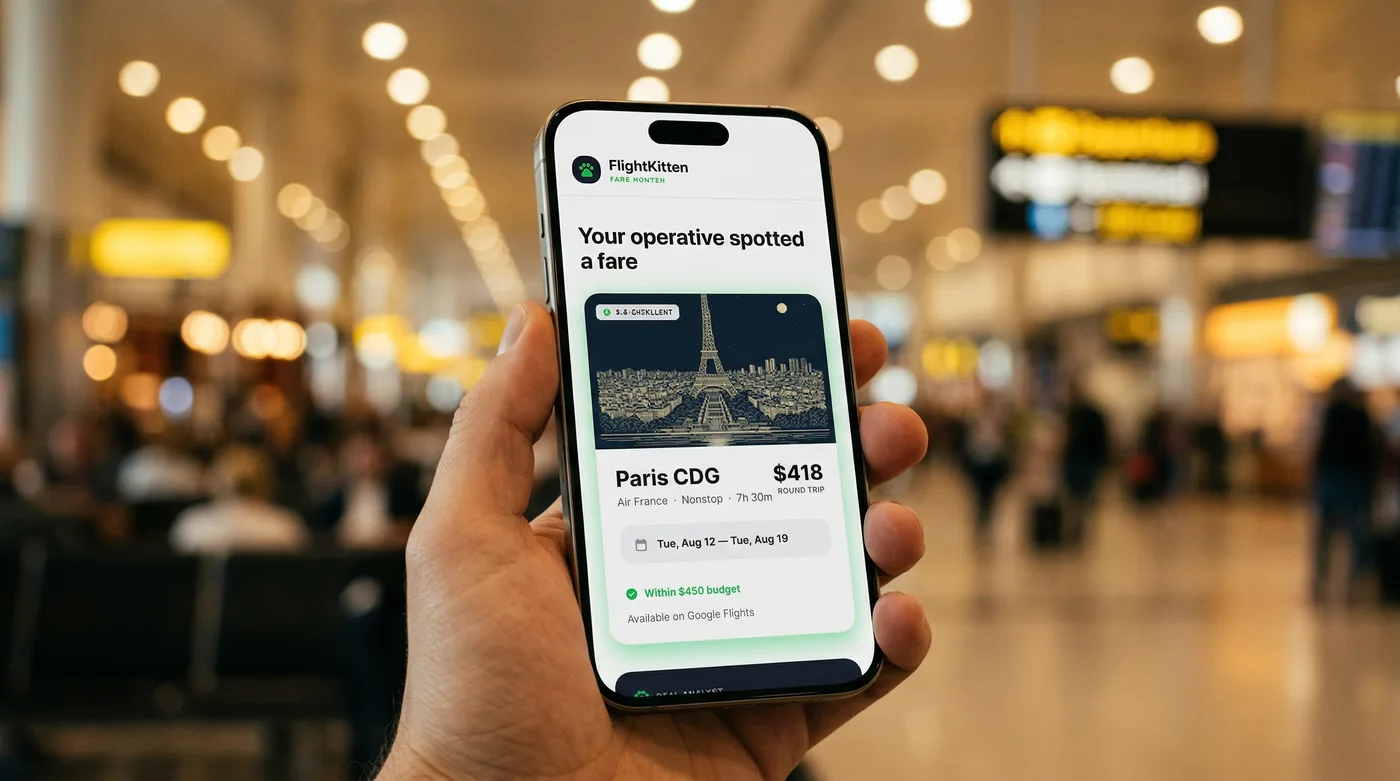
The smarter move: set a FlightKitten hunt on a route for a 3-month window with no fixed dates. When a pounce alert fires at a price that makes you say "okay, fine, I'll go," that's when you decide the dates. You're letting the price tell you when to travel, not the other way around. This is how you catch the genuinely weird drops — a $389 ORD-NRT on United that appeared for 11 hours last November, or a $298 BOS-DUB on Aer Lingus that lasted about six hours before correcting.
Flexibility is a financial instrument. Treat it like one.
Pro Tip: Set your hunt with a target price 20% below the current lowest fare you see. You'll get fewer alerts, but the ones you get will actually be worth acting on.
4. The "mistake fare" window is shorter than you think
Mistake fares — when an airline accidentally publishes a fare that's 40-70% below market — do still happen in 2026. They're rarer than 2019, but they happen. The window to book is typically 2-6 hours before the airline's revenue management system flags and kills it.
The catch: you need to be ready to book without deliberating. That means having your passport details saved, a travel credit card ready, and a flexible enough work situation that you can commit to a trip before you've fully thought it through. I once booked a $247 round-trip SFO-Tokyo on ANA during a mistake fare event. I had 22 minutes from alert to confirmation. The flight was real. The price held.
Mistake fares are not a strategy you plan around — they're an opportunity you either catch or you don't. Being subscribed to a good alert service is the only preparation that matters.
5. Stop ignoring connecting city fares
Direct flights are comfortable. They're also usually priced at a premium because airlines know you want them. On routes where a direct option exists, the one-stop alternative is often 25-40% cheaper — and sometimes, the layover city is itself worth a visit.
| Route | Direct fare (avg) | One-stop fare (avg) | Layover city |
|---|---|---|---|
| NYC-Tokyo | $890 | $540 | Seoul (Korean Air) |
| LAX-Amsterdam | $760 | $480 | Reykjavik (Icelandic) |
| MIA-Johannesburg | $1,100 | $680 | Addis Ababa (Ethiopian) |
| ORD-Bangkok | $920 | $590 | Tokyo (ANA) |
6. The "nearby airport" trick has a less obvious version
Yes, you know to check EWR vs. JFK vs. LGA. But the real play is checking nearby airports on the destination side, not the departure side — especially in Europe, where budget carriers like Ryanair and Wizz Air serve secondary airports that major carriers ignore.
Flying into London? Check Stansted (STN) alongside Heathrow. Into Italy? Milan Bergamo (BGY) is 45 minutes from central Milan and sometimes $80 cheaper than MXP. Into Germany? Frankfurt Hahn (HHN) is... actually, don't use Frankfurt Hahn. It's two hours from Frankfurt and the bus costs €15. Some secondary airports are worth it; some are a scam. Know which is which before you book.
The rule of thumb: if the ground transport to the city costs more than €20 or takes more than 60 minutes, the airport discount needs to be at least $100 to justify it.
7. Book one-ways on separate tickets — carefully
Round-trip fares are not always cheaper than two one-ways. This surprises people. On routes with strong competition in one direction — say, lots of carriers flying westbound transatlantic in summer — the one-way westbound fare can be absurdly cheap while the eastbound one-way is expensive. Booking them separately on different carriers sometimes beats any round-trip option.
The risk: if your outbound flight is delayed and you miss your separately-ticketed return, the airline owes you nothing. You need travel insurance that covers missed connections, and you need to build in a buffer — at least one night between your inbound arrival and your outbound departure.
I've done this successfully on LAX-MEX (Volaris out, Aeromexico back, $40 cheaper total) and less successfully on a DEN-LHR itinerary where a weather delay cost me a $180 rebooking fee. The math works until it doesn't. Know the risk.
8. Use the "force the calendar" method on airline sites
Google Flights is excellent for discovery. It is not always excellent for finding the absolute lowest price on a specific airline's own inventory. Some carriers — particularly smaller ones like PLAY Airlines, Condor, or Corsair — don't fully integrate with aggregators or show their cheapest fares there.
For these carriers, go directly to their site and use their own calendar or fare grid view. Condor's fare calendar for FRA-PUJ (Punta Cana) showed a $340 round-trip last February that Google Flights had listed at $410 because it was pulling a cached fare. Not a huge difference, but $70 is $70.
The airlines most worth checking directly: Condor, PLAY, Corsair, Transavia, Eurowings, and any carrier you've never heard of that suddenly starts a new transatlantic route. New routes are almost always underpriced for the first 6-12 months.
Pro Tip: When a new transatlantic route launches, the introductory fares are often 30-50% below where they'll settle. PLAY's inaugural Boston-Reykjavik fares in 2022 were $179 one-way. They normalized to $280+ within eight months.
9. The credit card points trap — and how to avoid it
This is the strategy most people think they're already using correctly. They're not.
Points and miles have a redemption value that varies wildly depending on how you use them. Chase Ultimate Rewards points are worth about 1.5 cents each if you transfer to a partner airline — but only 1 cent if you use them through the Chase travel portal. That gap matters. On a $600 flight, you're either spending 40,000 points or 60,000 points for the same seat.
The trap: accumulating points on a card with a high annual fee, then redeeming them at low value because you didn't want to deal with transfer partners. If you're not going to learn the transfer partner game, a 2% cash-back card and a FlightKitten pounce alert will beat a points card almost every time for economy travelers.
Points are a legitimate strategy. They're just not a substitute for finding a good base fare — they're a multiplier on top of one.
10. Watch for fuel surcharge-free redemptions
If you are using miles, this one is worth understanding. Some airline programs pass fuel surcharges through to award tickets — meaning your "free" flight on British Airways booked through Avios can cost $400+ in fees. Other programs don't charge fuel surcharges at all, even when booking on partner airlines.
American Airlines AAdvantage miles, for instance, don't add fuel surcharges when booking on American metal. Alaska Mileage Plan miles don't add them on most partners. United MileagePlus is more variable. This isn't trivia — on a transatlantic award ticket, the difference between a program that charges fuel surcharges and one that doesn't can be $300-$500 in cash fees on an otherwise "free" flight.
The cleanest economy award redemptions right now: Alaska miles on JAL (JFK-NRT for 35,000 miles one-way, no fuel surcharges), AAdvantage on British Airways short-haul Europe (4,500-7,500 miles, no surcharges), and Air Canada Aeroplan on Star Alliance partners with reasonable fees.
Putting it together
None of these strategies require a spreadsheet obsession or a travel hacking blog subscription. They require two things: enough flexibility to let price drive your timing at least sometimes, and enough preparation that when a good deal appears, you can act in under 10 minutes.
The travelers who consistently pay less aren't luckier. They've set up their hunts in advance, they understand the pricing quirks of the routes they care about, and they've stopped assuming that the first price they see is the right price.
Set a FlightKitten hunt on the route you've been thinking about. Put in a target price that feels slightly too good. Then forget about it until your phone tells you it's time to pounce.