Mistake Fares 2026: Your Guide to Ultra-Cheap Flights
Imagine this: You’re scrolling through your phone, daydreaming about a European adventure. Suddenly, a notification from FlightKitten pops up. It's a pounce alert for a roundtrip flight from New York to Paris… for $87. Yes, you read that right. $87. Not a typo. Not a joke. That's the magic of a mistake fare.
In 2026, the travel world is buzzing. Airlines are locked in fierce competition, new routes are opening, and dynamic pricing algorithms are working overtime (and sometimes, making glorious errors). This creates the perfect storm for savvy travelers to snag flights at prices that feel like a glitch in the matrix – because they often are.
This guide isn't about finding a "good deal." It's about uncovering the kind of deals that make your friends gasp, deals that fund entire extra weeks of vacation, deals that feel almost too good to be true. And with FlightKitten by your side, you'll be ready to pounce.
What exactly are mistake fares? (And why do they happen?)
Let’s get one thing straight: a mistake fare isn't just a cheap flight. A cheap flight might be $400 roundtrip to London. A mistake fare is $87 roundtrip to Paris. It's a price so ridiculously low that it clearly wasn't intentional. These aren't deep discounts; they're outright errors in pricing.
Why do these glorious glitches happen? It boils down to a few core reasons:
* Human error: Someone in airline pricing might have a slip of the finger, typing $87 instead of $870, or forgetting a zero. It happens more often than you'd think, especially when dealing with thousands of daily price changes.
* Currency conversion blunders: Airlines operate globally. Sometimes, a conversion rate gets miscalculated, leading to massive discrepancies when a fare is displayed in a different currency. A flight priced at 1000 units in one currency might accidentally convert to $100 instead of $1000 in USD.
* Fuel surcharge screw-ups: Fuel surcharges are a complex part of ticket pricing. If an airline accidentally omits or miscalculates this component, the base fare drops dramatically.
* Technical glitches: The complex Global Distribution Systems (GDS) that airlines use to distribute fares are intricate beasts. A hiccup in the system can lead to a fare being published incorrectly across various booking platforms.
* Dynamic pricing hiccups: As airlines rely more on AI and algorithms for pricing, sometimes these systems go a little haywire, especially during off-peak times or when reacting to sudden, unexpected demand shifts.
The key takeaway? Mistake fares are not scams or illegal. They are genuine, albeit accidental, offers. And the best part? Airlines often honor them.
Pro Tip: Forget about "finding a cheaper flight." With mistake fares, you're hunting for a broken price. This mindset shift is crucial.
The anatomy of a mistake fare in 2026
So, what does a mistake fare look like in the wild? It's usually easy to spot because it stands out like a neon sign in a dark room.
* Absurdly low prices for long-haul routes: Think cross-continental flights for under $100, or transatlantic/transpacific journeys for less than $300. We're talking about a $200 roundtrip from Los Angeles to Tokyo, or a $150 roundtrip from Miami to Buenos Aires. These are not common sales; they are errors.
* Premium cabin at economy prices: This is the holy grail for many. Imagine flying business class to Europe for the price of an economy ticket, or even less. A recent (hypothetical, but based on real events) example might be $600 roundtrip in business class from Chicago to Rome on Lufthansa, when economy normally costs $800.
Specific routes or airlines showing unusual drops: Sometimes the error is localized. A particular airline might have a pricing error on one* specific route for a limited travel window, say, $347 JFK-BCN on TAP Portugal, when all other airlines are charging $700+.Here’s a quick look at what we've seen (or could realistically see) for mistake fare "catches":
| Route Example | Typical Economy Price | Mistake Fare Price (Roundtrip) | Potential Saving |
|---|---|---|---|
| NYC to Paris (CDG) | $600 - $900 | $87 - $150 | 85%+ |
| LAX to Tokyo (NRT) | $800 - $1200 | $200 - $350 | 70%+ |
| Chicago (ORD) to Rome (FCO) | $700 - $1000 | $180 - $280 | 70%+ |
| Miami (MIA) to Buenos Aires (EZE) | $600 - $950 | $150 - $250 | 75%+ |
| San Francisco (SFO) to Sydney (SYD) | $1000 - $1500 | $300 - $500 | 65%+ |
Why 2026 is prime time for mistake fares
Why focus on 2026? Because the travel industry is in a fascinating sweet spot.
Airlines are still recalibrating after years of disruption. They're aggressively expanding routes, introducing new pricing models, and trying to capture market share. This means:
* Increased competition: More competition often leads to more aggressive (and sometimes erroneous) pricing strategies.
* Evolving technology: The same advanced algorithms designed to optimize pricing can, under certain conditions, produce errors that slip through the cracks. As systems become more complex, the potential for unique glitches also grows.
* New routes & partnerships: With new routes launching and airline alliances shifting, there's a higher chance of mispriced introductory fares or errors in interline agreements.
* Post-recovery demand: While demand has largely returned, airlines are still fine-tuning their capacity and pricing to meet it. This dynamic environment is ripe for pricing anomalies.
It's a time of flux and innovation, and for the keen-eyed traveler, that spells opportunity.
Your mistake fare hunting toolkit
You can't catch what you don't hunt for. Here's what you need in your arsenal to find those elusive mistake fares.
Flight search engines
These are your basic scouting tools, but with a specific strategy.
* Google Flights: Hands down, one of the best for its flexible date and destination explorers. Use the "explore destinations" map and leave the destination blank to see prices to various cities. Also, look for the green dates – these are often the cheapest.
* Skyscanner: Great for "everywhere" searches. If you have flexible dates but no specific destination, Skyscanner can show you the cheapest places to fly to from your origin.
* Kayak: Offers a "flexible dates" option and can be good for comparing prices across different Online Travel Agencies (OTAs).
The trick here is to be broad. Don't search for "JFK to London on June 10th." Search for "JFK to Europe in June" or "anywhere from JFK in the next 6 months."
Deal aggregators & blogs
These are the dedicated hunters who often find errors before the general public.
* Scott's Cheap Flights (now Going): Excellent for curated deals, including mistake fares. Their premium service often alerts you faster.
* The Flight Deal: Focuses on specific routes and often identifies errors.
* Secret Flying: Another strong contender for finding global pricing errors.
* Flyertalk Forums: A community of highly experienced travelers. The "Mileage Run" and "Premium Fare Deals" forums are hotbeds for uncovering mistake fares.
These sites are often the first to report, so monitor them closely.
FlightKitten: Your personal pounce alert system
This is where FlightKitten truly shines. While other tools help you find deals, FlightKitten helps you catch them the moment they appear.
Think of it like this: You can't spend 24/7 checking every airline's website or refreshing deal blogs. FlightKitten does that for you.
* Set up "hunts" (watchlists): Create broad hunts. Instead of "JFK to Barcelona," try "JFK to Spain." Or even "JFK to Europe." The broader your hunt, the more likely you are to capture an anomalous price drop.
Configure "pounce alerts": This is critical. Set your pounce alerts for prices that are unrealistically* low. If a typical flight to Europe is $600, set your alert for $250 or $150. When FlightKitten detects a price that falls below your threshold, it sends an immediate notification. This instant alert is your golden ticket to being among the first to book.VPNs (Virtual Private Networks)
Sometimes, a mistake fare is due to a currency conversion error that only appears when booking from a specific country. Using a VPN can allow you to appear as if you're browsing from a different location, potentially revealing these region-specific errors.
Airline flexibility
Be open. Very open.
* Different airlines: Don't be loyal. The mistake could be on a budget carrier or a legacy airline.
* Different routes: If your dream is Rome, but a mistake fare pops up for Milan, take it! You can often find cheap connecting trains or flights.
* Nearby airports: Check surrounding airports. A $100 mistake fare from Newark (EWR) is just as good as JFK if you live in NYC.
The FlightKitten strategy: How to pounce on a mistake fare
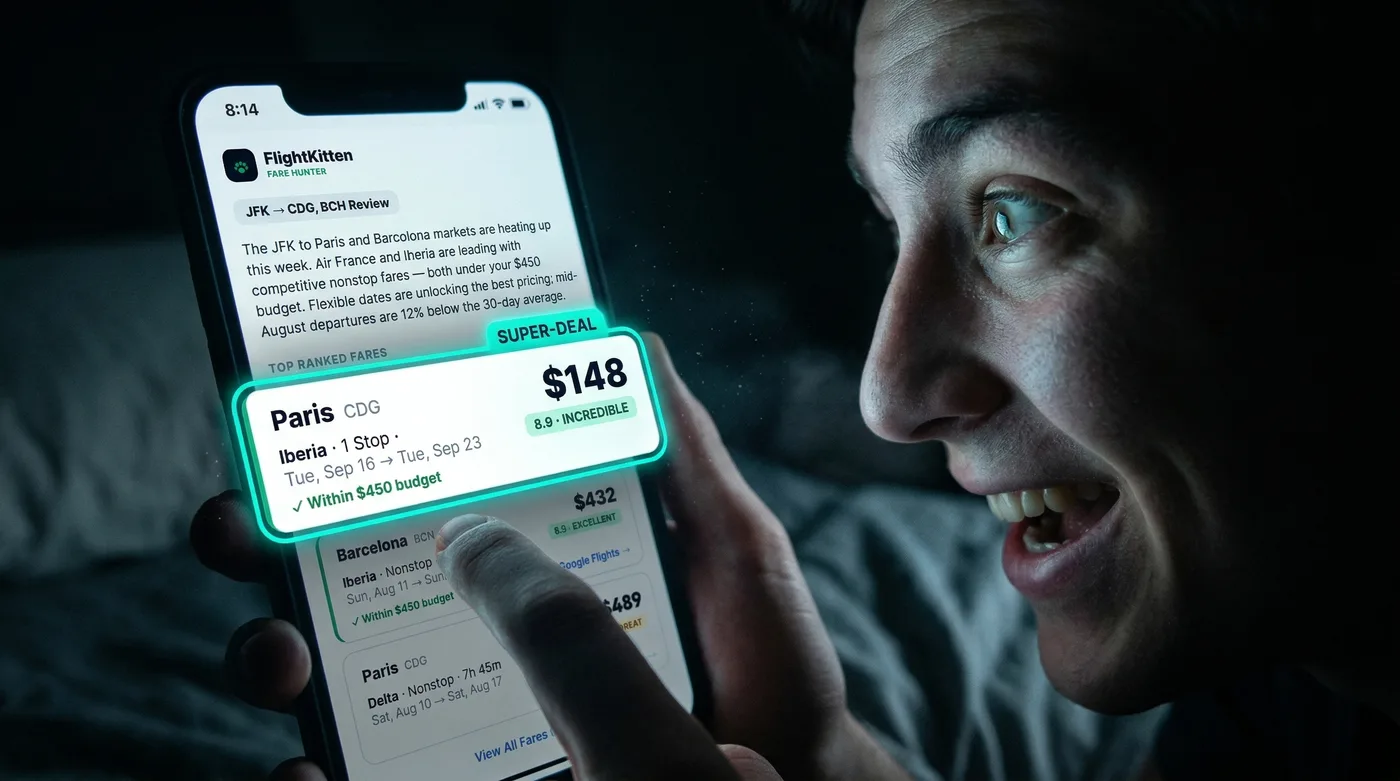
Finding a mistake fare is only half the battle. Booking it correctly and swiftly is what turns a dream into a ticket.
Speed is everything
Mistake fares don't last. Airlines catch their errors quickly, sometimes within minutes, sometimes within hours. If you see one, you need to act. Now.
* Don't overthink it: Is it the perfect date? Is it the ideal airline? Probably not. But it's an unbelievably cheap flight. Book it. You can always cancel within 24 hours (for most US-based bookings) if it doesn't work out.
* Have your details ready: Passport info, credit card, and travel companion details should be easily accessible. Minimize friction in the booking process.
Book first, ask questions later
This is the mantra. Your priority is to secure the fare.
* Direct booking with the airline is best: While you might find a mistake fare on an OTA (Online Travel Agency) like Expedia or Priceline, booking directly with the airline offers more security and flexibility if issues arise. If the airline decides not to honor the fare, dealing directly with them is usually smoother.
* Book one-way segments if necessary: Sometimes the error is only on the outbound or inbound leg. If you see a ludicrously cheap one-way, book it, then figure out the return later. Two one-ways can often be cheaper than a roundtrip with a mistake fare.
* Book individually for groups: If you're traveling with others, book your ticket first, then have them book theirs. Don't try to book multiple tickets in one transaction if it slows you down.
Hold off on other bookings
This is critical. Do not book non-refundable hotels, tours, or connecting flights until your mistake fare is confirmed and ticketed by the airline.
* Wait for confirmation: An airline might take 24-72 hours to officially "ticket" your flight. Until you have a ticket number (not just a reservation code), the booking isn't 100% secure.
* The 24-hour rule: In the US, you typically have 24 hours to cancel a flight without penalty, even if it's a mistake fare. Use this window to double-check your dates, names, and itinerary.
Pro Tip: Once you've booked, resist the urge to call the airline to confirm or ask questions about the low price. You do not want to alert them to their error. Let sleeping dogs lie!
What happens after you book? (The waiting game)

You've pounced, you've booked. Now what? You wait.
Confirmation email & ticket number
First, you'll receive a confirmation email. This will have your reservation code. Within 24-72 hours, you should receive a second email with your official ticket number. This is the moment your booking transitions from a reservation to a confirmed ticket.
The cancellation risk
Mistake fares do carry a risk of cancellation. Airlines can choose not to honor an obvious pricing error. However, many major airlines have a history of honoring these fares, especially if they've been public for a few hours. The longer the fare is live, the more likely it is to be honored.
If an airline cancels, they are legally obligated to provide a full refund. They generally won't offer alternative flights at the mistake fare price, but you'll get your money back.
Your rights if canceled
If your mistake fare is canceled:
* Full refund: You are entitled to a full refund of the amount you paid.
* Don't expect compensation: While some regions (like the EU with EC 261/2004) offer compensation for flight cancellations, these rules usually apply to operational cancellations, not pricing errors. Don't count on getting extra money.
* Be polite: If you need to contact customer service, be courteous. They are not personally responsible for the mistake.
The "what if" scenarios: When a mistake fare goes wrong
Even with the best planning, sometimes things go sideways. Here’s how to navigate potential issues.
The airline cancels your ticket
This is the most common "mistake fare gone wrong" scenario.
* What to do: You'll typically receive an email notifying you of the cancellation and the refund process. Ensure you get your full refund.
* Rebooking: Do not expect the airline to rebook you at the mistake fare price. You'll need to find new flights at current market rates. This is why you never book non-refundable hotels or activities in advance.
The airline tries to reprice your ticket
This is rarer, but it can happen. An airline might contact you, claiming the fare was an error and asking you to pay the difference.
* Stand your ground (politely): If you have a confirmed ticket number, you have a strong case. Refer to your booking confirmation. Most airlines will back down rather than deal with negative PR. However, be prepared for a fight, and weigh the cost of your time against the potential savings.
Your own plans change
Once a mistake fare is ticketed, it's just like any other economy ticket.
* Standard change/cancellation policies apply: If you decide you can't go, you'll be subject to the airline's normal change fees or cancellation policies. For ultra-cheap economy tickets, this often means no refund or a hefty change fee that might negate the savings.
* Travel insurance: Consider "cancel for any reason" travel insurance if you're particularly worried about your plans changing, but be aware these policies are more expensive.
Mistake fare etiquette and best practices for 2026
Being a mistake fare hunter comes with a few unwritten rules.
* Don't brag too early: You scored a $100 flight to Tokyo? Fantastic! But wait until it's ticketed before you shout it from the rooftops. Premature celebration can lead to the airline catching the error faster.
* Share wisely: If you find a mistake fare, share it with your immediate travel buddies or a trusted small group. Avoid mass social media posts until the fare has been live for a few hours and seems to be holding. The more attention it gets, the faster it dies.
* Be prepared for flexible travel dates: Mistake fares rarely align with perfect holiday weekends. You might need to travel mid-week, during off-peak seasons, or for a specific, odd duration. Embrace the flexibility.
* Understand the risk: Always remember that mistake fares come with a small risk of cancellation. Factor this into your planning and don't book anything non-refundable based solely on an un-ticketed mistake fare.
* Be polite: If you ever need to interact with airline customer service regarding a mistake fare, be friendly and respectful. They're often just doing their job.
FlightKitten's secret sauce for 2026: Setting up your hunts
FlightKitten isn't just about finding the lowest expected prices; it's designed to sniff out the unexpected. Here’s how to configure your hunts to maximize your chances of catching a mistake fare.
- Go broad with your "hunts":
* Departure: If you're flexible, broaden your departure airport. "NYC (all airports)" is better than just "JFK."
* Dates: This is where flexibility pays dividends. Set your hunt for a wide date range, e.g., "next 6 months" or "any time in 2026." Mistake fares rarely align with peak travel periods.
- Configure aggressive "pounce alerts":
* Consider "any destination" alerts: Some mistake fares are so wild they might take you somewhere you never considered. Set a hunt from your home airport to "anywhere" with a super low pounce alert ($100-$200). You might end up on an unexpected adventure!
- Combine hunts:
* Then, create broader hunts from your home region to entire continents (e.g., "ORD to Europe") with an even lower pounce alert. This multi-pronged approach covers your bases.
FlightKitten’s algorithms are constantly scanning millions of routes, looking for sudden, dramatic price drops that signal an error. By setting your hunts and pounce alerts strategically, you're essentially building a highly sensitive radar for these rare and incredible deals.
Ready to pounce?
Mistake fares are the stuff of travel legends, but in 2026, they can be your reality. With a bit of knowledge, a lot of flexibility, and FlightKitten as your co-pilot, you're not just dreaming of ultra-cheap flights – you're preparing to book them.
Stop paying full price. Start hunting for those glorious glitches. Your next adventure could be just one pounce alert away.
Download FlightKitten today and set up your first mistake fare hunt!