Mistake Fares 2026: How to Find and Book Airline Error Fares Before They Disappear
In 2026, a glitch in Lufthansa's pricing system briefly listed business class tickets from New York to Frankfurt for $152 round-trip. In 2023, United Airlines accidentally sold first-class seats from San Francisco to Hawaii for $39. And in early 2025, a currency conversion error sent Air France fares from Los Angeles to Paris tumbling to $87 return. These weren't sales. These weren't promotions. These were mistake fares — and the travelers who caught them in time flew for a fraction of what everyone else paid.
This guide is your complete playbook for understanding what mistake fares are, why they happen, how to find them, and — most critically — how to book them before airlines pull the plug.
What Exactly Is a Mistake Fare?
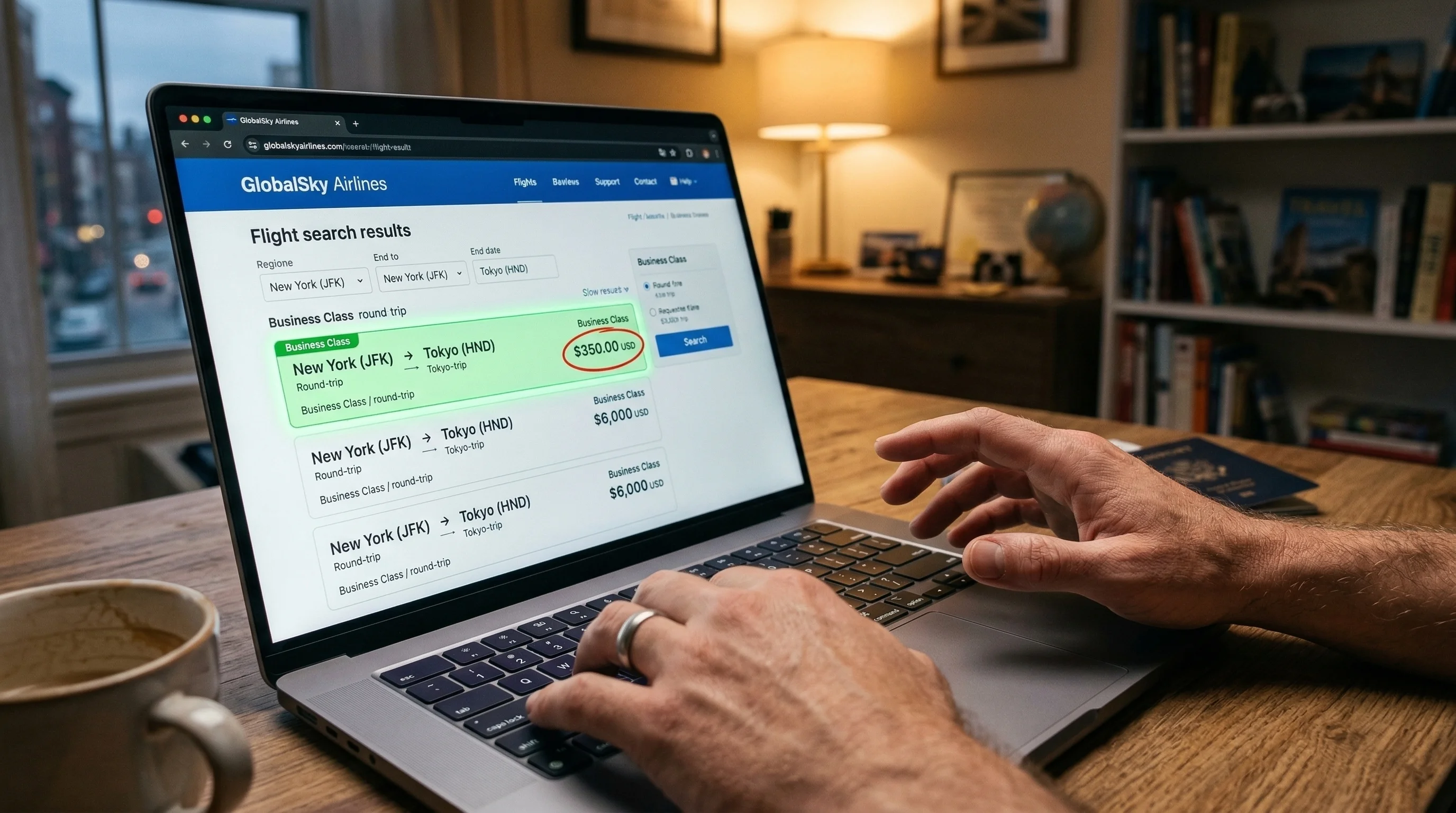
A mistake fare (also called an error fare or glitch fare) is an airline ticket listed at a price dramatically below its intended market rate — typically due to a human or technical error in the airline's pricing system. We're not talking about a 20% discount. We're talking about transatlantic business class for the price of a domestic economy seat, or round-the-world itineraries for under $500.
The price gap is usually so obvious it's almost comical. If a business class ticket from Chicago to Tokyo normally runs $4,800 and suddenly appears at $480, that's a mistake fare. If a round-trip to Bali from London is £89 when it normally costs £900+, that's a mistake fare.
How Are Mistake Fares Different From Flash Sales?
This distinction matters a lot, because airlines treat them very differently:
| Feature | Mistake Fare | Flash Sale |
|---|---|---|
| Intentional? | No — it's an error | Yes — deliberate promotion |
| Duration | Minutes to hours | Hours to days |
| Discount depth | 70–95% off normal price | Typically 20–50% off |
| Airline obligation to honor | Legally grey, varies by country | Always honored |
| Advance notice | None — you have to find it | Often announced via email |
| Booking window | Extremely narrow | Usually 24–72 hours |
Why Do Mistake Fares Happen? The Real Causes
Airline pricing is absurdly complex. A single fare is the product of dozens of interconnected systems — the airline's own revenue management software, Global Distribution Systems (GDS) like Amadeus, Sabre, and Travelport, third-party booking platforms, and automated currency conversion tools. When any one of these systems hiccups, prices can go haywire.
The Most Common Causes of Error Fares
1. Currency Conversion GlitchesWhen an airline prices a route in one currency and that price gets converted incorrectly into another, the results can be spectacular. A fare listed as 500 something might accidentally become $500 when it should be $5,000. This is especially common on routes between countries with large exchange rate differentials.
2. Fuel Surcharge OmissionsFuel surcharges can add hundreds of dollars to a base fare. When they accidentally get stripped out of the calculation — often during system updates — the listed price can drop by 60–80% overnight.
3. Misplaced Decimal PointsThe classic. A human data entry error turns $1,200 into $120. Simple, devastating (for the airline), and surprisingly common.
4. Fare Class MiscodingAirlines use letter codes (Y, B, M, Q, etc.) to denote different fare classes with different prices and rules. When a business class seat gets accidentally coded as a deeply discounted economy fare class, the ticket price collapses.
5. GDS Synchronization ErrorsWhen airlines update their fares, those updates need to propagate across multiple distribution systems. Sometimes the update goes wrong mid-sync, and old (lower) prices remain visible on some booking platforms while the correct prices appear on others.
Pro Tip: Mistake fares often appear on third-party booking sites (Google Flights, Kayak, Skyscanner) before they're corrected on the airline's own website. Always check both.
The Legal Reality: Will Airlines Actually Honor Mistake Fares?
This is the question everyone asks, and the honest answer is: it depends.
In the United States, the Department of Transportation (DOT) used to require airlines to honor any fare that had been ticketed. In 2015, the DOT reversed this policy, allowing airlines to cancel mistake fare tickets as long as they notify passengers promptly and provide a full refund. So in the US, there's no legal guarantee — but many airlines honor them anyway to avoid the PR nightmare.
In the European Union, consumer protection laws are stronger. Under EU Regulation 261/2004 and general contract law principles, airlines often have a harder time canceling confirmed bookings, particularly if the passenger has already made non-refundable arrangements based on the ticket.
In the UK (post-Brexit), similar principles apply under the Consumer Rights Act, though enforcement is inconsistent.
The practical reality in 2026: Most major airlines will cancel obvious mistake fares and issue full refunds. However, a significant number of errors do get honored — especially when:- The fare, while low, isn't completely absurd (e.g., $300 transatlantic economy vs. a $4,000 business class seat)
- The error persists for several hours before being caught
- The airline has already issued actual e-tickets (not just booking confirmations)
- There's significant social media attention on the deal
Airlines With a History of Honoring Mistake Fares
- Southwest Airlines — has a strong track record of honoring errors
- JetBlue — generally customer-friendly on glitch fares
- Alaska Airlines — has honored several notable errors in recent years
- Singapore Airlines — honored a famous 2015 business class error; mixed record since
Airlines More Likely to Cancel
- British Airways — aggressive about canceling errors, will cite "obvious mistakes"
- Emirates — has canceled high-profile errors with refunds
- American Airlines — inconsistent; has honored some, canceled others
Pro Tip: Never book non-refundable hotels, tours, or connecting flights until you receive an actual e-ticket (not just a booking reference). Wait at least 24–48 hours after booking a suspected mistake fare before making any dependent reservations.
How to Find Mistake Fares: Your 2026 Hunting Strategy
Mistake fares don't announce themselves. You need systems in place to catch them — because the window between "this fare appears" and "this fare disappears" can be as short as 15 minutes.
1. Set Up Fare Alerts on Multiple Platforms
This is the single most important thing you can do. You cannot manually check flight prices all day. Automated alerts do it for you.
Tools like FlightKitten are built specifically for this — you set up a "hunt" for your target routes, and the moment prices drop to unusual levels, you get a pounce alert so you can act immediately. The speed advantage here is enormous; most mistake fares are gone before casual browsers ever see them.
For maximum coverage, FlightKitten's Explorer mode (Core and Pro plans) scans every destination in a region — like all of Europe or Southeast Asia — which massively increases your odds of catching error fares on routes you wouldn't have thought to search. Each alert includes an AI briefing that flags exactly why a fare looks suspiciously low, and price insights showing how the fare compares to historical norms. When a $300 roundtrip to Tokyo appears and the typical fare is $900, you'll know instantly it's an anomaly worth booking.
Set alerts for:
- Routes you actually want to fly (your home airport to dream destinations)
- Flexible destination alerts ("anywhere from JFK under $300")
- Specific date ranges if you have travel flexibility
2. Follow the Right Communities
Mistake fare hunters have built active communities that crowdsource discoveries:
- Reddit r/flightdeals — one of the fastest communities for spotting and sharing error fares
- Secret Flying (secretflying.com) — dedicated mistake fare aggregator, updated constantly
- Flyertalk forums — the old guard, still relevant for complex itineraries
3. Use Google Flights Strategically
Google Flights has a "Price Insights" feature and price tracking built in. More usefully, its calendar view and "Explore" map can help you visually spot anomalies — a route that's consistently $800 suddenly showing $180 stands out immediately on a price graph.
Set price tracking on Google Flights for your key routes as a secondary layer of monitoring.
4. Check Booking Sites Directly at Off-Peak Hours
This sounds counterintuitive, but many pricing system updates happen overnight (in the airline's home timezone). Fares that go wrong often do so between midnight and 6am local time — and may persist for hours before anyone catches them. If you're an early riser or night owl, a quick scan of Skyscanner's "Everywhere" search or Google Flights' explore map during these hours can pay off.
5. Know Your Baseline Prices
You can't recognize a mistake fare if you don't know what normal prices look like. Spend time understanding typical fare ranges for routes you care about:
- Transatlantic economy (US to Western Europe): $400–$900 typical; under $200 is suspicious
- Transpacific economy (US West Coast to Asia): $600–$1,200 typical; under $350 is suspicious
- Intra-Europe economy: €50–€250 typical; under €20 might be a glitch
- US domestic: $150–$400 typical; under $50 coast-to-coast warrants a second look

How to Book a Mistake Fare: The Step-by-Step Process
Speed is everything. Here's the exact process to follow the moment you spot a potential error fare.
Step 1: Verify It's Real (30 seconds)
Check the fare on at least two different booking platforms. If it shows up on Google Flights and directly on the airline's website, it's more likely to be honored. If it only appears on one obscure OTA, be more cautious.
Step 2: Book Directly With the Airline When Possible
Airlines are far more likely to honor fares booked through their own website. Third-party bookings add complexity, and OTAs sometimes cancel before the airline even knows about the error.
Step 3: Complete the Booking Immediately — Don't Overthink It
Don't spend 20 minutes picking your seat or debating travel dates. Book the best available option right now. You can change seats later. You cannot book a fare that's already been pulled.
Have your payment details ready in advance. Saved credit cards in your browser or a password manager can shave critical minutes off the booking process.
Step 4: Screenshot Everything
Capture the fare listing, the booking confirmation page, and the confirmation email. If the airline later tries to cancel, having documented evidence of what you saw and paid can be useful in disputes.
Step 5: Wait for the E-Ticket
A booking reference is not an e-ticket. An actual e-ticket (with a 13-digit ticket number starting with the airline's code) means the fare has been properly issued and ticketed. This is a much stronger position than a mere reservation.
Step 6: Don't Announce It Publicly Until You're Ticketed
This sounds selfish, but there's a practical reason: the more people who book a mistake fare, the faster the airline notices and kills it. Share with close friends, sure — but posting to a public forum with 50,000 members before you've completed your own booking is a mistake.
Pro Tip: Use a credit card with strong travel protection for mistake fare bookings. If the airline cancels and issues a refund, you're whole. If you've booked hotels based on the ticket and the airline cancels, some travel credit cards offer trip cancellation coverage that may reimburse those costs.
Real Mistake Fare Examples: What's Actually Possible
To calibrate your expectations, here are documented error fares from recent years:
2023 — United Airlines: San Francisco → Maui, $39 round-tripA fuel surcharge calculation error. United honored the fares for passengers who had already received e-tickets. Estimated 2,000+ passengers flew for essentially free.
2026 — Lufthansa: New York → Frankfurt Business Class, $152 round-tripA GDS synchronization error. Lufthansa initially canceled bookings but reversed course after significant media coverage, honoring tickets for passengers who had already ticketed.
2026 — Cathay Pacific: Various US Cities → Vietnam, $293 round-trip (business class)One of the most celebrated recent error fares. Cathay Pacific honored all bookings, reportedly losing millions. The fare persisted for nearly 12 hours before being corrected.
2025 — Air France: Los Angeles → Paris, $87 round-trip (economy)A currency conversion error affecting USD pricing. Air France canceled most bookings but honored those where passengers could demonstrate they had received actual e-tickets.

What to Do If Your Mistake Fare Gets Canceled
It happens. Here's how to respond:
- Request a full refund immediately — you're entitled to this in virtually every jurisdiction
- Check if the airline offers alternatives — some will offer a discounted fare (not as good, but better than nothing) as goodwill
- File a credit card dispute if the refund is delayed — most card issuers will side with you
- In the EU/UK, consider a formal complaint — national aviation authorities take consumer protection seriously
- Don't book non-refundable travel until ticketed — this is the lesson that hurts the most when learned the hard way
Building Your Mistake Fare Infrastructure
The travelers who consistently catch mistake fares aren't lucky — they're prepared. Here's the setup that gives you the best chance:
Monitoring layer:- FlightKitten hunts set up for your 5–10 most desired routes
- Google Flights price tracking for the same routes
- BusinessClassSignal.com fare drops for business class routes
- Accounts pre-created on major airline websites (United, Delta, American, British Airways, Lufthansa, Singapore, Cathay, Emirates)
- Payment details saved and ready
- Passport details saved in booking profiles
- A decision framework: "If I see a transatlantic fare under $X, I book immediately"
- Clear understanding of your flexible travel dates
- A travel credit card with good protection benefits
The goal is to reduce the time from "I see a deal" to "booking confirmed" to under five minutes. Every minute matters.
Frequently Asked Questions About Mistake Fares
Can I get in trouble for booking a mistake fare?
No. Booking a publicly listed fare — even an erroneous one — is completely legal. You're not exploiting a vulnerability; you're purchasing a ticket at the price the airline listed.
Should I book multiple mistake fares at once?
Only if you're genuinely willing to take all of them. Booking speculatively and then canceling is bad form and can get your accounts flagged by airlines.
How long do mistake fares typically last?
Anywhere from 5 minutes to 48 hours. The average is probably 2–6 hours for major carriers. Budget airlines tend to catch errors faster.
Are mistake fares more common on certain days or times?
There's some evidence that pricing system updates — and therefore errors — are more common on Tuesday nights and Wednesday mornings (US Eastern time), when airlines traditionally update their fare structures. This is also when many flash sales launch, which provides cover for errors to go unnoticed longer.
What's the best route to find mistake fares on?
High-volume transatlantic and transpacific routes have the most pricing complexity and therefore the most errors. New York–London, Los Angeles–Tokyo, and Chicago–Frankfurt are historically rich hunting grounds.
The Bottom Line: Patience, Preparation, and Speed
Mistake fares are real, they happen regularly, and ordinary travelers book them every week. You don't need insider access or special software — you need a monitoring system that catches anomalies fast, a booking setup that lets you act in minutes, and enough baseline knowledge to recognize a genuine error when you see one.
The travelers who fly business class to Asia for $300 aren't special. They just had alerts set up, payment details ready, and the presence of mind to book first and ask questions later.
Looking for business class deals specifically? BusinessClassSignal.com specializes in tracking business class error fares and mistake fares worldwide — the perfect companion to FlightKitten's economy fare hunting.
Set up your fare monitoring today — whether that's FlightKitten pounce alerts, Google Flights tracking, or a combination of both — and make sure your airline accounts are ready to go. The next mistake fare could appear in the next 24 hours. The only question is whether you'll be ready when it does.
Start your first hunt now. Set up FlightKitten pounce alerts for economy deals, and check BusinessClassSignal.com for business class error fares. The next great mistake fare won't wait.