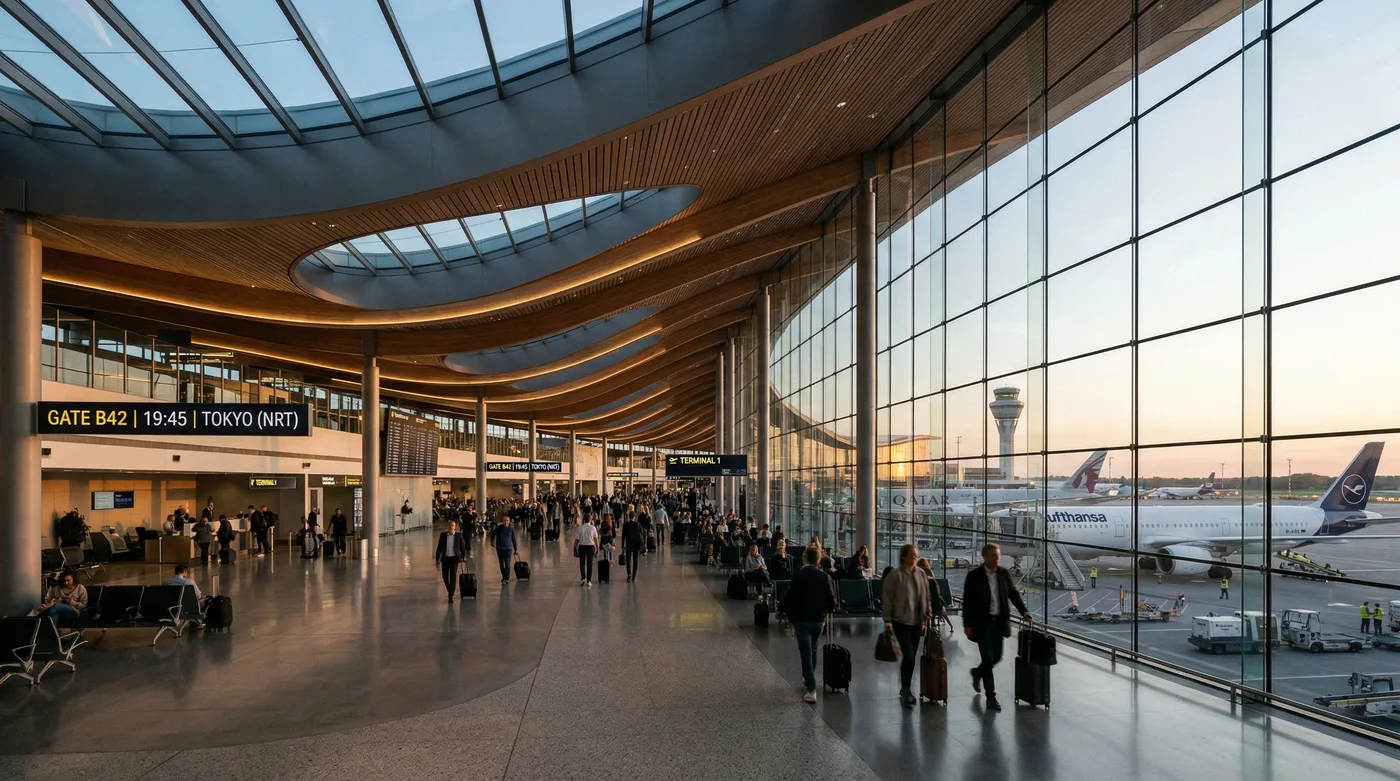
I once paid $112 in checked bag fees on a Spirit round-trip to Cancún. The bag weighed 47 pounds. Half of it was shoes I wore once. That was the last time I checked a bag.
Two years and fourteen countries later, I do every trip — including two-week stints — out of a single carry-on. Not a personal item. Not a duffel duct-taped to my back. A real, roll-aboard carry-on that fits in the overhead bin on a regional jet.
Here's the actual system.
Why carry-on only matters more than you think
This isn't just about convenience, though watching everyone else wait 25 minutes at baggage claim while you're already in a taxi is deeply satisfying. It's about money.
Checked bag fees in 2026 have gotten genuinely ridiculous. American and Delta charge $40 each way for the first checked bag on domestic routes — $80 round-trip before you've bought a single coffee at the airport. Internationally, it's worse. Ryanair will charge you €40-€60 each way if you don't pre-pay, and they will charge you at the gate with zero apology. On a two-week trip with even one connection, you're looking at $100-$200 in fees that could have been a night's accommodation in Lisbon.
FlightKitten users who set pounce alerts on transatlantic routes regularly catch fares like $387 round-trip JFK-MAD on Iberia or $341 JFK-LIS on TAP. Those prices are for basic economy. Add a checked bag and you've just made that "cheap" flight significantly less cheap.
The bag itself: size rules that actually matter
Before you pack a single sock, you need to know what you're working with. Airline carry-on size limits are not standardized, and the difference between 22 inches and 24 inches is the difference between boarding normally and getting gate-checked in the jetway.
| Airline | Max carry-on size | Max weight | Fee if oversized |
|---|---|---|---|
| American Airlines | 22 x 14 x 9 in | No limit | Gate check, free |
| Delta | 22 x 14 x 9 in | No limit | Gate check, free |
| United | 22 x 14 x 9 in | No limit | Gate check, free |
| Ryanair | 40 x 20 x 25 cm | 10 kg | €40-60 at gate |
| EasyJet | 56 x 45 x 25 cm | No limit | £48 at gate |
| Wizz Air | 40 x 30 x 20 cm | 10 kg | €50 at gate |
| TAP Air Portugal | 55 x 40 x 20 cm | 8 kg | Fee varies |
If you're flying budget European carriers specifically — Ryanair, Wizz Air — pay very close attention to the weight limits. 10 kg is 22 pounds. That sounds like a lot until you realize your bag itself weighs 3-4 pounds empty. You're packing 18 pounds of stuff. It's doable, but you need to weigh everything.
The clothing system: 9 items, infinite outfits (sort of)
I'm going to be direct with you: the "10 items, 30 outfits" content you see on Pinterest is mostly nonsense. You're not going to rewear a blazer four different ways on a backpacking trip through Southeast Asia. But a realistic capsule wardrobe for two weeks? That's completely achievable.
Here's what I actually bring for a two-week trip to Europe in shoulder season:
Tops (4)- 2 merino wool t-shirts (Uniqlo, ~$25 each — not the fancy $80 Icebreaker ones, though those are also great)
- 1 long-sleeve merino layer
- 1 button-down shirt that doesn't look like camping gear
- 1 pair of dark jeans (Uniqlo slim fit, 12 oz, compresses well)
- 1 pair of lightweight chinos or travel pants
- 1 pair of shorts if the destination warrants it
- A packable down jacket. Full stop. The Uniqlo Ultra Light Down folds into its own pocket and weighs about 10 oz. It's not the warmest thing on earth, but layered over a merino long-sleeve it handles most European weather.
- Wear your bulkiest shoes on the plane. Always.
- One pair of versatile walking shoes or clean sneakers in the bag
Merino wool is the secret weapon here. It genuinely doesn't smell after a full day of walking. I've worn the same merino t-shirt three days in a row in Barcelona without anyone noticing or saying anything (that I know of). It dries overnight when hand-washed in a sink. It's worth the price premium.
Underwear and socks: Bring 5 pairs of each. Wash every 3-4 days. Merino wool socks, again, are worth it — Darn Tough makes a travel sock for about $20 that will outlast everything else in your bag.Toiletries: the TSA 3-1-1 rule is your actual constraint
Everything liquid goes in a single quart-size bag. This is non-negotiable on flights into and out of the US, UK, EU, and most of the world. The trick is accepting this early and planning around it instead of trying to cheat it.
Pro Tip: Solid toiletries bypass the liquid rule entirely. Solid shampoo bars (Lush makes decent ones, ~$13), solid conditioner, and solid sunscreen exist and work. I switched to a solid shampoo bar two years ago and have not looked back.
For everything else:
- Buy travel-size at your destination, not at the airport. A 100ml sunscreen at a Spanish pharmacy costs €3. The same thing at JFK costs $9.
- Toothpaste tablets are real and they work. Bite makes them, about $12 for a tin that lasts 3-4 weeks.
- If you wear contacts, pre-portion solution into small bottles. Don't bring the full 12 oz bottle.
The things people consistently over-pack in toiletries: full-size shampoo, three different moisturizers, backup backup sunscreen, and — I'm not judging — a full-size hair dryer. Hotels have hair dryers. Airbnbs usually have hair dryers. Pack a universal adapter instead.
Electronics: be ruthless
The average person's electronics pile has gotten out of control. I see people at airport security removing laptops, tablets, e-readers, portable speakers, three charging cables, a portable monitor, and a travel router from their bag. That's not a carry-on, that's an IT closet.
Here's what actually needs to come:
- Phone (obviously)
- Laptop OR tablet — pick one. If you're not working remotely, a tablet with a keyboard cover is lighter and more versatile
- One universal charging cable that handles everything (USB-C has mostly won this battle)
- A compact power bank — Anker's 10,000 mAh model is about $26 and handles two full phone charges
- Universal power adapter — the Epicka universal adapter is $18 and covers 150+ countries
- Noise-canceling earbuds — not headphones, earbuds. The case is half the size.
Leave the portable speaker home. You're traveling, not hosting a pool party.
Packing technique: it actually matters
How you pack is almost as important as what you pack. I spent two years rolling everything before I learned that rolling is actually not always optimal — it depends on the fabric.
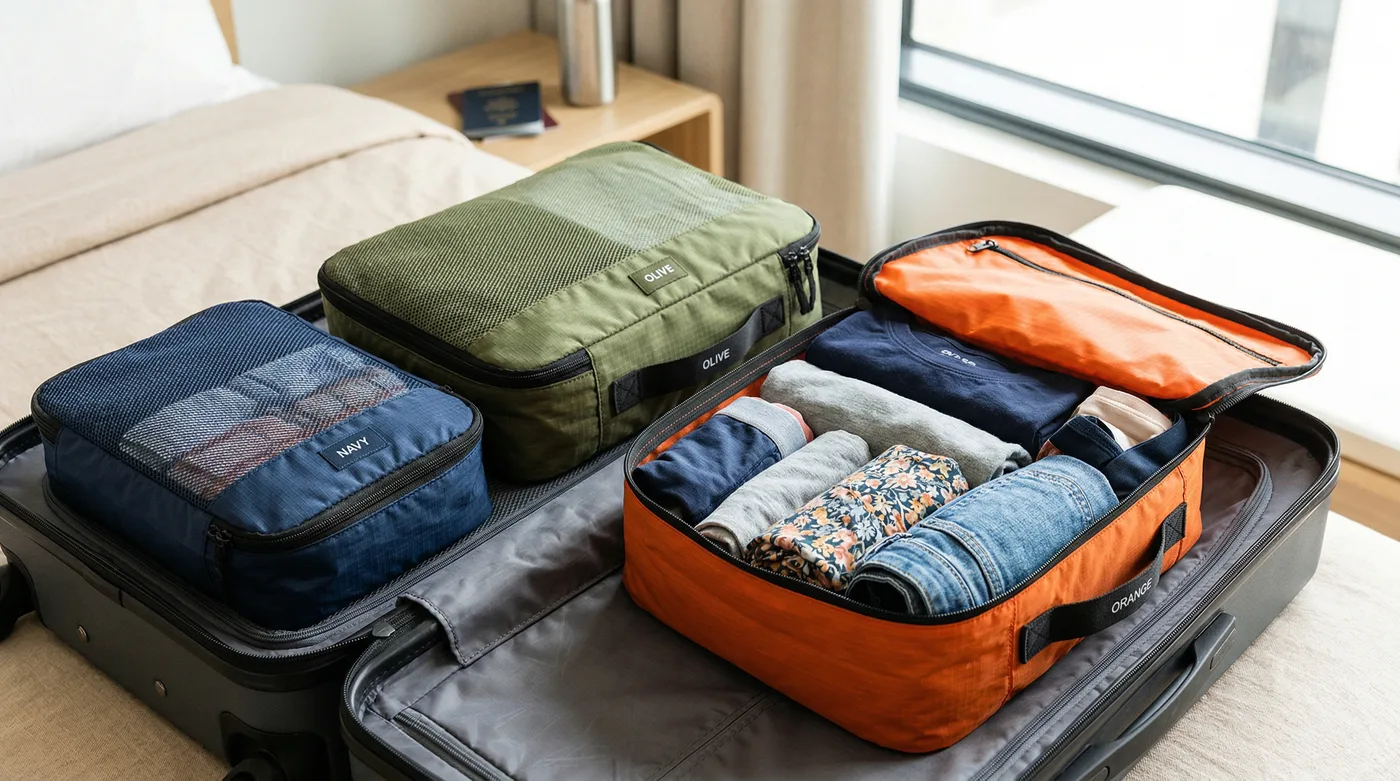
Roll: t-shirts, underwear, socks, lightweight pants, anything that wrinkles minimally Fold flat: structured items like button-downs and blazers (if you're bringing one) Compression cubes: worth it for bulky items like the down jacket and jeans. Eagle Creek makes good ones. Two small cubes will organize your entire wardrobe section.The packing order: heaviest items (shoes, electronics) go against the back panel near the wheels. Clothes in the middle. Toiletry bag and things you'll need during the flight on top or in the front pocket.
Wear your heaviest outfit on travel days. Jeans, boots or sneakers, your heaviest layer. This isn't a fashion show, it's a weight optimization exercise.
What to do about laundry
Two weeks is long enough that you need a laundry plan. Here are the three realistic options:
Sink washing: Works great for underwear, socks, and merino wool. Takes about 5 minutes, dries overnight on a towel or over a shower rod. Not ideal for jeans. Laundromat: Most cities have self-service laundromats. In Europe, expect to pay €4-8 for a wash and dry. In Southeast Asia, drop-off laundry services charge by the kilo and are absurdly cheap — I've had a full load done for $2 in Chiang Mai. Build one laundry day into a two-week trip and you can pack even lighter. Hotel laundry service: Usually expensive. A $3 t-shirt should not cost $8 to launder. Skip it unless you're staying somewhere that includes it.My personal system: sink wash every 2-3 days for small items, one laundromat visit around day 8-10 for everything else. This lets me pack 5 days of clothing and wear it comfortably for 14 days.
The stuff you think you need but don't
After four years of carry-on-only travel, here's my definitive list of things people pack that they don't use:
- A second pair of jeans
- "Just in case" formal wear (you won't need it, and if you do, you can buy something there)
- A full first-aid kit (bring a small blister kit and some ibuprofen, not a pharmacy)
- Physical guidebooks — your phone exists
- A travel pillow for trips under 8 hours
- More than 2 books (e-reader, people)
- A rain jacket AND an umbrella (pick one)
- Snacks from home for a two-week trip (you will eat local food, it will be fine)
I once watched someone at check-in pull a jar of peanut butter out of their bag because it was over the liquid limit. A full jar of peanut butter. Two weeks in Europe. The peanut butter stayed at the airport.
How carry-on only changes how you book flights
Once you commit to carry-on only, your booking options open up significantly. Basic economy fares — which are often $40-$100 cheaper per leg — almost always include a personal item and sometimes a carry-on. You're no longer locked out of the cheapest fare class.
On a JFK-BCN round-trip, the difference between basic economy and the next fare class up is often $60-$120. Multiply that across a few trips per year and you're talking real money.
FlightKitten's pounce alerts are particularly useful here because they catch basic economy fares at their lowest — fares that disappear within hours. A $298 JFK-DUB fare on Aer Lingus basic economy includes a carry-on. A $341 JFK-LIS fare on TAP basic economy also includes a carry-on. These are the catches that make the whole system work.
Pro Tip: Always verify carry-on inclusion before booking basic economy. United's Basic Economy does NOT include a carry-on on domestic routes — only a personal item. Delta and American do include it. This is a $60 mistake waiting to happen if you don't check.
The mindset shift that makes it all work
Here's the thing nobody tells you: the first trip you do carry-on only, you'll feel underprepared. You'll stand in your hotel room on day two, look at your bag, and think "I should have brought more."
You won't need more. You'll figure out that you've been wearing 30% of your wardrobe on every trip while the rest sat in a suitcase. You'll realize that most cities have pharmacies, laundromats, and shops. You'll discover that the freedom of walking out of an airport 25 minutes before everyone else, with both hands free, is genuinely one of the better feelings in budget travel.
The second trip, you'll pack lighter than the first.
By the third trip, you'll wonder why you ever checked a bag.
Set up a hunt on FlightKitten for your next route, book the basic economy fare with confidence, and leave the checked bag fees for someone else. You've got a carry-on and a plan.