Last October, I watched a guy at a Lisbon tasca pay €3.50 for a glass of wine, a bowl of soup, and bread. He was reading a newspaper. Nobody was rushing him. That meal would have cost $22 in Barcelona and come with a waiter sighing at you.
That moment is basically the entire argument for Portugal.
While the rest of Western Europe has spent the last decade pricing out budget travelers, Portugal has stayed stubbornly, gloriously affordable — and the flights to get there have quietly become some of the best deals FlightKitten catches all year. If you've been watching Spain or Italy and wondering why your wallet hurts just thinking about it, it's time to move your hunt west.
Why Portugal still wins on price (when everywhere else has given up)
Portugal's cost advantage isn't a fluke. It's structural. The country has a lower average wage than Germany, France, or the UK, which means local businesses — restaurants, guesthouses, transport — price for locals, not tourists. Unlike Lisbon's neighbor Madrid, which recalibrated its entire hospitality economy around Northern European spending power, Portugal's secondary cities never fully made that switch.
The result: you can eat well in Porto for €12-15 a day on food alone. A metro ride in Lisbon costs €1.61. A night in a solid 3-star hotel in the Algarve in shoulder season runs €55-75. These aren't hostel-dorm numbers — this is actual comfortable travel.
And the flight prices? That's where it gets interesting.
The flight math: what you're actually paying to get there
The transatlantic leg is where most people assume Portugal gets expensive. It doesn't have to be.
TAP Air Portugal is the obvious anchor here. They've been running competitive fares on their Lisbon hub routes for years, and their JFK-LIS and EWR-LIS routes regularly drop to $320-$420 round-trip in economy during shoulder season (March-April, October-November). I've personally caught a $347 round-trip on TAP out of Newark that included a free stopover in Lisbon on the way to another destination — which is a whole separate trick worth knowing.
If you're on the East Coast, United and Delta both serve LIS nonstop from JFK and BOS, but their prices tend to sit $80-150 higher than TAP for the same dates. Fine if you have miles to burn. Not the move if you're paying cash.
From the West Coast, you're almost always connecting, which actually opens up more options:
| Route | Airline | Typical economy price (shoulder season) | Notes |
|---|---|---|---|
| LAX-LIS (via LHR) | British Airways + TAP | $480-$620 | Watch for BA flash sales |
| SFO-LIS (via MAD) | Iberia | $440-$580 | Iberia sales hit hard in Feb |
| LAX-OPO (via AMS) | KLM | $510-$650 | Porto is underrated entry point |
| ORD-LIS (via FRA) | Lufthansa | $430-$560 | Often cheaper than direct |
| JFK-LIS (nonstop) | TAP Air Portugal | $320-$420 | Best consistent value |
Pro Tip: Set up a FlightKitten hunt for both LIS and OPO simultaneously. I've seen the cheaper airport flip between the two within the same week depending on which carrier is running a promotion. Catching both means you never miss the better deal.
When to go (and when to absolutely not go)
Portugal has a tourist season problem now. Lisbon and the Algarve in July and August are no longer the quiet escape they were five years ago. Prices spike, queues form at every pastelaria worth visiting, and the "affordable" reputation starts to crack a little.
The sweet spots are:
March to mid-May — Flights are cheap, the almond blossoms are done but the wildflowers are everywhere in the Alentejo, and Lisbon is genuinely walkable without sweating through your shirt. Expect $320-$380 on TAP from the East Coast. October to mid-November — My personal favorite. The Douro Valley harvest is finishing up, the Algarve beaches are still warm enough to swim, and the crowds have thinned dramatically. TAP tends to drop fares hard in this window. FlightKitten caught a $298 EWR-LIS in late October 2025 — one of the lowest transatlantic prices we logged all year. December (excluding Christmas week) — Underrated. Lisbon's Christmas lights are legitimately beautiful, the Christmas markets are less insane than Germany's, and fares drop to their annual floor. Early December especially.Avoid: last two weeks of July through August unless you've booked 6+ months out and have already accepted that Sintra will feel like Disneyland.

Where to actually go: beyond Lisbon
Lisbon is great. It's also now on every "top 10 European cities" list published by every travel outlet since 2019, which means it gets the crowds to match. Here's where the real budget value lives:
Porto — Already mentioned, but worth doubling down. Porto has better food than Lisbon (controversial opinion, standing by it), cheaper accommodation, and the kind of neighborhood character that Lisbon's Alfama has been slowly losing to short-term rentals. A good double room in central Porto runs €55-80 in shoulder season. The francesinha sandwich at Cafe Santiago costs €13 and will ruin all other sandwiches for you. The Alentejo — This is Portugal's interior plains region and it is almost comically undervisited. Towns like Évora (a UNESCO-listed Roman city), Monsaraz, and Mértola have virtually no tourist infrastructure in the bad sense — meaning no overpriced tourist menus, no queues, no one trying to sell you a tuk-tuk tour. Évora is 90 minutes from Lisbon by bus (€12.50 on Rede Expressos). A meal at a local tasca runs €9-13 for a full sit-down lunch with wine. The Algarve (off-season) — In July, Lagos is a British package holiday destination. In October, it's one of the most beautiful coastlines in Europe with nobody on it. Accommodation prices drop 40-50% compared to peak season. The Lagos to Sagres coastal walk is free and takes about 4 hours. The Azores — Technically Portugal, technically the Atlantic, technically one of the most dramatic landscapes on earth. TAP and Azores Airlines both fly LIS-PDL (Ponta Delgada) for €60-120 round-trip if you're already in Lisbon. The island of São Miguel has thermal pools, crater lakes, and whale watching. A night in a guesthouse runs €45-65. It feels like it should cost three times as much.Getting around without hemorrhaging money
Portugal's domestic transport is genuinely budget-friendly, which is rarer than it sounds in Western Europe.
Train: CP (Comboios de Portugal) connects Lisbon to Porto in about 3 hours for €25-35 on the Alfa Pendular. Lisbon to Faro (Algarve) is €24-32. Book direct on cp.pt — third-party booking sites add fees for no reason. Bus: Rede Expressos covers most of the country and is often cheaper than the train for less popular routes. Lisbon to Évora is €12.50. Lisbon to Sagres is €20. The buses are clean and on time. Car rental: Worthwhile if you're doing the Alentejo or exploring the Douro Valley. Prices are reasonable by European standards — €25-40/day for a compact from local operators at Porto or Lisbon airports. Avoid the international chains at the airport desk; book through a comparison site in advance.Flying domestically within mainland Portugal makes almost no sense given how small the country is. Save the flight budget for getting there.
Food and drink: the actual numbers
I want to be specific here because vague promises of "affordable food" mean nothing.
The menu do dia (set lunch menu) is your best friend in Portugal. Almost every non-tourist-facing restaurant offers one: soup, main course, dessert or coffee, and usually a glass of wine or beer. Price range: €9-13. In Lisbon's Mouraria neighborhood, in Porto's Bonfim, in basically any town in the Alentejo, this is the norm.
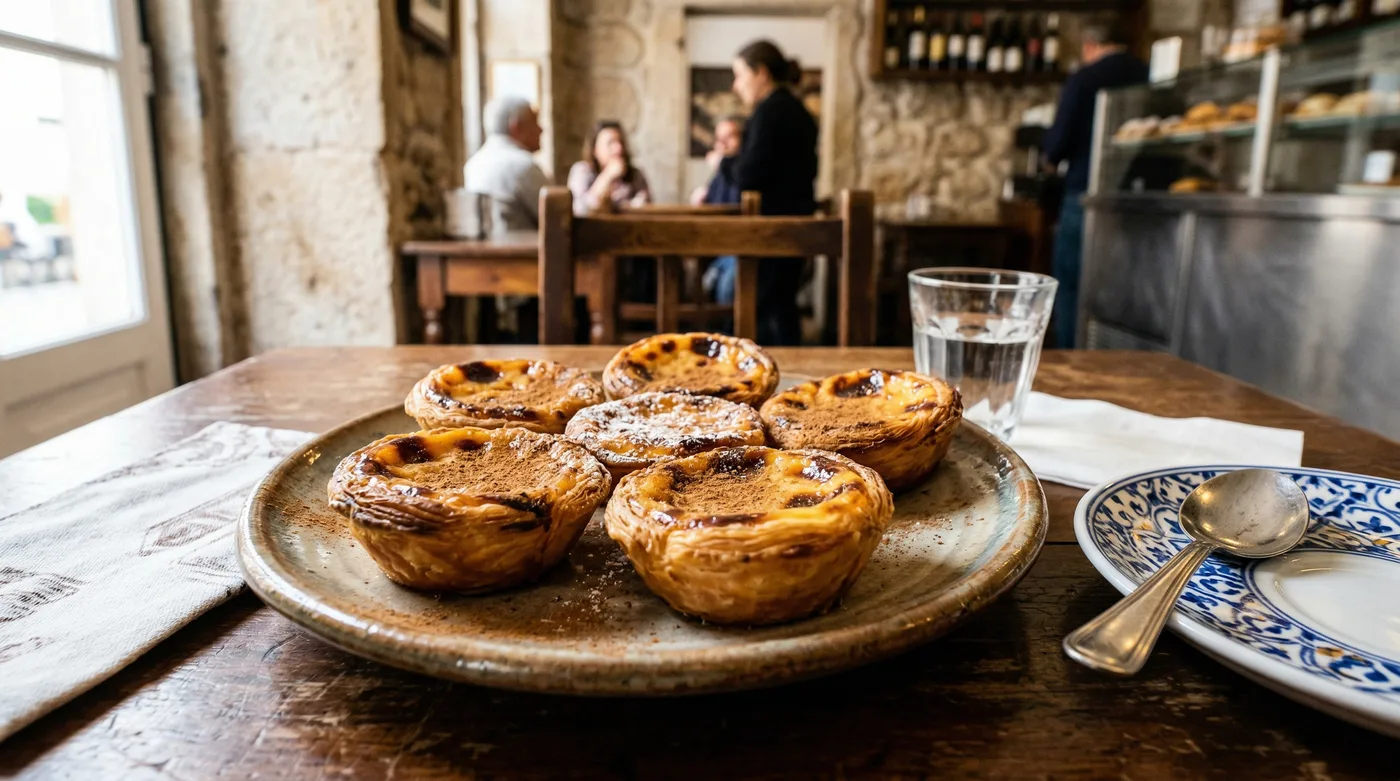
A pastel de nata (the famous custard tart) costs €1.20-1.50 at a local bakery. At the famous Pastéis de Belém in Lisbon, it's €1.50 with a 25-minute queue. At the bakery two streets from your hotel, it's €1.20 with no queue and approximately the same quality.
Supermarket wine in Portugal starts at €2.50 for something genuinely drinkable. Restaurant wine by the glass runs €2.50-4. A beer at a local bar is €1.50-2. These prices exist in 2026. I'm not describing 2015.
Pro Tip: The Pingo Doce supermarket chain is everywhere in Portugal and has a hot food counter at lunchtime that sells full meals — roast chicken, rice, salad — for €3.50-5. It's not glamorous but it's genuinely good, and locals eat there regularly. I've had worse meals at sit-down restaurants in other European countries for four times the price.
What Portugal actually costs: a realistic weekly budget
| Expense | Budget traveler | Mid-range traveler |
|---|---|---|
| Accommodation (per night) | €25-40 (hostel private/guesthouse) | €55-85 (3-star hotel) |
| Food (per day) | €15-20 | €30-45 |
| Local transport (per day) | €3-6 | €8-15 |
| Activities (per day) | €5-10 | €15-30 |
| Weekly total (excl. flights) | €340-530 | €750-1,225 |
The one thing that's actually gotten more expensive
I'm not going to pretend Portugal is still 2018 prices across the board. Lisbon's short-term rental explosion has pushed accommodation costs up in the historic center — Alfama and Bairro Alto especially. A decent Airbnb in central Lisbon now runs €90-130/night in peak season, which would have been unthinkable six years ago.
The workaround is straightforward: stay slightly outside the tourist core. Lisbon's Mouraria, Penha de França, and Beato neighborhoods are 15-20 minutes from everything by metro and run €55-80 for a good guesthouse. Porto's Campanhã and Bonfim are doing the same thing — local, cheaper, and more interesting than the postcard zones anyway.
Accommodation aside, the fundamentals — food, drink, transport — have held up remarkably well. The €10 lunch menu hasn't disappeared. The €2 wine hasn't disappeared. Portugal has absorbed tourist demand without fully repricing its soul, which is more than you can say for Lisbon's neighbor across the border.
Start your hunt before someone else does
Here's the honest reality of budget travel to Portugal in 2026: the deals are still there, but they don't wait around. TAP's best fares on JFK-LIS and EWR-LIS sell out fast, particularly for October and March travel when every budget-conscious European traveler is also watching the same routes.
Set up your FlightKitten hunt now for both LIS and OPO, set your target price at $350 or below for East Coast departures, and let the pounce alert do the work. The $298 fare we caught last October didn't last 48 hours.
Portugal isn't a secret anymore — but it's still a deal. Those two things aren't mutually exclusive if you move fast enough.