Last March, I booked a round-trip from Chicago Midway to Denver on Southwest for $118 all-in. Same dates on United out of O'Hare: $94 base fare, plus a $35 checked bag fee, a $10 seat selection fee, and a $9 "carrier interface charge" that I still don't fully understand. Total: $148. Southwest won by doing absolutely nothing except not nickel-and-diming me.
That's the Southwest story in 2026. It's not the flashiest airline. The seats don't have seatback screens. The boarding process is a controlled chaos that somehow works. But when you add up what you actually pay versus what you actually get, Southwest keeps landing at the top of the pile for domestic budget travel.
Let me show you the math.
The fee structure that still changes everything
Every other major US carrier — and every ultra-low-cost carrier (ULCC) — has spent the last decade building elaborate fee architectures designed to make the base fare look cheap. Southwest has not. In 2026, Southwest still includes two checked bags free on every ticket, at every fare level. No carry-on fees. No seat selection fees. No change fees on most fares.
This sounds like a small thing until you actually price out a family of four flying from Dallas Love Field to Orlando. Two adults, two kids, four checked bags. On Frontier, that bag situation alone adds $240 to your ticket before you've picked a seat or printed a boarding pass. On Southwest, it adds zero.
| Airline | Base fare (DAL-MCO, economy) | 2 checked bags | Seat selection | Total estimated cost |
|---|---|---|---|---|
| Southwest (Wanna Get Away) | $129 | $0 | $0 (open seating) | $129 |
| Frontier | $89 | $120 | $25 | $234 |
| Spirit | $79 | $130 | $22 | $231 |
| American (Basic Economy) | $119 | $60 | $25 | $204 |
| United (Basic Economy) | $124 | $60 | $20 | $204 |
Where Southwest actually flies — and where it doesn't
Southwest operates about 121 airports across the US, Mexico, and the Caribbean. That's genuinely solid domestic coverage, but there are gaps worth knowing before you assume it's your best option.
Southwest dominates point-to-point routes between mid-sized cities that the legacy carriers treat as connecting feed. Think BNA (Nashville) to PHX (Phoenix), or OAK (Oakland) to LAS (Las Vegas), or MDW (Chicago Midway) to BWI (Baltimore). These are bread-and-butter Southwest routes where they often run 8-10 flights a day and fares stay competitive year-round.
What Southwest doesn't do: transatlantic, transpacific, or most of the Caribbean beyond a handful of beach destinations. If you're trying to get to Europe cheaply, you're looking at Norse Atlantic, Level, or hunting down a TAP Air Portugal deal on FlightKitten. Southwest won't help you there.
The other gap is New York JFK and LaGuardia. Southwest flies into Newark on some routes, but if you're a New Yorker whose nearest airport is JFK, your Southwest access is limited. This is genuinely annoying and has been for years.
The open seating situation (it's changing, and that's fine)
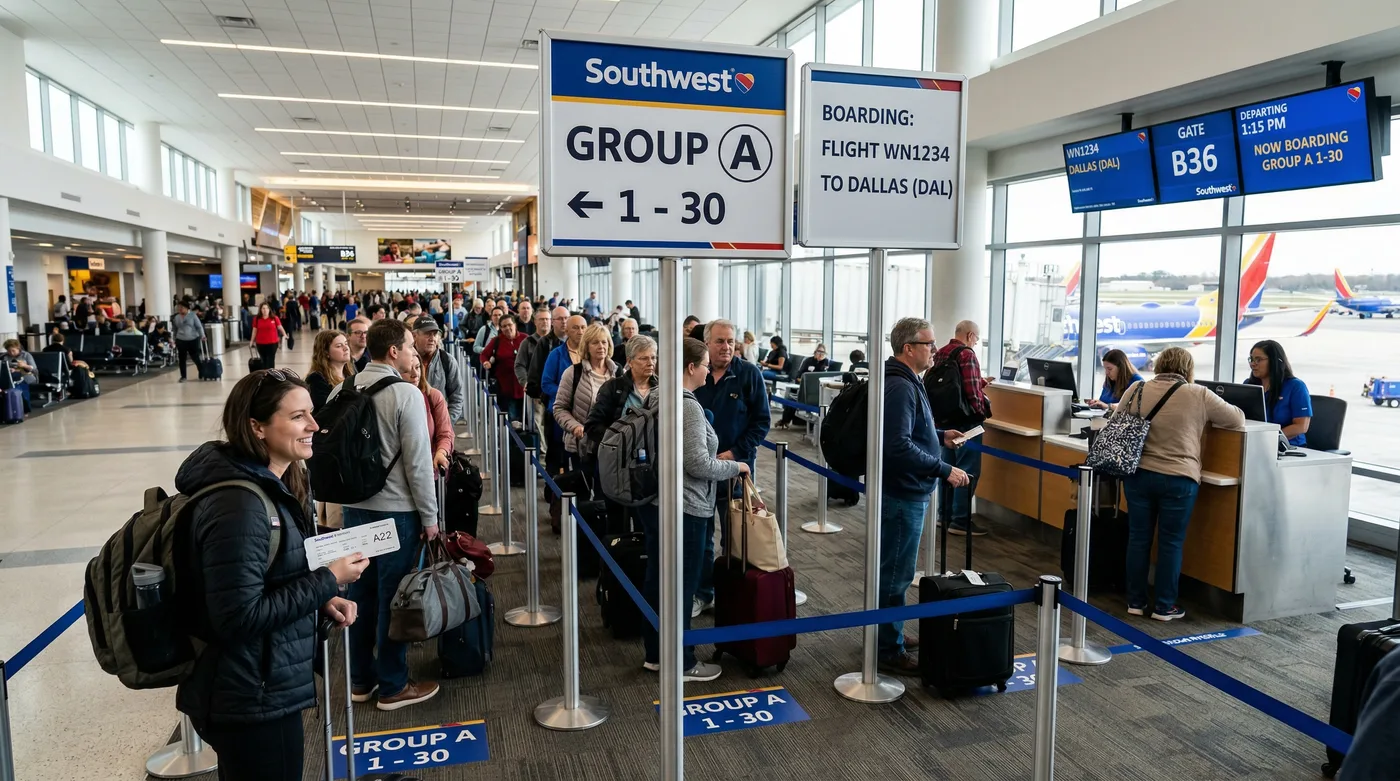
For decades, Southwest's boarding system was its most polarizing feature. No assigned seats. You get a boarding position (A, B, or C, with numbers 1-60 within each group), and you pick whatever seat is open when you board. People either loved the flexibility or hated the anxiety of it.
In 2026, Southwest has been rolling out assigned seating on select routes as part of a broader product shift that started in late 2024. It's not fully implemented everywhere yet, and the transition has been bumpy — I talked to a gate agent in Phoenix in January who described the rollout as "a work in progress, which is a polite way of saying chaotic."
Here's my take: assigned seating is probably better for most travelers, and Southwest was smart to eventually move in that direction. But the open seating era wasn't as bad as its reputation. If you paid $25 for EarlyBird Check-In (automatic A-group boarding), you almost always got an aisle seat. The people who ended up in middle seats were usually the ones who booked the cheapest fare and then didn't check in 24 hours early. That's a solvable problem.
During the transition period, check Southwest's site for your specific route before assuming which boarding system applies.
Pro Tip: If you're booking Southwest during the assigned seating rollout, filter by route when checking the fare details. Some routes have already switched; others are still running the old system. Mixing up your expectations mid-trip is a fast way to end up in a middle seat next to the lavatory.
Fare types decoded — Wanna Get Away is where the value lives
Southwest runs four main fare buckets. Understanding them is the difference between a great deal and an accidental overpay.
Wanna Get Away is the base economy fare and where almost all the good deals live. Fully non-refundable, but changeable without a fee (you get travel credit). This is what you want 90% of the time. Wanna Get Away Plus adds a little flexibility — you can transfer the credit to another person, which the base tier doesn't allow. Usually $20-40 more. Worth it if you're booking for someone else or your plans are genuinely uncertain. Anytime fares are refundable to your original payment method and get you priority boarding. They're also 2-3x the Wanna Get Away price, which makes them a tough sell unless you're booking on a corporate card and need maximum flexibility. Business Select is the top tier — refundable, A1-A15 boarding position, a free premium drink. On a two-hour domestic flight, it's hard to justify unless someone else is paying.For budget travelers, the playbook is simple: book Wanna Get Away, check in exactly 24 hours before departure to get the best available boarding position, and don't overthink it.
How Southwest compares to Spirit and Frontier in 2026
This is the comparison that matters most for true budget travelers, because Spirit and Frontier advertise fares that look absurdly cheap — sometimes $29 or $39 base — and the question is always whether the final price holds up.
The short answer in 2026: it usually doesn't, and the experience gap has widened.
Spirit has been through bankruptcy proceedings and has been cutting routes and staff. The operational reliability numbers have gotten worse, not better. I had a Spirit flight out of FLL (Fort Lauderdale) cancel on me in November 2025 with about four hours' notice and a rebooking offer that involved a 22-hour layover. That's not a statistical anomaly — Spirit's completion rate has been consistently below the industry average.
Frontier is more operationally stable than Spirit right now, but the fee structure is genuinely aggressive. A carry-on bag on Frontier costs $39-$79 depending on when you add it and which route you're on. If you travel with anything larger than a personal item, Frontier's base fare advantage evaporates fast.
| Airline | On-time performance (2025 avg) | Bag fees | Change fees | Overall value score |
|---|---|---|---|---|
| Southwest | ~82% | $0 | $0 | High |
| Frontier | ~76% | $39-$79 carry-on | $39+ | Medium |
| Spirit | ~71% | $37-$65 carry-on | $39+ | Low-Medium |
| Alaska | ~85% | $35 first bag | $0 (most fares) | High |
| American (Basic) | ~80% | $35 first bag | $99 | Medium |
The Rapid Rewards program: underrated for casual travelers
Frequent flyer programs are usually built for people who fly enough to actually accumulate meaningful points. Rapid Rewards is different in one specific way that matters for budget travelers: points don't expire as long as you have account activity every 24 months, and the redemption value is tied directly to the cash fare.
Most airline miles programs have award charts that make redemptions complicated and often terrible. Southwest's model is simpler — you earn points proportional to what you paid, and you redeem them at a roughly consistent rate (around 1.5 cents per point on Wanna Get Away fares). There's no sweet spot to hunt for, but there's also no trap. What you see is what you get.
The Southwest Companion Pass is the standout perk. Earn 135,000 Rapid Rewards points in a calendar year and you can designate one person to fly free with you (just paying taxes) on every flight for the rest of that year and all of the next. It's one of the best travel perks in domestic US travel, and it's achievable through a combination of flying and credit card spend.
I've had the Companion Pass twice. The second time I got it, I made the mistake of designating my sister before confirming she actually wanted to travel with me that often. Spoiler: she didn't. Pick your companion wisely.
When Southwest is NOT the right call
I want to be honest here, because the "Southwest is always best" take isn't accurate.
If you're flying a route that Southwest doesn't serve well — say, JFK to MIA, or any transcon where you want a direct flight and Southwest only offers connections — the calculus changes. A direct Delta flight at $189 beats a Southwest connection at $129 when you factor in the extra three hours of your life.
Southwest also doesn't participate in most flight aggregators. You can't find Southwest fares on Google Flights, Kayak, or most booking platforms. You have to go directly to southwest.com, which means if you're price-comparing quickly, you might miss a better Southwest option or accidentally assume Southwest doesn't fly your route when it does.
This is where setting up a hunt on FlightKitten helps — our Southwest fare tracking pulls directly from their system so you're not manually checking two separate sites every time prices shift. When a pounce alert fires on a route you're watching, Southwest fares are included in the comparison.
Pro Tip: Southwest's sale fares (they run them roughly every 6-8 weeks) often drop Wanna Get Away prices by 20-30% for travel 2-4 months out. If you're flexible on dates and not in a rush, waiting for a sale and then booking immediately when it drops is consistently the highest-value play.
The honest verdict
Southwest isn't perfect. The seating transition has been messy. The lack of seatback screens is increasingly noticeable when you're on a 4-hour flight to Hawaii. And the fact that you can't find their fares on Google Flights is a genuine inconvenience that costs them customers who don't know to look.
But the core value proposition — two free bags, no change fees, competitive fares on a reliable network — is still intact in 2026, and it's still better than what the ULCCs are offering once you price everything honestly.
For domestic US budget travel, Southwest remains the default recommendation. Not because it's the cheapest sticker price every time, but because it's the most consistently good deal when you count everything that actually costs you money.
Set up a hunt on FlightKitten for your regular routes, include Southwest in your tracking, and let the pounce alerts do the work. When a $89 MDW-DEN fare drops, you'll know within minutes — and unlike that $79 Spirit fare that somehow becomes $189 by checkout, the Southwest price is the price you'll actually pay.