I once refreshed a JFK-to-Lisbon fare 14 times in a single afternoon waiting for it to drop. It went up $40 instead. That was before I understood that airline pricing isn't a slot machine — it's closer to a very moody spreadsheet that follows actual rules, most of the time.
Airlines use dynamic pricing algorithms that adjust fares based on demand, seat inventory, competitor moves, and booking pace. The good news: these algorithms are consistent enough that patterns emerge. The better news: once you know the patterns, you can stop refreshing and start setting smarter pounce alerts.
Here's what the data actually shows.
The Tuesday myth — and why it's half true
You've heard it: book on Tuesday for the cheapest fares. This one has been floating around since the early 2000s and it's not entirely wrong, but it's not the full picture either.
Historically, airlines would drop sale fares on Monday evenings, competitors would match by Tuesday morning, and the window would close by Wednesday. That cycle still exists — but it's compressed. In 2026, matching happens in hours, not days. Delta, United, and American all run automated fare-matching systems that respond faster than any human pricing analyst could.
What's still true: Tuesday and Wednesday tend to show slightly lower average fares on domestic US routes — roughly 5-10% cheaper than Friday or Sunday departures on the same itinerary. On a $400 round-trip, that's $20-40. Not life-changing, but real.
What matters more than the day you book is the day you fly. Tuesdays, Wednesdays, and Saturdays are consistently the cheapest departure days across most major routes. A Wednesday departure on LAX-ORD can run $60-90 cheaper than the same flight leaving on a Friday — same airline, same week.
How far in advance should you actually book?
The "sweet spot" window gets thrown around a lot, usually as a single number. The truth is it varies significantly by route type, and collapsing it to one figure loses most of the useful signal.
| Route type | Cheapest booking window | Notes |
|---|---|---|
| Domestic US (short-haul) | 3-6 weeks out | Under 2 weeks gets expensive fast |
| Domestic US (long-haul, e.g. JFK-LAX) | 4-8 weeks out | Peaks in summer compress this window |
| Transatlantic (economy) | 2-5 months out | Budget carriers like Norse and Level push prices down |
| Europe-to-Europe | 6-10 weeks out | Ryanair/Wizz Air sales often hit 8 weeks out |
| Asia-Pacific | 3-6 months out | Long-hauls need more lead time |
| Last-minute (under 2 weeks) | Wildcard | Occasionally brilliant, usually painful |
The inventory release cycle airlines don't advertise
Here's the mechanic that most booking guides skip entirely: airlines don't release all their seats at once.
When a new schedule opens (typically 330-355 days before departure for most major carriers), airlines put a limited number of seats in the lowest fare buckets — sometimes as few as 4-6 seats at the introductory price. When those sell, the next bucket opens at a higher price. This is why fares on a route 11 months out can sometimes be cheaper than the same route 3 months out.
Lufthansa and Swiss are particularly predictable about this. Their economy "Light" fares on FRA-JFK and ZRH-JFK routes frequently open in the $480-540 range when schedules first publish, then climb to $650+ within weeks as the cheap buckets fill. United's basic economy on the same routes tends to follow within 48-72 hours once Lufthansa moves.
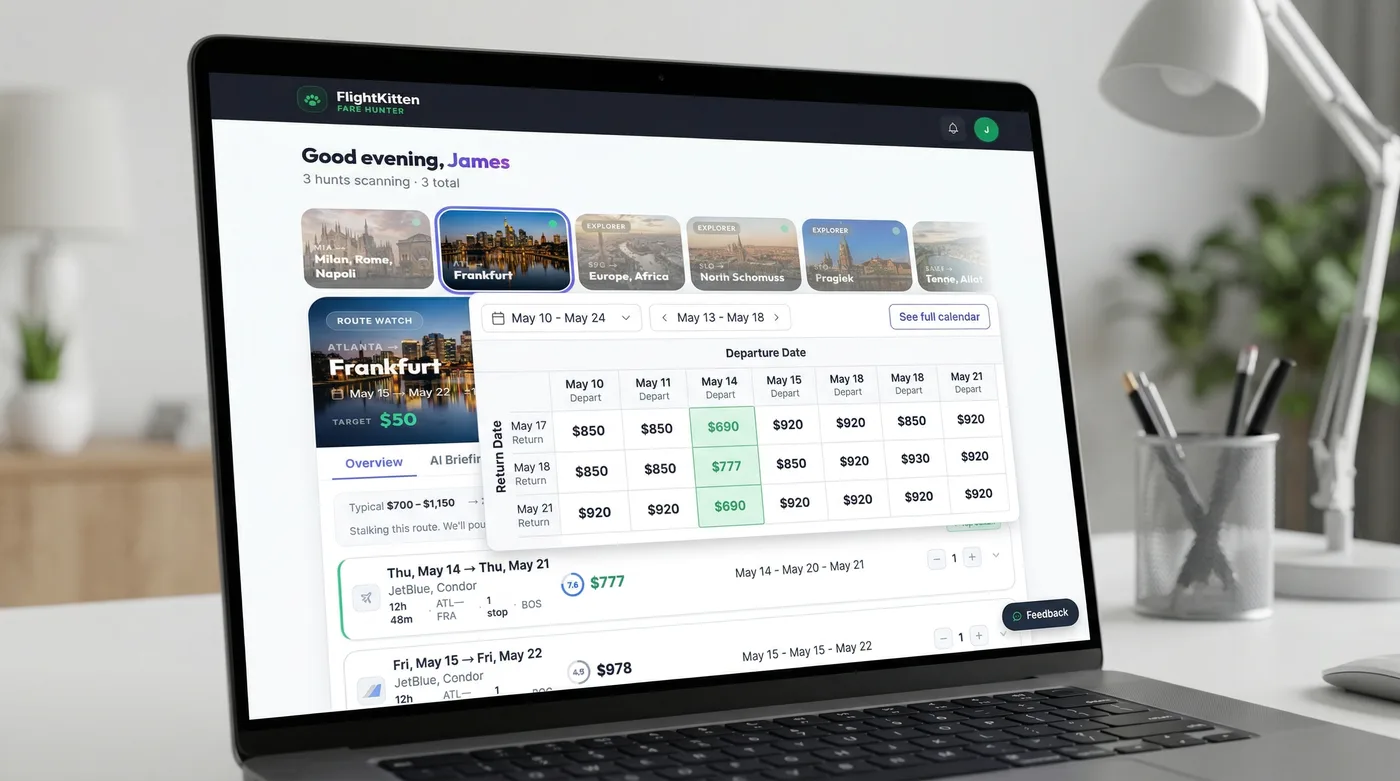
The practical move: if you have a fixed travel date more than 6 months away, check prices the week the schedule opens. Set a FlightKitten alert for that route anyway — sometimes an airline will run a flash sale that undercuts even the opening price.
Pro Tip: Google Flights' price graph is useful for seeing historical fare trends on a route, but it shows the lowest available price at each point in time — not what average travelers actually paid. Use it for pattern-spotting, not as gospel.
When airlines actually slash prices (and why)
Price drops aren't random. They happen for specific, predictable reasons:
Seats aren't selling fast enough. Airlines track booking pace obsessively. If a flight is 60 days out and only 40% full when they'd expect 65%, the algorithm starts dropping prices to stimulate demand. This is why checking fares on less popular routes 6-8 weeks out sometimes turns up genuine deals. A competitor dropped first. When Spirit or Frontier cuts a fare on a route, American and Southwest usually respond within hours. This is most visible on heavily competed leisure routes — think ORD-MCO, LAX-LAS, or BOS-FLL. The budget carrier moves, the legacies follow. Watch those routes during Spirit's frequent sales. Seasonal demand valleys. Every route has them. The two weeks after Thanksgiving and before Christmas is one of the cheapest domestic windows of the year — everyone thinks it's expensive, but demand actually craters between those peaks. I've seen JFK-LAX drop to $178 round-trip in that window on American basic economy. January and February (excluding school holidays) are the cheapest months for transatlantic economy across almost every carrier. Error fares and system glitches. These are rare but real. They usually last 2-6 hours before the airline catches and corrects them. In early 2025, a United pricing error had EWR-DUB round trips showing at $189 for about four hours on a Tuesday afternoon. FlightKitten caught it; most people checking manually didn't.
The budget carrier pricing pattern is completely different
Everything above applies primarily to legacy and full-service carriers. Ryanair, Wizz Air, Spirit, Frontier, and Allegiant operate on a different logic entirely — and confusing the two will cost you money.
Budget carriers price lowest earliest and highest latest. That's the opposite of the "wait for a sale" instinct. Ryanair's cheapest fares on routes like STN-BCN or DUB-MAD are almost always available 3-6 months out. By 4 weeks out, you're paying 2-3x the opening price for the same seat.
Spirit is slightly different in the US market — they do run flash sales that can undercut their own advance fares, usually 3-6 week window, promoted via email. Their "Thrillionaire" sale emails have historically offered routes like LAX-MIA for $49 one-way, but you need to be on the list and move within 24-48 hours.
| Carrier type | Cheapest booking window | Sale behavior |
|---|---|---|
| Ryanair / Wizz Air | 3-6 months out | Occasional flash sales, but advance pricing wins |
| Spirit / Frontier | 4-8 weeks out OR flash sales | Subscribe to emails, set alerts |
| Southwest | Varies, but watch for sales | No GDS, must check directly or via alert |
| Legacy (AA, UA, DL) | 4-10 weeks depending on route | Respond to competitor drops |
| Premium budget (Norse, Level) | 2-4 months out | Transatlantic, inventory-limited |
The 24-hour rule and why you should use it aggressively
US Department of Transportation rules require airlines to either hold a fare for 24 hours without payment or offer a 24-hour refund after purchase (for flights booked at least 7 days before departure). Most major US carriers offer the hold option.
This is more useful than people realize. If you spot a fare that looks good but you're not 100% sure — maybe you're waiting on a travel companion to confirm dates, maybe you think it might drop further — hold it. You lose nothing.
I've used this to lock in a $312 ORD-LHR fare on British Airways while I waited to confirm vacation days, then cancelled the hold when my boss said no. The fare was $389 the next day. The hold cost me zero dollars.
The caveat: this only applies to US-based airlines and flights departing from the US. Booking a Ryanair flight from a European airport? No such protection. Pay or walk.
Pro Tip: When you see a fare you like, hold it immediately, then spend the next few hours checking alternatives. Don't let a good price evaporate while you deliberate.
Reading the signs that a price drop is coming
This is where it gets a bit more art than science, but there are signals worth watching:
The flight has been listed for weeks with no price movement. Stagnant fares on routes with multiple competitors usually means demand is soft. That's a setup for a drop. A competing airline just added capacity on the route. When Norse Atlantic started flying JFK-LGW in 2022, legacy carrier fares on that crossing dropped 15-25% within months. New entrants compress prices. Watch for route announcements. You're looking at a shoulder-season departure. May, early June, September, and October are the sweet spots for transatlantic — lower demand than peak summer, better weather than winter. Airlines know this and price accordingly, but there's still more room for deals than in July. The fare has already dropped once. Algorithms that cut once often cut again if the booking pace doesn't respond. A fare that dropped from $520 to $440 on a slow-selling flight might hit $390 two weeks later. This is the riskiest play — sometimes it bounces back instead — but it's a real pattern on thin routes.How to actually use this information
Knowing the patterns is step one. Acting on them without spending your life watching fare screens is step two.
The practical setup: identify your routes, set your target price based on what you know is realistic (not aspirational), and let alerts do the work. A FlightKitten hunt on BOS-MAD with a target of $420 round-trip will catch the fare when it hits — whether that's a Tuesday morning competitor response, a 10-week-out inventory release, or a Spirit-triggered legacy price drop — without you needing to check manually.
The mistake most people make is setting alerts too low. If the realistic floor for JFK-BCN in October is $380, setting an alert for $250 means you'll never get notified and you'll end up booking at $490 in frustration two weeks before departure. Know your route, know the realistic range, set your target just below the historical average.
The other mistake: waiting for the perfect price on a flight you actually need to take. I've watched people hold out for a $300 ORD-LHR fare that hasn't existed since 2019, miss a $398 deal, and end up paying $560. A good price you catch beats a perfect price you don't.
The bottom line
Airline pricing has patterns — real ones, not folk wisdom. Domestic fares are cheapest 3-8 weeks out, with Tuesday/Wednesday departures consistently cheaper than weekend flights. Transatlantic economy has a 10-14 week sweet spot for most carriers. Budget airlines price lowest earliest. And price drops happen for reasons: soft demand, competitor moves, seasonal valleys, and inventory mechanics.
You don't need to become a fare analyst. You need to know roughly when prices behave on your routes, set realistic targets, and have something watching when you're not. That's the whole system.
Set up a hunt on FlightKitten for the routes you actually care about, put in a target price that's ambitious but not delusional, and let the pounce alerts do the refreshing for you. Your Tuesday afternoons have better uses.