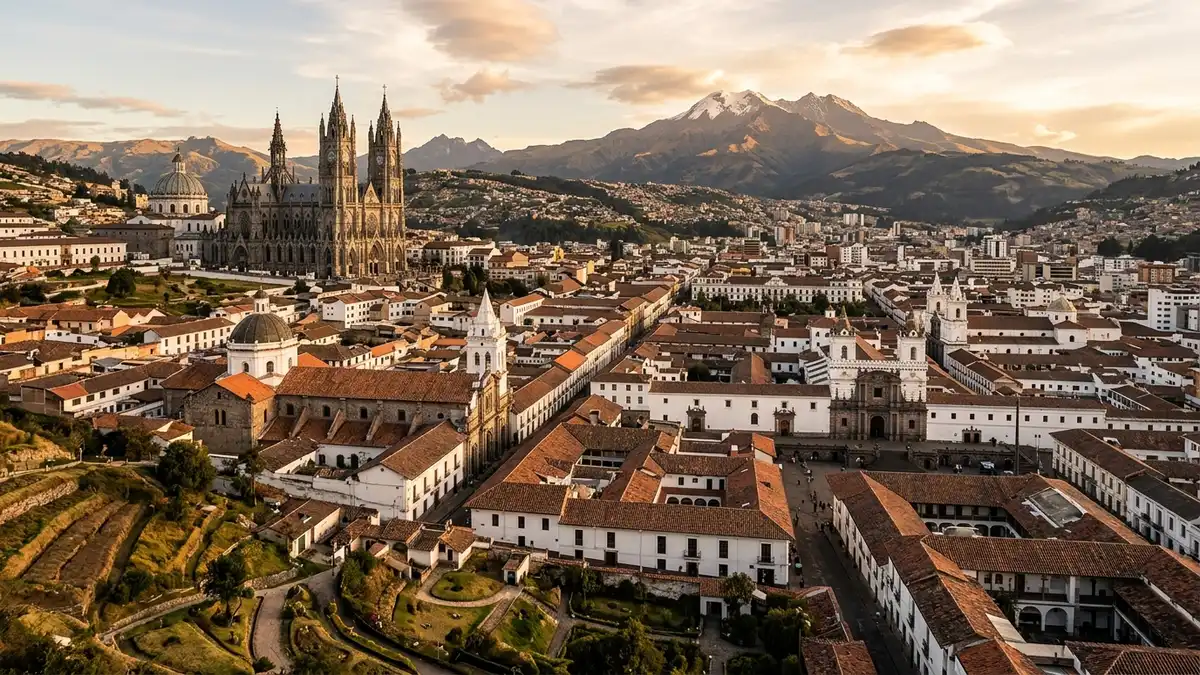



Route Briefing: Houston to Quito
Flying from Houston to Quito is one of those routes that punches well above its weight. At around seven hours and forty-five minutes with one stop, you're not exactly hopping across the border — but what's waiting on the other end makes every minute worthwhile. United, LATAM, and Copa Airlines all serve this corridor year-round, and if you catch a good deal, you can land a roundtrip for under $450. Standard fares creep past $700, so timing matters. Book six to eight weeks out and pay attention to connecting options — Copa routing through Panama City and LATAM through Bogotá tend to surface the most competitive prices.
Quito itself is genuinely unlike any other capital city in South America. Sitting at roughly 2,850 meters above sea level in a long, narrow valley carved between Andean peaks, it's one of the highest capital cities in the world, and your body will remind you of that fact within the first few hours. Take it easy on arrival day — skip the ambitious hike and let yourself acclimatize with a slow walk through the historic center instead. That colonial old town is a UNESCO World Heritage Site, and it earns the designation. The churches alone are staggering: La Compañía de Jesús, with its elaborately gilded interior, is the kind of place that stops you mid-sentence.
Beyond the city, Quito serves as the primary gateway to the Galápagos Islands, making it a natural launchpad for one of the most extraordinary wildlife experiences on the planet. Even if the Galápagos isn't on this particular itinerary, the surrounding Andes offer cloud forests, active volcanoes, and indigenous markets that are deeply rewarding in their own right.
For getting into the city from Mariscal Sucre International Airport, official taxis and app-based ride services are your most straightforward options — the airport sits northeast of the city center and the journey takes roughly 45 minutes depending on traffic.
Timing your visit is worth thinking through carefully. June through August brings drier, sunnier weather and is peak season, meaning higher prices and more crowds. December and January also see a surge in visitors. If you want a quieter, more affordable experience, the shoulder months on either side of those windows can be genuinely rewarding — Quito's climate is mild year-round thanks to its elevation, so you're rarely dealing with extreme heat regardless of when you go.
The one tip worth burning into your memory: spend at least one night in the historic center rather than the modern Mariscal district. The atmosphere after the day-trippers leave is something else entirely.