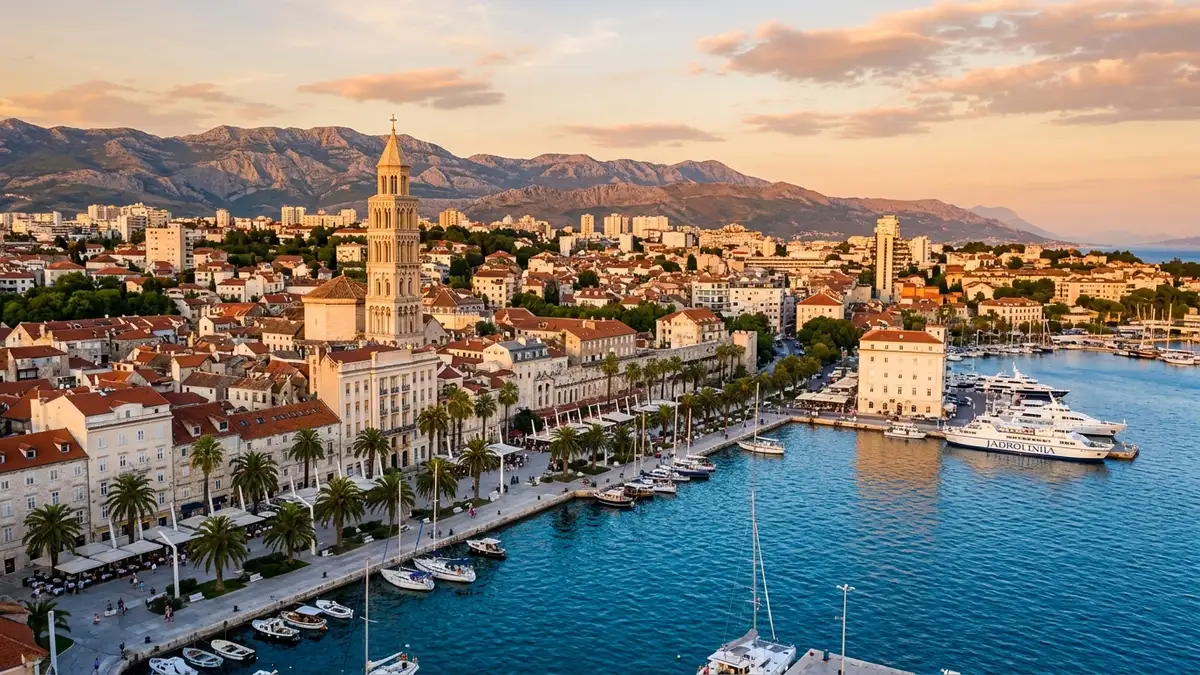



Route Briefing: New York to Split
Few cities in the world let you sleep inside a Roman emperor's retirement palace, but Split pulls it off without even trying to be dramatic about it. Diocletian built his sprawling complex on the Dalmatian coast around the fourth century AD, and over the following centuries the locals simply moved in, converting temples into churches, towers into apartments, and courtyards into café terraces. That layered, lived-in quality is what separates Split from a museum piece — it's a genuinely breathing city that happens to be one of the most extraordinary archaeological sites in Europe.
Getting there from New York takes around thirteen and a half hours with one stop, typically connecting through Frankfurt, Vienna, or Zurich on Lufthansa, Austrian Airlines, or Swiss. None of these are bad layover cities if you have time to stretch your legs, and all three hubs offer solid onward connections to Split's airport. From Split Airport, located just outside the city, you can reach the waterfront Riva promenade by bus or taxi in under half an hour — straightforward enough that you'll be sipping a coffee overlooking the Adriatic before the jet lag fully sets in.
Timing matters enormously on this route. June through August is peak season, and for good reason — the Adriatic is warm, the days are long, and the island ferries run frequently, making it easy to day-trip to Hvar, Brač, or Vis. But those summer months also bring crowds and higher prices across the board. Early June and September hit a genuine sweet spot: warm enough to swim, calm enough to actually enjoy the old town's narrow marble streets without shuffling through tour groups.
On fares, a roundtrip under $700 is a genuinely good deal on this route, while standard pricing runs between $1,000 and $1,400 or more. The single most effective way to stay on the right side of that gap is to book four to six months before a summer trip. Fares tend to climb sharply after April, so if you're dreaming of a July visit, start watching prices in January or February. Setting a fare alert through a tracker like FlightKitten means you catch the dip without obsessively refreshing search engines.
Beyond the palace walls, Split is the natural launching pad for the Dalmatian coast. The food leans heavily on fresh seafood, grilled meats, and local olive oil, and the wine from the surrounding region — particularly varieties made from the indigenous Plavac Mali grape — is worth exploring. The city rewards slow mornings and late evenings far more than a rushed itinerary, so resist the urge to treat it purely as a gateway. Give Split itself at least two full days before you start chasing islands.