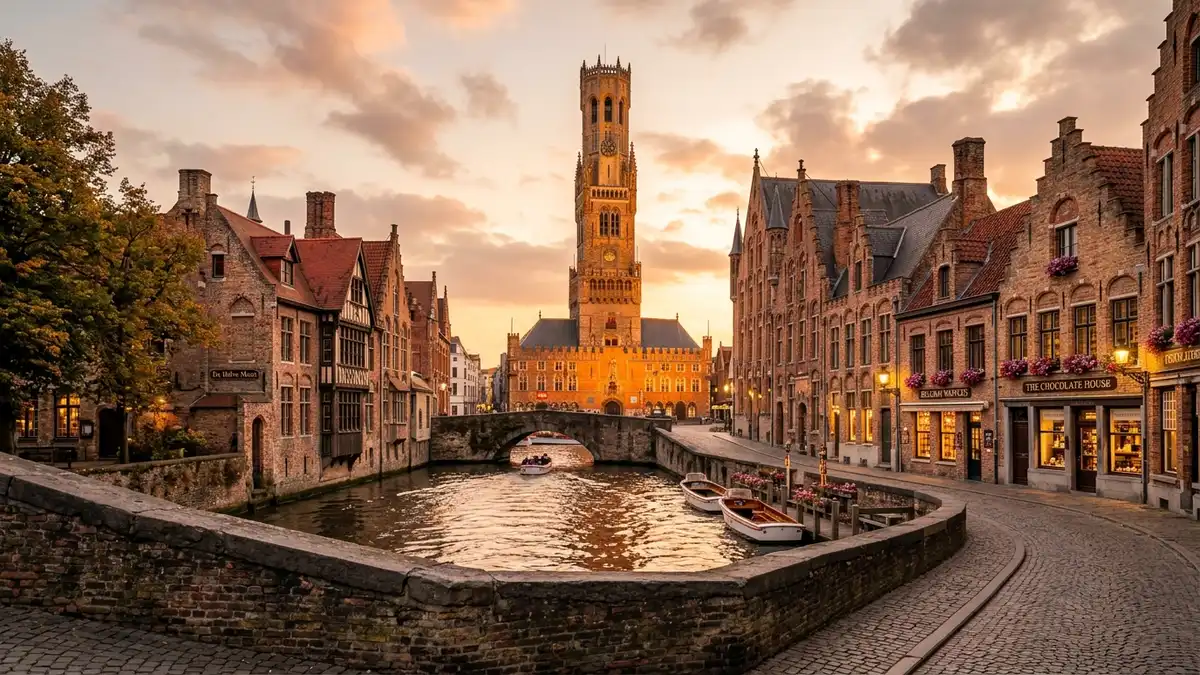



Route Briefing: Toronto to Bruges
Bruges is one of those rare places that genuinely looks like it was lifted from the pages of a storybook, and the fact that you can reach it from Toronto in roughly nine and a half hours with one stop makes it far more accessible than most Canadians realize. For a medieval European gem of this calibre, that's a remarkably manageable journey.
From Toronto Pearson, Air Canada, Brussels Airlines, and Lufthansa are your most reliable carriers, with common connections through Frankfurt, Amsterdam, or London. Worth knowing: routing through Frankfurt or Amsterdam can sometimes shave meaningful dollars off your ticket compared to a straightforward Brussels booking, so it pays to be flexible when you search. A genuinely good deal on this route lands under $700 roundtrip — anything close to that is worth snapping up. Standard fares tend to hover above $950, so the gap between a savvy booking and a last-minute one is real. Aim to book two to four months ahead for the best shot at those lower fares.
Once you land at Brussels Airport, Bruges is easily reached by train. The Belgian rail network is efficient and well-connected, and the journey from Brussels to Bruges by train takes roughly an hour, dropping you right in the heart of the city. No rental car needed — Bruges itself is compact and best explored entirely on foot or by bicycle.
And what a city to explore. The medieval centre is a UNESCO World Heritage Site, laced with canals that earned Bruges its reputation as the Venice of the North. The Markt square, the Belfry tower, the Basilica of the Holy Blood — these aren't just postcard images, they're genuinely moving in person. The chocolate culture here is serious business, with artisan chocolatiers around every corner, and Belgian beer is practically a civic religion. Set aside time to simply wander without a plan; getting pleasantly lost in Bruges is half the experience.
Timing matters. June through August is peak season, when the city is at its most vibrant but also its most crowded and expensive. If you can travel in shoulder season — April, May, or September — you'll find the canals just as beautiful, the queues shorter, and accommodation more affordable. Winter Bruges, particularly around the Christmas market season, has its own quiet magic.
The one tip that genuinely elevates this trip: resist the urge to use Bruges purely as a day trip from Brussels. Stay at least two or three nights in the city itself. Once the day-trippers leave in the evening, Bruges transforms into something quieter and far more intimate — and that version of the city is the one worth travelling nine hours to experience.