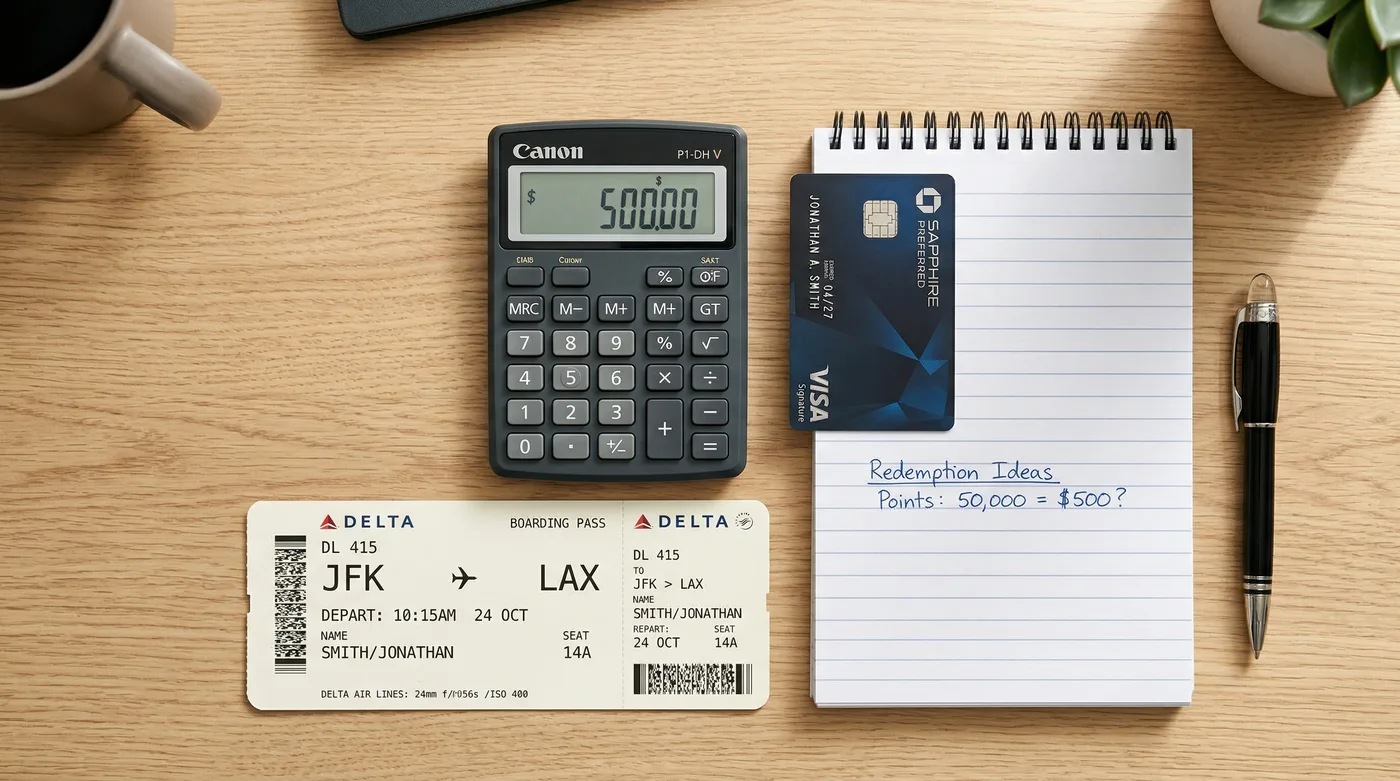
The flight I paid $0 for — and never left my couch to earn it
Last March, I redeemed 60,000 American Airlines AAdvantage miles for a round-trip JFK to Madrid in economy. The redemption value worked out to about $0.013 per mile — solid. The part that still makes me a little smug: I earned roughly 40,000 of those miles without stepping foot on a plane. Grocery runs. A hotel booking. A streaming subscription I was already paying for.
Most people treat miles like a byproduct of flying. That's leaving serious money on the table. If you're the kind of traveler who sets up hunts on FlightKitten waiting for that $380 JFK-BCN fare to drop, you should also be treating every dollar you spend on the ground as a potential fraction of your next free flight.
Here's exactly how to do it.
Credit card sign-up bonuses: the fastest miles you'll ever earn
Nothing in the miles world moves the needle faster than a sign-up bonus. We're talking 50,000 to 100,000 miles in exchange for hitting a spending threshold in the first 3 months — sometimes as low as $3,000, which is basically one month of normal spending for a lot of households.
The math on this is almost offensive in how good it is. The Chase Sapphire Preferred currently offers 60,000 Ultimate Rewards points after $4,000 spend in 3 months. Transfer those to United MileagePlus at 1:1 and you're looking at a one-way business class saver award to Europe — or two round-trip economy flights to the Caribbean. The card has a $95 annual fee. The flights you'd be booking with those miles would cost $700-$1,200 in cash. You do the math.
| Card | Welcome bonus | Spend requirement | Transfer partners | Annual fee |
|---|---|---|---|---|
| Chase Sapphire Preferred | 60,000 UR points | $4,000 / 3 months | United, Hyatt, Southwest, BA | $95 |
| Amex Gold | 60,000 MR points | $6,000 / 6 months | Delta, Air France, Virgin Atlantic | $250 |
| Capital One Venture X | 75,000 miles | $4,000 / 3 months | Air Canada, Turkish, TAP | $395 |
| Citi Strata Premier | 70,000 ThankYou points | $4,000 / 3 months | Turkish, Air France, Qatar | $95 |
Pro Tip: Don't apply for multiple cards in the same 30-day window. Chase specifically has an informal "5/24 rule" — if you've opened 5 or more cards in 24 months, they'll likely deny you. Apply for Chase products first, then branch out to Amex and Citi.
Everyday category spend: where most people leave miles on the floor
Sign-up bonuses are a one-time event. Category bonuses are forever — or at least until the card issuer quietly nerfs them, which happens more than anyone admits.
The Amex Gold earns 4x Membership Rewards points at US supermarkets (up to $25,000/year) and 4x at restaurants worldwide. If you spend $500/month on groceries and $300/month eating out, that's 38,400 points annually just from those two categories. Transfer to Air France Flying Blue at 1:1 and you're looking at a round-trip economy flight from the East Coast to Paris, which Flying Blue prices at around 30,000-35,000 miles during their monthly Promo Rewards sales.
I personally messed this up for two years by putting all my grocery spend on a flat 2x card. The opportunity cost was real and I'm still annoyed about it.

Shopping portals: the hack that takes 45 seconds and most people skip
Every major airline has an online shopping portal. You click through it before buying something you were already going to buy, and the airline credits your account with bonus miles. That's the entire mechanic. It's almost too simple.
American Airlines AAdvantage eShopping, United MileagePlus Shopping, and Delta SkyMiles Shopping all work this way. Rates vary wildly by retailer and season, but here's what realistic looks like:
- Nike: 3-6 miles per dollar spent
- Macy's: 2-5 miles per dollar
- Walmart: 1-2 miles per dollar
- Hotels.com: 3-5 miles per dollar
- Hertz: 500-1,000 miles per rental
Before any online purchase over $50, I check cashbackhound.com or just open two or three portal tabs to compare rates. Takes less time than finding the promo code field. On a $400 electronics purchase, the difference between a 1x and 5x portal can be 1,600 miles. Over a year of normal shopping, portal miles alone can add up to 8,000-15,000 miles without changing a single spending habit.
The portals also stack with credit card category bonuses. Buy something at a department store through the AA eShopping portal using your Amex Gold? You get the portal miles AND 4x Membership Rewards. Both post. It's not a glitch, it's just how it works.
Dining programs: free miles for eating out you're already doing
United MileagePlus Dining, Delta SkyMiles Dining, and American AAdvantage Dining all operate through the same underlying network (run by Rewards Network). You register your credit card, eat at a participating restaurant, and miles post automatically. No app to open at the table, no QR code to scan.
Base earn rates are typically 3 miles per dollar, but new members often get a promotional 5-7 miles per dollar for the first 30-90 days. If you're eating out $200/month and half of that is at participating restaurants, that's 3,000-7,000 miles annually for doing absolutely nothing differently.
The catch: restaurant coverage is uneven. Major cities like NYC, Chicago, LA, and Miami have solid networks. If you're in a smaller market, you might find three participating spots in a 10-mile radius. Worth checking before you get excited.
You can also register the same physical card across multiple dining programs simultaneously. I have my Amex Gold registered in both United and Delta dining. Whichever program I'm closest to a redemption threshold in, that's the one I'll feed. Both will track the same transactions, but only one will award miles per meal — it's first-come, first-served based on which program processes first.
Hotel stays and car rentals: the overlooked ground game
Flying isn't the only way to earn airline miles through travel. Almost every major hotel chain has airline transfer partnerships, and they're more useful than people realize.
Marriott Bonvoy is the big one. You earn Marriott points on stays, then transfer to airline partners at a 3:1 ratio — with a 5,000-mile bonus for every 60,000 points transferred. The math works out to roughly 1.25 airline miles per Marriott point when you hit those thresholds. Not spectacular on its own, but if you're already staying at Marriotts for work travel, there's no reason not to convert idle points into United or Delta miles.
Hilton Honors transfers to Virgin Atlantic Flying Club at a brutal 10:1.5 ratio — I'd avoid it. But World of Hyatt transfers to World of Hyatt's own award chart, which is genuinely excellent for hotel redemptions, and Hyatt is a Chase Ultimate Rewards transfer partner, which keeps it in the ecosystem.
For car rentals, Hertz Gold Plus Rewards lets you earn miles directly in several airline programs. A week-long rental at $250-$300 can generate 500-1,000 bonus miles depending on the promotion. Not life-changing, but it adds up when you're stacking every touchpoint.

Subscriptions and bills: the boring stuff that quietly pays off
Some credit cards earn elevated rates on streaming, phone bills, and utilities. The Amex Blue Cash Preferred earns 6% back on US streaming services — but that's cash back, not miles. For miles specifically, the Capital One Venture X earns a flat 2x on everything, which means your $16/month Netflix bill earns 32 miles. Small, but it's 384 miles a year for doing nothing.
More interesting: Amex Membership Rewards has a Pay With Points feature for certain subscription services, but I'd skip it — the redemption rate is terrible at 0.6 cents per point. Better to keep the points and transfer them.
The actual play for subscriptions is simpler: put every recurring bill on your highest earning flat-rate or category card and forget about it. If your monthly bills total $400 and you're earning 2x on all of them, that's 9,600 miles per year from bills alone. Over two years, that's a one-way domestic flight on Southwest or a significant chunk of a transatlantic economy redemption.
Transferable points vs. airline-specific miles: which to chase
This is where strategy actually matters. Airline-specific miles — Delta SkyMiles, United MileagePlus, AA AAdvantage — are only useful for that airline and its partners. If Delta devalues its award chart (which it did aggressively in 2023-2024), your miles are worth less overnight with no recourse.
Transferable points — Chase Ultimate Rewards, Amex Membership Rewards, Capital One miles, Citi ThankYou — give you flexibility. You hold the points until you find a specific redemption you want, then transfer. This matters because sweet spots exist across different programs, and they change.
Right now in 2026, some of the best economy redemptions I'm seeing:
- Turkish Miles&Smiles: 15,000 miles each way for US-Europe on Star Alliance partners
- Air France Flying Blue Promo Rewards: 30,000-35,000 miles round-trip US-Europe, published monthly
- Virgin Atlantic Flying Club: 12,500 miles one-way US domestic on Delta (when available)
- Avianca LifeMiles: 20,000 miles round-trip US-Europe on United
All of these are reachable through Amex MR, Chase UR, or Citi ThankYou transfers. If you're only earning Delta SkyMiles, you can't access any of them.
Pro Tip: Before transferring points to an airline, search for award availability first. Points transfers are almost always one-way and instant — you can't get them back if the seats aren't there.
How to actually track all of this without losing your mind
I'll be honest: managing four credit cards, two dining programs, three shopping portals, and a hotel transfer is a lot. I've missed portal credits, forgotten to register a new card for dining, and once transferred 20,000 Amex points to the wrong airline program (still stings).
The system that works for me:
- One spreadsheet tracking annual fees, renewal dates, and current point balances
- A browser bookmark folder with all shopping portals — I open them before any purchase over $30
- Email filters that tag all miles-related notifications so I can audit them monthly
- FlightKitten hunts set for the routes I'm targeting, so I know what redemption I'm building toward
That last point matters more than people realize. Earning miles without a destination in mind is like saving money without knowing what you're saving for. When I have an active catch alert set on FlightKitten for, say, ORD-NRT under $650, I also know I need roughly 35,000-40,000 miles for an economy award on the same route — and I can decide which is the better deal when the time comes.
The honest math: what a year of ground-based earning actually looks like
Let's put real numbers on this for a typical budget traveler spending around $3,500/month:
| Source | Monthly spend | Miles earned | Annual total |
|---|---|---|---|
| Groceries (4x Amex Gold) | $500 | 2,000 MR | 24,000 |
| Dining (4x Amex Gold + dining program) | $300 | 1,200 MR + 900 UA | 14,400 MR + 10,800 UA |
| Shopping portals (avg 3x) | $400 | 1,200 AA | 14,400 AA |
| Everything else (2x Venture X) | $2,300 | 4,600 Capital One | 55,200 Capital One |
| Sign-up bonus (one-time, Year 1) | — | 60,000 UR | 60,000 UR |
Year two, without the bonus: still 40,000-50,000 miles from spending alone. Enough for one solid economy redemption annually.
Start with one thing, not everything
The biggest mistake people make with miles is trying to optimize everything at once and burning out after three weeks. Pick one lever — probably a credit card sign-up bonus, since it's the highest-impact single action — and do that first.
Get the Chase Sapphire Preferred or the Citi Strata Premier. Hit the minimum spend. Watch 60,000-70,000 points land in your account. Then set a FlightKitten hunt for the route you actually want to fly, figure out which program prices it best, and transfer accordingly.
The shopping portals and dining programs can come later. They're free to join and take 10 minutes to set up. But the sign-up bonus is where the real acceleration happens, and there's no reason to wait.
Your next flight is already being paid for. You just don't know it yet.