I once booked a JFK-to-Lisbon flight for $389 round-trip on TAP Air Portugal. My colleague booked the exact same route, same flight number, four days later and paid $612. We were sitting in adjacent seats.
That $223 difference didn't happen by accident. It was the result of a system airlines have spent decades and hundreds of millions of dollars perfecting — one specifically designed to charge every single passenger the maximum they're willing to pay. Understanding how that system works is the first step to consistently beating it.
The basic engine: revenue management explained
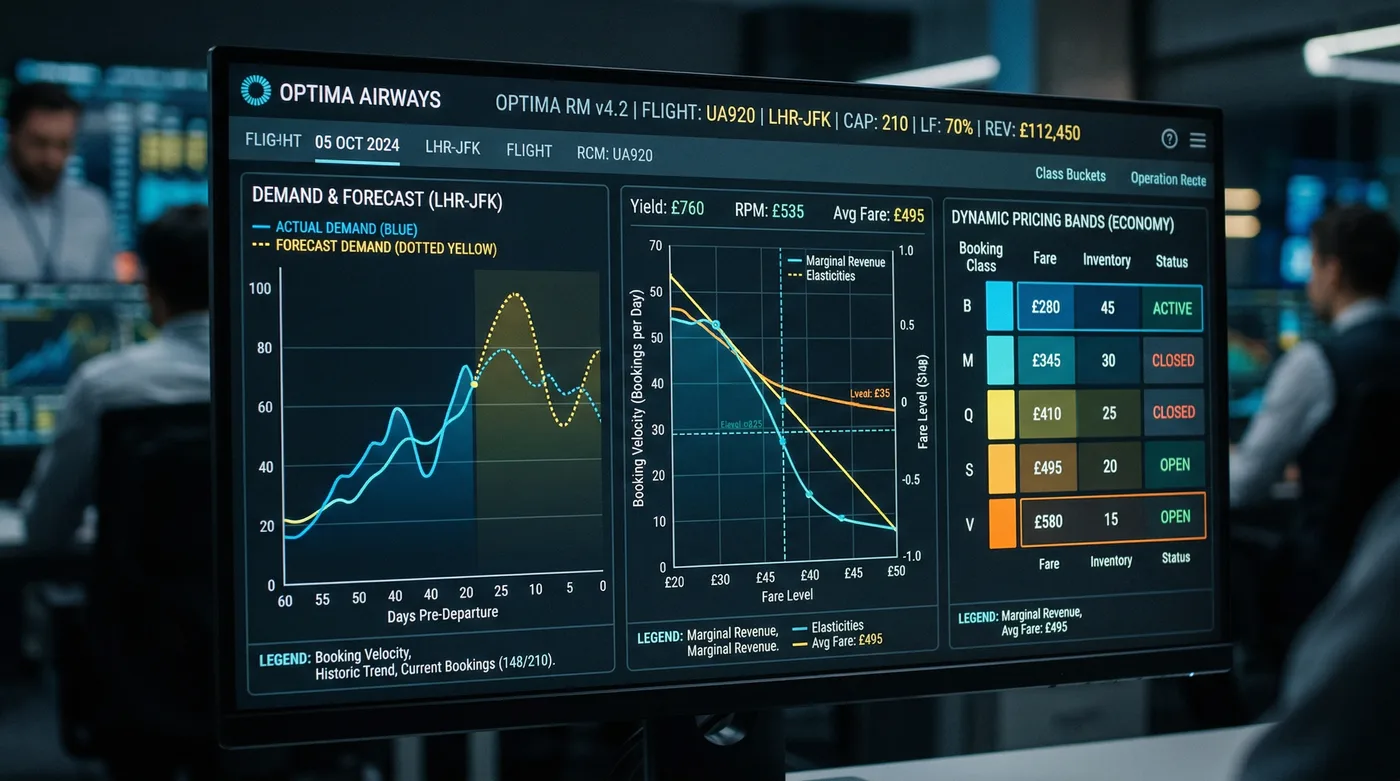
Airlines don't just set one price per flight. They divide every plane into what are called fare buckets — sometimes 20 or more on a single route. Each bucket has a letter code (Y, B, M, H, K, Q, etc.) and a different price. When the cheapest bucket sells out, the next one opens. When that sells out, the next. The plane fills up, and the average fare per seat climbs as departure approaches.
This is called yield management, or revenue management, and it's been standard since American Airlines basically invented the modern version in the 1980s. The goal is simple: fill every seat while maximizing total revenue. An empty seat at departure is $0. A seat sold for $180 is better than $0. A seat sold for $480 is better than $180. The algorithm is constantly trying to thread that needle.
What makes it genuinely complex is that the system is dynamic. It's not just watching how many seats are left — it's comparing current booking pace against historical data for that route on that day of week, factoring in competitor pricing, upcoming holidays, whether there's a conference in the destination city, and about forty other variables. Delta's Endeavor AI system, for instance, reportedly recalculates prices across its network thousands of times per day.
Why the same seat costs different prices at the same time
Here's the part that makes people genuinely angry when they find out about it: two people searching for the same flight at the same moment can sometimes see different prices. Not always, and not on every airline, but it happens.
Some of it is cookies and browsing history — the old "search in incognito" trick has some basis in reality, though airlines deny dynamic pricing based on individual browsing. Some of it is geographic: IP addresses in higher-income countries occasionally get quoted higher fares. Some of it is which sales channel you're booking through. Booking directly on United.com versus through a third-party OTA versus through a corporate travel portal can all yield slightly different numbers on the same inventory.
The bigger factor, though, is simply time and demand. That $389 TAP fare I mentioned? It was available on a Tuesday in February, about 47 days before departure, for a mid-April travel date. Not a school holiday week, not a summer peak. My colleague searched on a Saturday, after a travel influencer had apparently posted about Lisbon, and the cheap fare buckets had cleared out.
Timing isn't superstition. It's math.
The booking window sweet spot (it's not what you think)
You've probably heard "book 6-8 weeks in advance" or "book on Tuesdays." The Tuesday thing is mostly dead — airlines used to load sales on Monday nights, competitors would match by Tuesday morning, and there was a brief window. That gap has compressed to near-zero with modern automated pricing.
The booking window advice is more nuanced than a single number.
| Route type | Typical sweet spot | Notes |
|---|---|---|
| Transatlantic (US-Europe) | 5-12 weeks out | Earlier for summer; later for shoulder season |
| Domestic US | 3-8 weeks out | Ultra-low-cost carriers (Spirit, Frontier) often cheaper last-minute |
| US-Asia | 8-16 weeks out | Long-haul premium routes fill business class first, economy later |
| US-Latin America | 4-10 weeks out | High variance; Colombia and Mexico routes fluctuate wildly |
| Intra-Europe | 6-16 weeks out | Ryanair and easyJet price up fast once <4 weeks |
Pro Tip: Set a FlightKitten hunt for your route as soon as you know your rough travel window. You don't have to book the first catch — but you'll build a price baseline fast, which is more valuable than any generic "book X weeks out" rule.
How airlines use competition (and lack of it) against you
Route monopolies are where airlines make their real money, and where travelers get absolutely crushed.
Take Charlotte Douglas (CLT). American Airlines operates roughly 90% of seats out of that airport. If you need to fly CLT-DFW, you're largely at American's mercy, and fares reflect that. A last-minute CLT-DFW ticket regularly runs $380-$520 one-way. Compare that to ORD-DFW, where American, United, and Southwest all compete — you can find that route for $89-$140 with some regularity.
The same dynamic plays out internationally. When Norwegian Air was operating transatlantic routes, it forced legacy carriers to drop JFK-LHR fares significantly. Norwegian's collapse in 2020 was followed by a noticeable price recovery on those routes. Now that Norse Atlantic has picked up some of those routes (they operate 787s on JFK-OSL and JFK-LGW), you can find transatlantic fares starting around $299-$349 round-trip when they run promotions — and legacy carriers tend to respond with matching sales.
The actionable version of this: always check whether a low-cost carrier flies your route, even if you don't end up booking with them. Their presence alone suppresses prices on the whole route.
The mistake I made that taught me about fare classes
A few years ago I was trying to use miles to book a flight to Tokyo. I found "award availability" on a partner airline, called the carrier, and was told there were no seats. The agent was technically correct — there were no seats in the specific fare bucket that could be ticketed as an award. The plane had plenty of seats. They just weren't in the right bucket.
This is the fare class rabbit hole, and it matters for paid tickets too, not just awards.
When you see a $412 round-trip on United from EWR to FRA, that ticket is almost certainly in a deeply discounted fare bucket — maybe "N" or "G" class. Those tickets come with restrictions: no same-day changes, no upgrades, sometimes no seat selection without a fee. The $587 ticket on the same flight might be "H" class: still economy, still middle seat territory, but with more flexibility baked in.
Airlines use this to segment buyers. The person who absolutely must fly Thursday and can't risk any restrictions pays $587. The person who can be flexible and doesn't mind the constraints pays $412. Same seat, same bad legroom, different bucket.
Knowing this helps you make smarter tradeoffs. If you're booking a leisure trip and you're confident in your dates, the cheapest fare bucket is usually fine. If there's any chance your plans change, the math on a slightly higher fare class versus a change fee often favors paying more upfront.
Connecting flights and the hidden city trick (use carefully)
Here's a pricing quirk that genuinely makes no logical sense until you understand the competitive dynamics: it is sometimes cheaper to book a connecting flight through your destination than to book a direct flight to it.
The classic example: flying ORD-DFW might cost $220. But ORD-DFW-AUS (with a connection in Dallas) might cost $178. If you only want to go to Dallas, you could book the connecting ticket and simply not board the second flight. This is called hidden city ticketing.
I'm going to be straight with you: airlines hate this, it violates most carriers' terms of service, and it can get your frequent flyer account flagged. It also only works if you have carry-on luggage only (checked bags go to the final destination). It's a tool, not a strategy — use it occasionally and carefully, not as your default move.
The broader lesson is that airline pricing is not always logical from a consumer standpoint. Adding a connection can make a ticket cheaper. Booking two one-ways is sometimes cheaper than a round-trip. Flying into a secondary airport (MDW instead of ORD, EWR instead of JFK) regularly saves $40-$120 on domestic routes.
Pro Tip: When FlightKitten sends you a pounce alert, check whether the deal is on a direct or connecting itinerary — and then check if the direct flight dropped too. Sale fares on connecting itineraries often force competing direct routes to respond within 24-48 hours.
Airline sales cycles and how to time them
Airlines do run genuine sales, and they follow loose patterns worth knowing.
Most major US carriers (Delta, American, United) run domestic sale events roughly every 4-6 weeks. These tend to drop Tuesday or Wednesday mornings, last 48-72 hours, and target travel windows 3-10 weeks out. International sales are less predictable but often tied to slow booking periods — January for spring travel, August for fall travel.
Low-cost carriers have different patterns. Spirit and Frontier run flash sales that can be genuinely absurd ($29 one-way ORD-MCO type of absurd) but they're short windows, sometimes 6-12 hours. Frontier in particular has a history of dropping sales late on Thursday nights. I have no idea why Thursday nights. I've stopped asking.
AerLingus does a reliable transatlantic sale around Black Friday that has historically produced some of the best JFK-DUB and JFK-CDG fares of the year — I've seen $298 round-trip in that window. TAP Air Portugal runs similar events. These are worth watching for if your travel dates are flexible enough to align with the sale travel windows.
What airlines don't want you to know about flexible dates
The single most effective thing most travelers can do to find cheaper fares isn't a hack or a trick. It's flexibility.
Flying Tuesday-Wednesday instead of Friday-Sunday on a transatlantic route can save $150-$300 round-trip on the exact same airline. Shifting a trip from the last week of June (school's out) to the second week of June can save $200+ on popular Europe routes. These aren't edge cases — they're consistent patterns baked into the pricing algorithms.
Airlines know that business travelers have fixed dates and will pay for them. Leisure travelers who act like they have fixed dates when they don't are essentially subsidizing business class.
If you have any flexibility at all, the fare calendar view (available on Google Flights and built into FlightKitten's hunt results) is the most powerful free tool available to economy travelers. Looking at a 2-week window around your preferred dates takes about 90 seconds and can save you more than an hour of searching for promo codes ever will.
Putting it all together: a practical framework
Here's how I actually approach booking a flight now, after years of watching prices and making expensive mistakes:
Step one: Set a hunt immediately when I know my rough destination and window. Don't wait until I'm "ready to book." Price data is valuable even before I'm committed. Step two: Check whether any low-cost carrier flies the route. If Norse, Condor, or WOW's spiritual successor is operating the transatlantic route I want, I use that as my price anchor. Step three: Look at the fare calendar for a 10-14 day window around my target dates. If shifting by 2 days saves $180, I seriously consider it. Step four: Check direct booking vs. OTAs. For most major carriers, direct booking is now equal or cheaper (airlines have been quietly pulling their cheapest fares from third-party sites). Step five: If the fare is within $30-40 of my target price, I book it. Waiting for the last $30 of savings is how people end up paying $200 more when a sale evaporates.The airlines have entire data science teams working to extract maximum revenue from every seat. You don't need to out-engineer them. You just need to understand the basic logic well enough to stop making the moves they're counting on — searching at peak times, assuming direct is always cheapest, and booking with fixed dates when your schedule is actually flexible.
Set your hunts, watch the catches, and let the pounce alerts do the heavy lifting. The algorithm is working against you 24 hours a day. You might as well have something working for you.