I once booked two separate one-way tickets for a JFK-to-Lisbon trip because I was convinced I was being clever. Mixing carriers, optimizing each leg independently — very sophisticated, very me. The round-trip on TAP Air Portugal that week was $487. My two one-ways totaled $631. I paid $144 extra for the privilege of feeling smart.
That experience sent me down a rabbit hole I haven't fully climbed out of. The "one-way vs round-trip" question sounds simple, but the actual answer depends on the route, the airline's business model, the direction you're flying, and sometimes just the day of the week. There's no universal rule — but there are patterns, and once you know them, you'll stop leaving money on the table.
The myth that round-trips are always cheaper
For decades, this was basically true on legacy carriers. Airlines like United, Delta, and Lufthansa priced one-way tickets at roughly 60-75% of the round-trip fare — not half, which meant buying two one-ways was always more expensive than a return ticket. The logic was partly yield management and partly a way to squeeze business travelers who needed flexibility.
That pricing model still exists on many full-service transatlantic and transpacific routes. But the rise of low-cost carriers fundamentally broke the formula. When Ryanair, easyJet, Wizz Air, and their American counterparts entered the market, they priced every seat as a standalone product. One-way is just... one-way. Half a round-trip, more or less. That shift forced the entire industry to rethink things, but legacy carriers haven't fully let go of the old model.
So the short answer: round-trips win on legacy carriers for long-haul, one-ways win (or at least break even) on low-cost carriers for short-haul. Everything else is nuance.
Where round-trips genuinely beat two one-ways
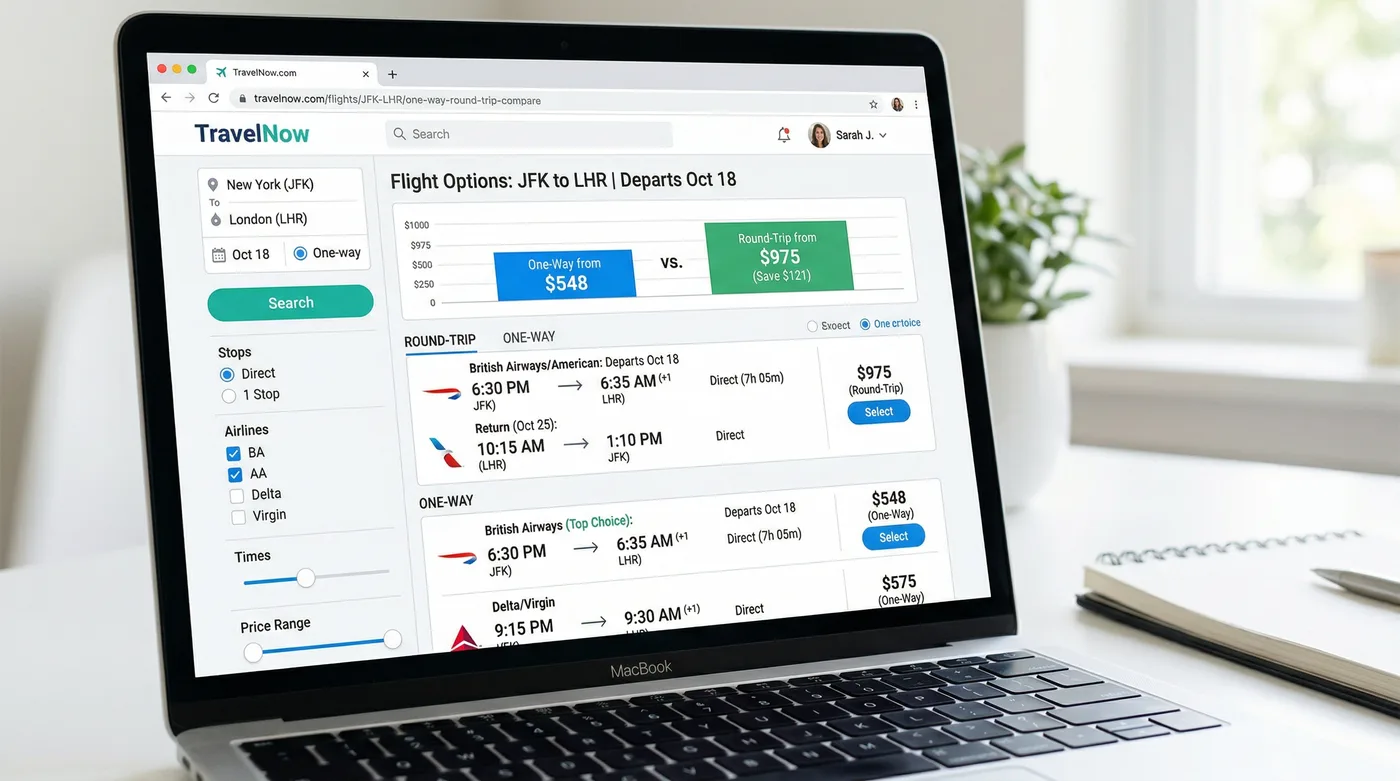
Transatlantic routes on major carriers are the clearest example of round-trip pricing still making sense. Here's a snapshot from early 2026 bookings for summer travel:
| Route | Round-trip (economy) | Two one-ways | Difference |
|---|---|---|---|
| JFK-LHR (British Airways) | $618 | $890 | -$272 |
| ORD-CDG (Air France) | $574 | $812 | -$238 |
| LAX-NRT (Japan Airlines) | $780 | $1,140 | -$360 |
| BOS-LIS (TAP Air Portugal) | $487 | $631 | -$144 |
| EWR-FCO (ITA Airways) | $542 | $798 | -$256 |
The same pattern holds for most non-stop transatlantic routes on the Big Three US carriers. Delta's JFK-AMS one-way in economy runs around $480-520 most of the year. The round-trip? Often $540-580. You're paying $60 more for both legs combined than you'd pay for just one leg alone. That's not a pricing strategy, that's a trap.
Where one-ways actually win (or at least tie)
Europe's low-cost carrier market is where the math flips. Ryanair, Wizz Air, and easyJet price their fares symmetrically — a one-way from BCN to WAW on Wizz might be €34, and the return might be €34. Book them separately or as a round-trip and you're paying the same thing. The "round-trip discount" simply doesn't exist.
This matters for a few reasons beyond just Europe:
- Open-jaw itineraries: If you want to fly into Rome and out of Barcelona, two separate one-ways are often your only option anyway. Trying to force that into a round-trip search just muddies the results.
- One-way positioning flights: Flying to a hub city to catch a cheap long-haul departure is a classic budget move. You're not coming back the same way, so a one-way is the only product that makes sense.
- Spirit and Frontier domestically: These two operate almost identically to European LCCs. A Spirit one-way from LAX to LAS is $39. The "round-trip" is just two $39 one-ways bundled together. No discount exists.
Frontier's domestic pricing is worth calling out specifically. I've seen FlightKitten catches where a Frontier one-way from Denver to Miami was $29, and the round-trip search returned $58 — exactly double. No penalty, no discount. Pure symmetry. That's the LCC model working as intended.
Pro Tip: On Ryanair and easyJet, always search one-way and book each leg separately. Their round-trip search tool sometimes returns slightly inflated bundles compared to manually adding two one-ways to your cart.
The open-jaw exception — and why it changes everything
Here's where budget travelers leave the most money behind: they search round-trips when they should be searching open-jaw.
An open-jaw is when you fly into one city and out of a different one. Fly into Madrid, travel overland through Portugal, fly home from Lisbon. Fly into Bangkok, travel through Southeast Asia, fly home from Singapore. This is how a lot of experienced budget travelers actually move through the world — and it almost always requires two one-ways.
The price comparison here isn't one-way vs round-trip anymore. It's "round-trip with backtracking" vs "two one-ways with a logical routing." When you frame it that way, the two one-ways often win on total trip value even if they're slightly more expensive in raw dollars, because you're not paying for a flight you don't need (the return to your origin city).
I ran this for a Southeast Asia trip recently. Round-trip BOS-BKK on EVA Air: $720. One-way BOS-BKK on EVA Air: $480. One-way SIN-BOS on Singapore Airlines: $390. Total for the open-jaw: $870. Yes, that's $150 more — but I didn't have to backtrack from Bangkok to Singapore, which would have been another $80-120 in regional flights. Net difference: basically a wash, and I got a more logical itinerary.
The hidden cost nobody talks about: baggage fees
This is where the one-way calculation gets messy in ways that don't show up in the headline fare.
When you book a round-trip on a single carrier, your checked bag fee covers both legs. When you book two separate one-ways — even on the same airline — you're often paying two separate baggage fees. On American Airlines, that's $35 each way, or $70 total vs $35 on a round-trip. On Spirit, it's worse: their checked bag fees can hit $79 per segment if you add at the airport.
For carry-on-only travelers, this doesn't matter. But if you're checking a bag, add the real math before you commit to the two-one-way strategy.
| Carrier | Checked bag (one-way) | Checked bag (round-trip) | Net difference |
|---|---|---|---|
| American Airlines | $35/segment | $35 first leg only | $35 |
| Delta | $35/segment | $35 first leg only | $35 |
| Spirit | $79/segment (at gate) | Same — no discount | $0 |
| Ryanair | €10-25/segment | Same — no discount | €0 |
| TAP Air Portugal | €35/segment | Included on some fares | Varies |
How to actually search for the cheaper option
The problem with most flight search tools is that they default to round-trip search, which means they're not showing you the one-way options in any useful comparative way. Here's the workflow I actually use:
First, search the round-trip on Google Flights. Note the total price and which carrier is offering it. Then open a second tab and search each leg as a one-way on the same dates. If the two one-ways are within $30 of the round-trip, the round-trip usually wins once you factor in baggage and the hassle of managing two separate bookings.
If the one-ways are significantly cheaper — more than $50 total — dig into why. Is one leg on a different carrier? Are you mixing a legacy carrier with an LCC? If so, make sure you're not creating a connection risk (separate tickets mean separate liability if you miss a connection).
FlightKitten's pounce alerts work for both booking types — you can set a hunt for a specific route and the catch will fire whether the deal appears as a one-way or a round-trip. The alert just shows you the cheapest available fare for that route on that date, and you decide how to book it. That's the right way to use fare alerts: let the price trigger the decision, not the booking format.
Pro Tip: For transatlantic routes, set your FlightKitten hunt for the round-trip fare. For European short-haul or US domestic LCC routes, set separate hunts for each one-way leg — you'll catch asymmetric deals where one direction drops while the other stays flat.
When airlines actively penalize one-ways
A few specific situations where one-way pricing is genuinely punitive and you should just book the round-trip:
US-Japan on Japanese carriers: JAL and ANA consistently price one-ways at 70-80% of the round-trip fare. A round-trip LAX-NRT on ANA in economy runs $750-900 most of the year. A one-way? Often $550-620. You're paying $550 for one direction when the other direction is effectively $200-350. Always book the round-trip here. US-Australia on Qantas: Similar story. Qantas one-ways from LAX to SYD in economy can hit $900-1,100. Round-trips are often $950-1,200. The math barely works in favor of the round-trip, but it does work. Any route with fuel surcharges: Carriers like British Airways and Lufthansa apply fuel surcharges per segment. On a round-trip, these are sometimes capped or reduced. On two separate one-ways, you pay full surcharges twice. This can add $80-150 to your total cost without showing up in the base fare.The verdict
There's no universal answer, which I know is annoying to read. But here's the closest thing to a decision tree:
Book a round-trip when:- You're flying transatlantic or transpacific on a legacy carrier
- You're flying to Japan, Australia, or South America on the flag carrier
- You're checking a bag on Delta or American
- The round-trip price is within $50 of two one-ways combined
- You're flying European short-haul on Ryanair, easyJet, or Wizz
- You're flying US domestic on Spirit or Frontier
- You want an open-jaw itinerary
- One direction has a significantly better deal on a different carrier than the other
The biggest mistake most budget travelers make isn't booking the wrong format — it's not checking both options before committing. Takes three extra minutes. Saved me $144 on my last trip to Lisbon (after I learned my lesson the hard way, obviously).
Set up your hunts on FlightKitten for the routes you're watching, and when an alert fires, run both searches before you click buy. The deal that triggered the alert might be a one-way fare — and the round-trip on the same carrier might be an even better catch.
The cheapest flight is the one you actually researched. Everything else is just guessing with extra steps.