


Route Briefing: Dallas to Venice
There are few flights you'll ever take that deliver a more dramatic payoff than the journey from Dallas to Venice. You board in the sprawling, sun-baked heart of Texas and, roughly twelve and a half hours later — with one stop along the way — you step out into a city that has no roads, no cars, and no real equivalent anywhere on the planet. That contrast alone makes this route worth every penny.
American Airlines, Lufthansa, and British Airways all service this corridor, typically routing through major European hubs like London Heathrow, Frankfurt, or Amsterdam. Shopping connections through those cities is genuinely smart strategy — not just logistically, but financially. Fares can dip under $700 roundtrip if you catch the right window, though standard pricing runs closer to $1,000 to $1,400 or more. The golden rule here is to book four to six months ahead if you're targeting summer travel. Venice is one of those destinations where airfare doesn't creep up gradually — it jumps. May is roughly where the spike begins, so locking in by January or February for a June or July trip is the move.
Once you land at Marco Polo Airport, the most memorable transfer option into the city is by water taxi or the Alilaguna public ferry service, which carries you directly across the lagoon into Venice proper. It's slower than a land transfer, but arriving by water — watching the skyline of domes and bell towers emerge from the mist — is genuinely one of travel's great arrival moments. Don't rush it.
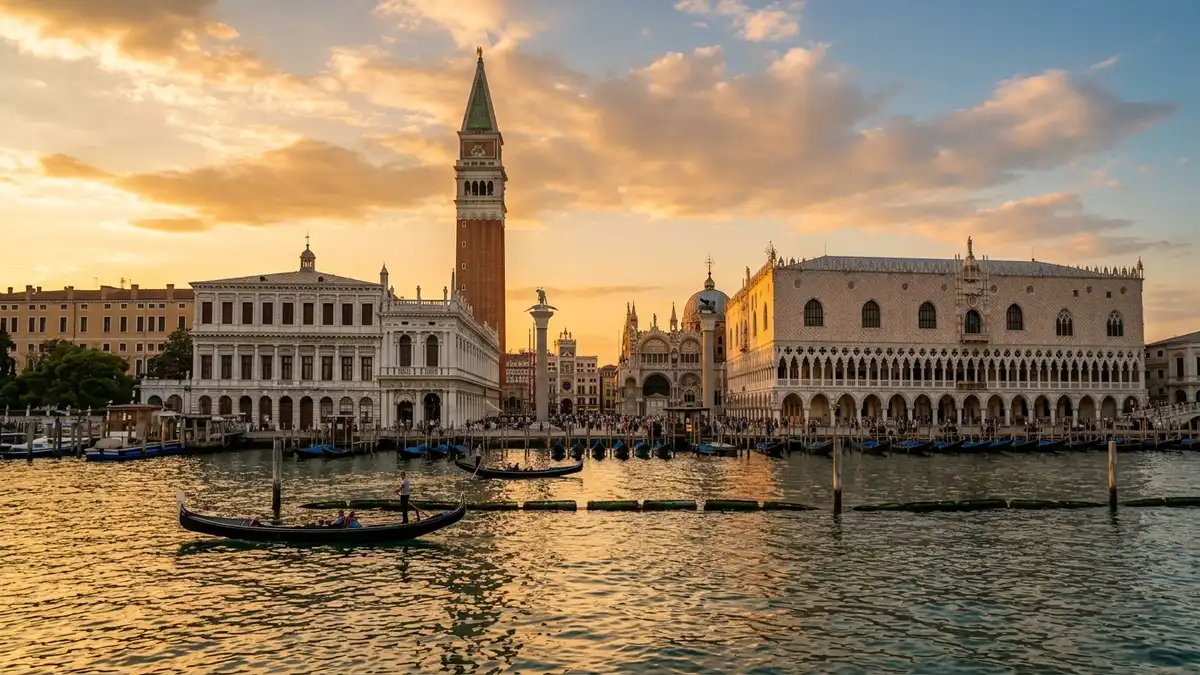
Venice rewards slow, aimless wandering more than almost any city in Europe. Getting lost in the narrow calli away from Piazza San Marco is not a problem — it's the whole point. The Basilica di San Marco and the Doge's Palace are essential, but the quieter sestieri like Cannaregio or Dorsoduro offer a more local rhythm. The food scene leans heavily on the Adriatic — fresh seafood, cicchetti (the Venetian answer to tapas, served in small bacaro wine bars), and a glass of Aperol Spritz, which was practically invented for this city.
Peak season runs June through August, when crowds are at their most intense and prices follow. If your schedule allows any flexibility, late September and October offer cooler temperatures, thinner crowds, and a moodier, more atmospheric version of the city that many travelers actually prefer. Venice in the off-season has a melancholy beauty that's hard to describe and impossible to forget.