


Route Briefing: Frankfurt to Stockholm
Just under three hours separates Frankfurt from one of Europe's most quietly spectacular capitals, and that short hop across the Baltic region is one of the better-value journeys you can make on the continent. Lufthansa, SAS, and Eurowings all serve this route year-round, and if you time your booking right — roughly four to eight weeks out, flying midweek rather than Friday or Sunday — you have a real shot at snagging a roundtrip under $200. Standard fares creep above $350, so a little planning goes a long way.
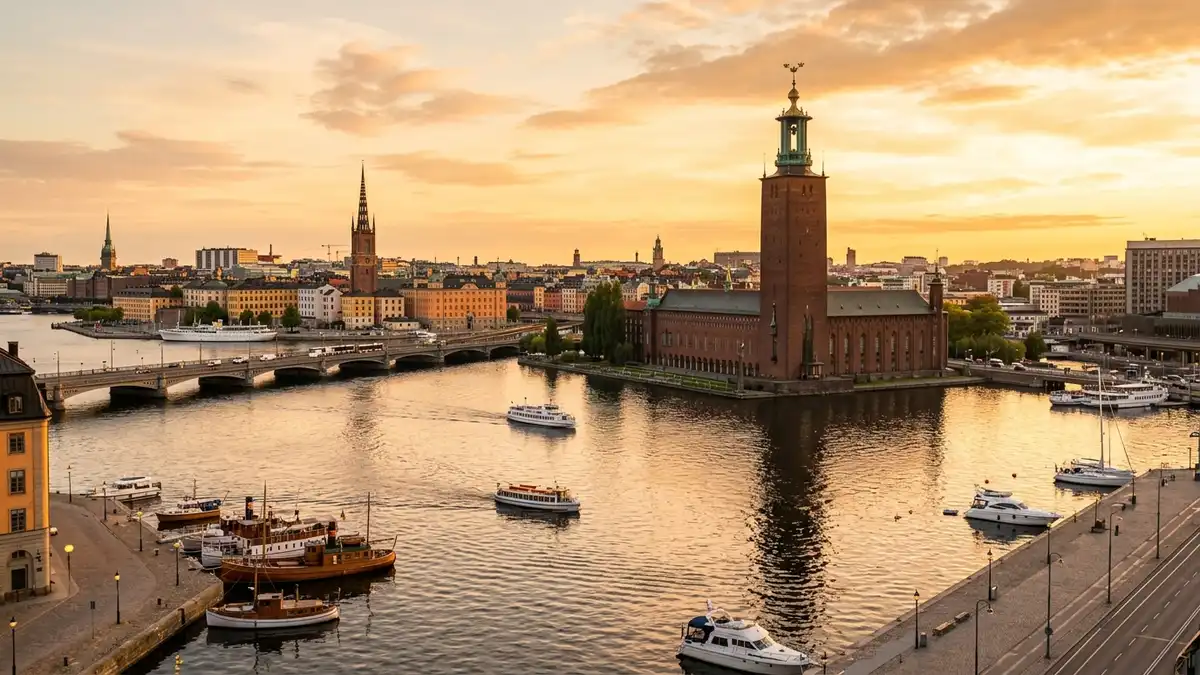
Stockholm earns its nickname, the Venice of the North, honestly. The city sprawls across fourteen islands where Lake Mälaren meets the Baltic Sea, and the water is never far from view no matter which neighbourhood you wander into. Gamla Stan, the medieval old town, is a tangle of amber and ochre buildings on a tiny island at the city's heart — genuinely one of the most photogenic historic centres in Scandinavia. From there you can walk to the Royal Palace, which still functions as the official residence of the Swedish royal family and hosts a changing of the guard worth timing your morning around.
What surprises most first-time visitors is the metro system. Stockholm's Tunnelbana stations are famously decorated by local artists, turning an ordinary commute into something closer to an underground gallery — the blue line in particular is worth riding just for the experience. Pick up a travel card and use it freely; the network connects the city efficiently and cheaply.
Arlanda Airport sits north of the city, and the Arlanda Express train is the fastest way into the centre, cutting the journey to around twenty minutes. It's not the cheapest option, but for a direct, no-fuss connection it's hard to beat after even a short flight.
Culturally, Stockholm rewards curiosity. The Nobel Prize has been awarded here since the early twentieth century, and the City Hall — where the Nobel Banquet is held each December — is open for guided tours that give you a genuine sense of the ceremony's grandeur. Swedish cuisine has evolved well beyond meatballs, though those remain deeply satisfying done properly. Fika, the Swedish ritual of coffee and a pastry taken as a genuine pause in the day, is something to embrace rather than rush through.
Peak season runs June through August when the days are extraordinarily long and the city hums with outdoor life. But shoulder season — particularly May or early September — offers milder crowds, lower accommodation prices, and weather that's still very manageable. Stockholm in any season has a particular calm elegance that Frankfurt's busy energy makes you appreciate all the more upon arrival.