


Route Briefing: Houston to Split
Few American cities have as direct a cultural leap to offer as Houston to Split — you're trading Gulf Coast heat for Adriatic brilliance, and the journey, while long at around fourteen and a half hours with one or two stops, is absolutely worth every minute in transit. Connecting through Frankfurt with Lufthansa, Vienna with Austrian Airlines, or Istanbul with Turkish Airlines tends to surface the best fares from IAH, so run searches across all three hubs before committing. If you can land a roundtrip under $900, you're doing well — standard pricing runs considerably higher, so booking four to six months ahead for summer travel isn't just a suggestion, it's genuinely the difference between a great deal and an expensive one.
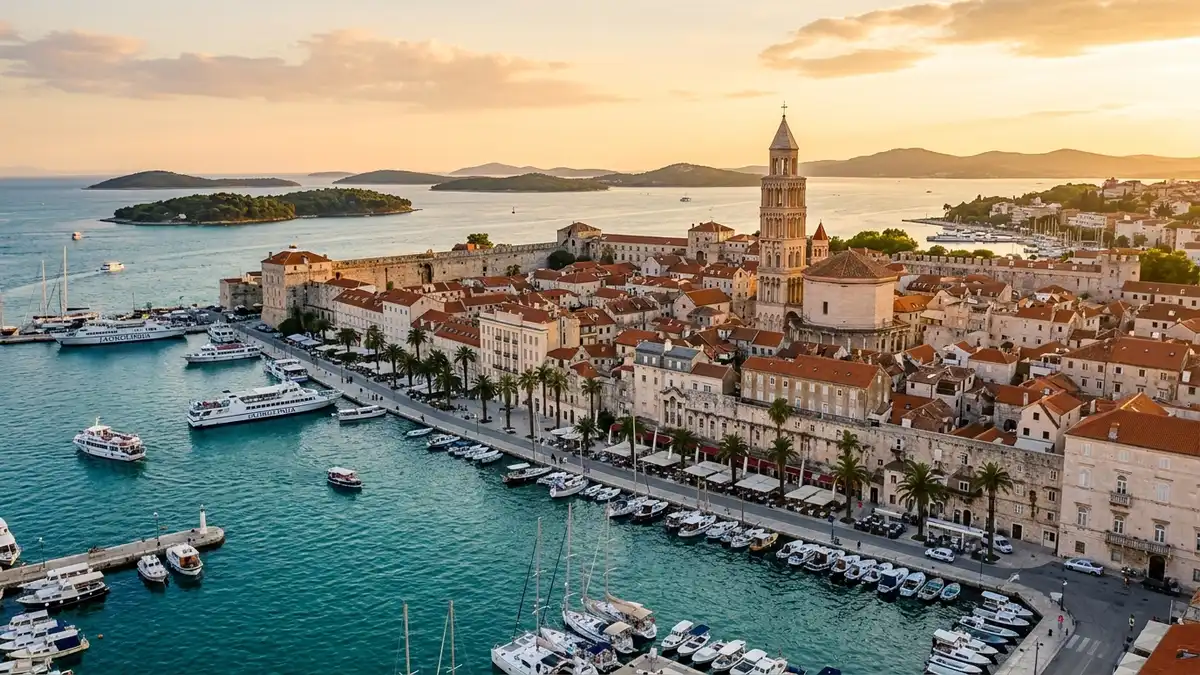
Split rewards the effort immediately. The city's beating heart is Diocletian's Palace, a Roman emperor's retirement complex built in the fourth century that never became a ruin — instead, locals simply moved in and never left. Today it's a living neighborhood of restaurants, bars, apartments, and tiny churches crammed inside ancient stone walls. Walking those narrow lanes at dusk, with the marble worn smooth by centuries of footsteps, is one of Europe's genuinely irreplaceable experiences. The Riva promenade runs along the waterfront just outside the palace walls and is perfect for that essential Croatian ritual of slow coffee and people-watching.
Split also functions as the gateway to the Dalmatian islands. Ferries and fast catamarans connect the city to Hvar, Brač, Vis, and Korčula, making it easy to combine a few days in the city with island time. Brač is closest and famous for its beaches, while Hvar draws a livelier crowd. Book island ferries in advance during July and August — they fill up.
The airport sits a short distance from the city center, and taxis and shuttle buses connect arrivals to the old town without much fuss. Peak season runs June through August when the Adriatic is warm, the days are long, and the city is buzzing. If you prefer fewer crowds and still-pleasant weather, late May and September are genuinely excellent — accommodation prices soften noticeably and the palace feels more like yours to explore.
The one tip worth burning into your memory: Croatian cuisine is outstanding and often underpriced relative to Western Europe. Fresh seafood, grilled fish, local olive oil, and Dalmatian wines are the real deal. Eat where locals eat, slightly away from the palace's most tourist-heavy lanes, and you'll eat extraordinarily well without spending much at all.