


Route Briefing: Atlanta to Rome
There are cities you visit, and then there are cities that visit you back — Rome is firmly in the second category. Flying out of Atlanta's Hartsfield-Jackson, you're looking at roughly ten and a half hours with one stop before you're standing in a place where two thousand years of history is simply the backdrop to daily life. Delta, ITA Airways (the successor to ITA Airways), and American Airlines all service this route, and if you're flexible with your connections, routing through hubs like JFK or Amsterdam can sometimes shake loose a better fare than you'd otherwise find.
Speaking of fares — under $650 roundtrip is genuinely a good deal on this route, and it does happen, particularly outside the summer rush. Standard pricing tends to run $900 to $1,200 or more, so if your travel window is flexible, the shoulder seasons of April through May and September through October are your sweet spot. The weather is mild, the crowds are thinner than the summer peak, and the city feels more like itself. June through August is spectacular but busy and expensive — if that's your only window, book three to six months out without hesitation.
Landing at Fiumicino (Leonardo da Vinci Airport), you have a straightforward and reliable option into the city center: the Leonardo Express train runs directly to Roma Termini, the main rail hub, in about thirty minutes. It's fast, comfortable, and removes all the guesswork of navigating an unfamiliar city after a long flight.
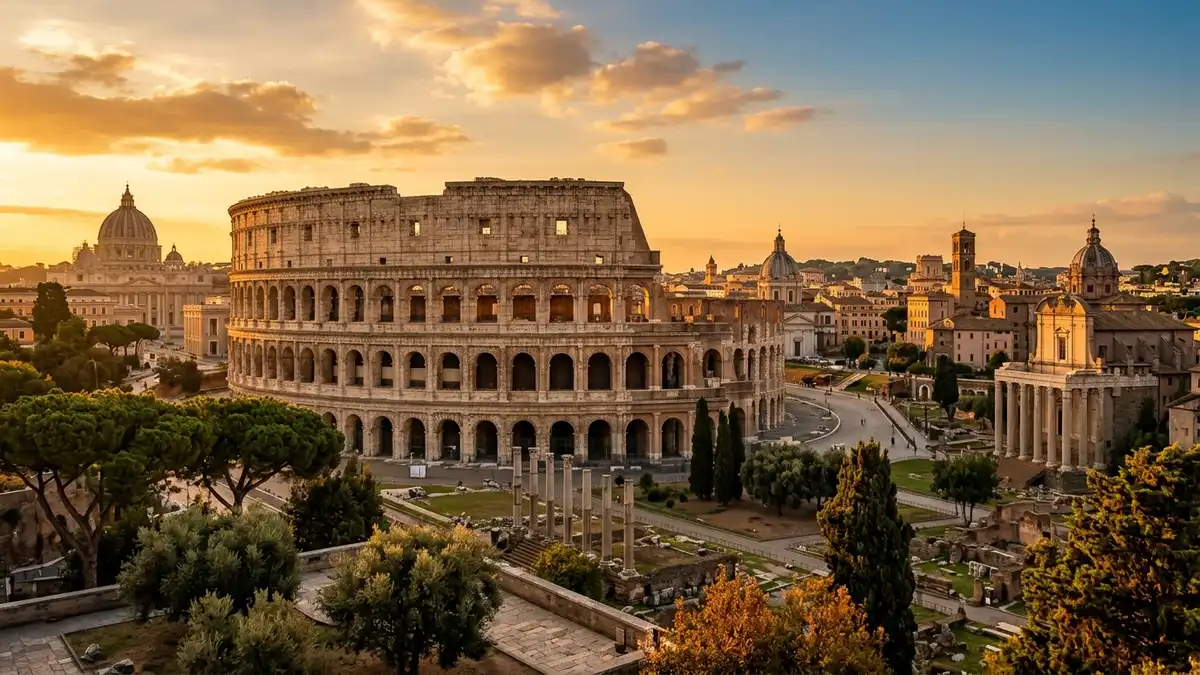
Once you're in Rome, the city rewards slow, aimless walking more than almost anywhere else on earth. The Colosseum and the Roman Forum sit together in a way that makes ancient history feel genuinely tangible rather than textbook. Vatican City — technically its own sovereign state — houses St. Peter's Basilica and the Sistine Chapel, and both exceed expectations even if you've seen a thousand photographs. The Trevi Fountain is as dramatic in person as advertised, though arriving early morning will spare you the densest crowds.
Roman food culture is its own education. The pasta here — cacio e pepe, carbonara, amatriciana — is built on a handful of simple ingredients treated with absolute seriousness. Gelato from a quality gelateria bears almost no resemblance to what gets sold under that name elsewhere. Eat where the menus are in Italian and the locals are actually sitting down.
The single best experience-enhancing tip for this trip: buy timed entry tickets for the Colosseum and the Vatican Museums well in advance. The lines for walk-up entry can consume hours of a day you'd rather spend eating pasta in a sun-drenched piazza. A little planning here pays enormous dividends.