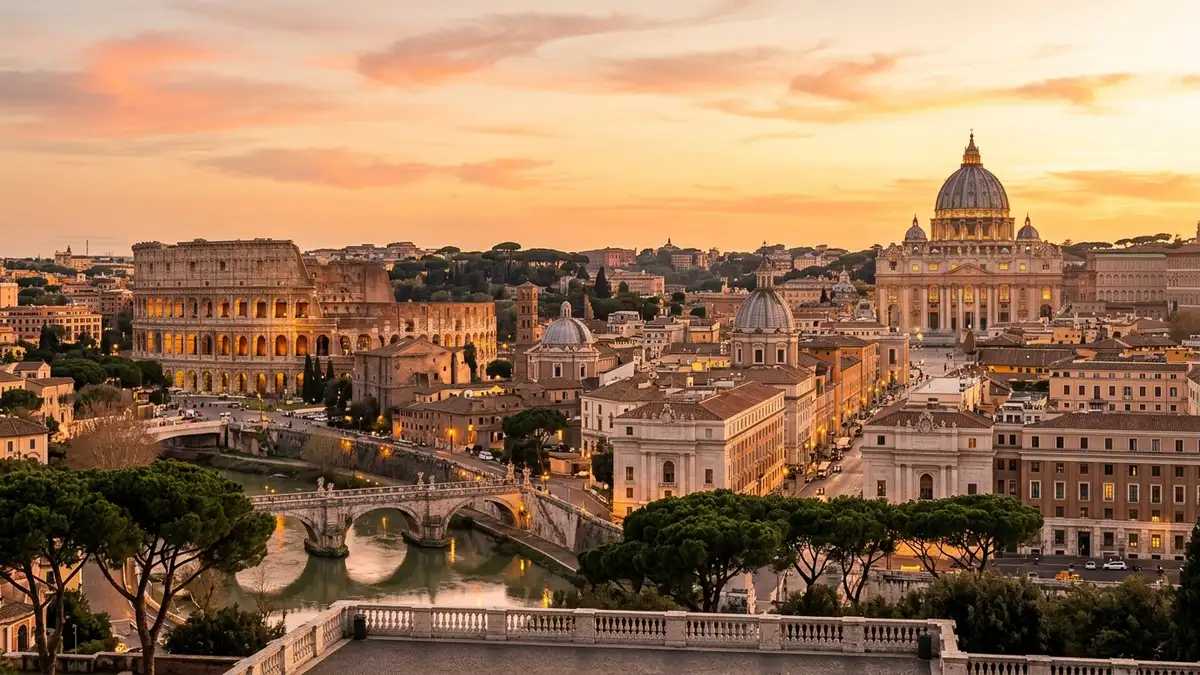



Route Briefing: New York to Rome
There are few flights that feel as genuinely transformative as the nonstop from New York to Rome. Just over eight hours in the air and you step off the plane into a city that has been continuously inhabited for nearly three thousand years — a place where you can eat a cornetto at a bar that sits on top of ancient Roman ruins and nobody thinks twice about it. That contrast, that casual layering of history onto daily life, is what makes Rome unlike anywhere else on earth.
Fiumicino Airport, officially Leonardo da Vinci, is well connected to the city center. The Leonardo Express train runs directly from the airport to Roma Termini, the main train station, making arrival straightforward even when you're running on transatlantic sleep. From Termini you're within reach of virtually every neighborhood worth exploring.
Rome rewards slow wandering more than any checklist approach. Yes, you should see the Colosseum and the Vatican — they are genuinely as extraordinary as advertised — but the city's real magic lives in the quieter moments: stumbling onto a piazza at dusk, eating cacio e pepe at a neighborhood trattoria, watching the Trevi Fountain glow after dark when the crowds thin out. Roman cuisine is one of the world's great regional food traditions, built on simplicity and quality ingredients. Gelato here is not a tourist gimmick; it's a daily ritual.
On the fare side, this route runs year-round with solid options from JFK and Newark on carriers including ITA Airways, Delta, and American Airlines. A genuinely good deal comes in under $600 roundtrip — achievable if you're flexible and strategic. Standard pricing runs considerably higher, often $900 to $1,200 or more. Summer, June through August, is peak season and fares reflect it sharply. If Rome in summer is your goal, book three to six months out and look at mid-week departures from JFK or Newark, where nonstop options on ITA Airways or Delta tend to offer the best value.
The smartest timing tip, though, is to consider shoulder season. Rome in April, May, or October gives you mild weather, manageable crowds, and meaningfully lower fares. The light in autumn is particularly beautiful, and the city feels more like itself when it isn't overwhelmed with visitors. Spring brings blooming wisteria and outdoor dining without the summer heat. Either window lets you experience the Eternal City at something closer to its natural rhythm — which, after an eight-hour flight, is exactly what you came for.