


Route Briefing: Boston to Accra
Boston to Accra is one of those routes that rewards patience — both in booking and in travel time. At around 17 and a half hours with a connection, it's a commitment, but what waits on the other end is a city that grabs you immediately and doesn't let go. Accra is West Africa's most accessible capital for first-time visitors to the region, buzzing with creative energy, deep historical weight, and a coastal warmth that feels genuinely welcoming rather than performative.
The route runs year-round, with Delta, Air France, and British Airways covering the bulk of traffic. Most itineraries connect through European hubs — Paris via Air France or London via British Airways — and this is actually worth leaning into strategically. Connecting through those European gateways tends to surface more competitive pricing than routing through US hubs, so when you're searching, filter accordingly. A strong roundtrip fare comes in under $900, while standard pricing typically lands between $1,200 and $1,600 or higher. Book three to six months out to give yourself the best shot at the lower end of that range.
Timing matters in Accra. December through January brings a festive atmosphere and drier conditions, and the city fills with the Ghanaian diaspora returning home for the holidays — which makes for an electric, celebratory energy but also means higher fares and busier accommodation. July and August are similarly popular. If you want the experience without the peak-season price tag, shoulder months on either side can offer a genuine sweet spot.
Once you land at Kotoka International Airport, you're already close to the city center — Accra is compact in that sense, and taxis are the standard way to get from the airport into town. Agree on a fare before you get in, as metered cabs are not universal.
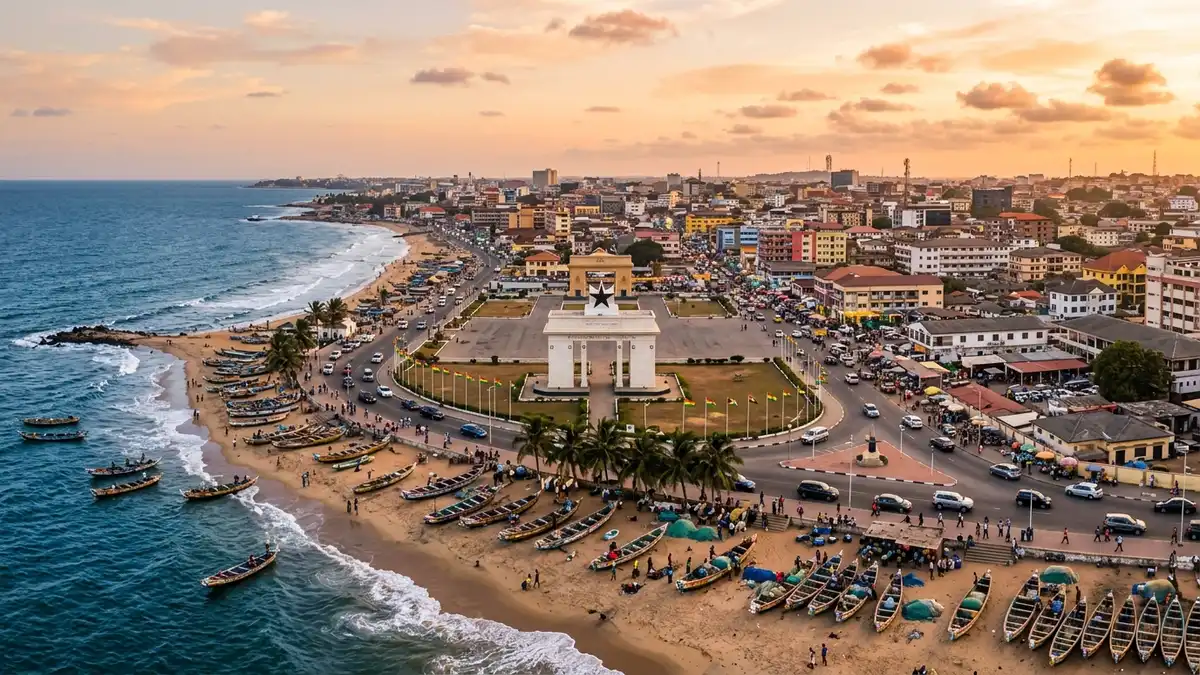
In the city itself, the Jamestown neighborhood offers a raw, atmospheric look at old colonial Accra, with its lighthouse and fishing harbor. The National Museum gives essential context for understanding Ghanaian history and the broader region. Makola Market is sensory overload in the best possible way — textiles, produce, noise, color. And no visit is complete without heading to Cape Coast, a few hours west, where the slave castles stand as one of the most profound and sobering historical sites on the continent.
The one tip worth burning into your memory: bring cedis in cash for smaller vendors and markets, but keep your budget flexible for the food. Ghanaian cuisine — jollof rice, kelewele, grilled tilapia along the coast — is one of the great underrated pleasures of West African travel, and eating where locals eat will cost you very little and reward you enormously.