


Route Briefing: Dallas to Havana
Flying from Dallas to Havana is one of those trips that genuinely feels like stepping through a portal. The journey runs around six and a half hours with a connection — most commonly through Miami or Fort Lauderdale — and that brief Florida layover actually works in your favor, giving you time to grab any last-minute Cuban convertible currency or simply decompress before landing in one of the most visually arresting cities in the Western Hemisphere.
Before you book, the single most important thing to sort out is your travel license category. U.S. regulations restrict straightforward tourism to Cuba, so you'll need to travel under one of the approved categories — support for the Cuban people, educational activities, and journalism are among the most commonly used. This isn't as daunting as it sounds, but it does require a little paperwork homework before you hit purchase. American Airlines, Southwest, and JetBlue all operate this route, and fares under $500 roundtrip represent genuinely good value. Standard pricing climbs to $700–$900 or more, so booking two to four months out gives you the best shot at the lower end. This is a winter-heavy route, with December through March being peak season — and for good reason, since Havana's dry season delivers warm, breezy days that make wandering the city an absolute pleasure.
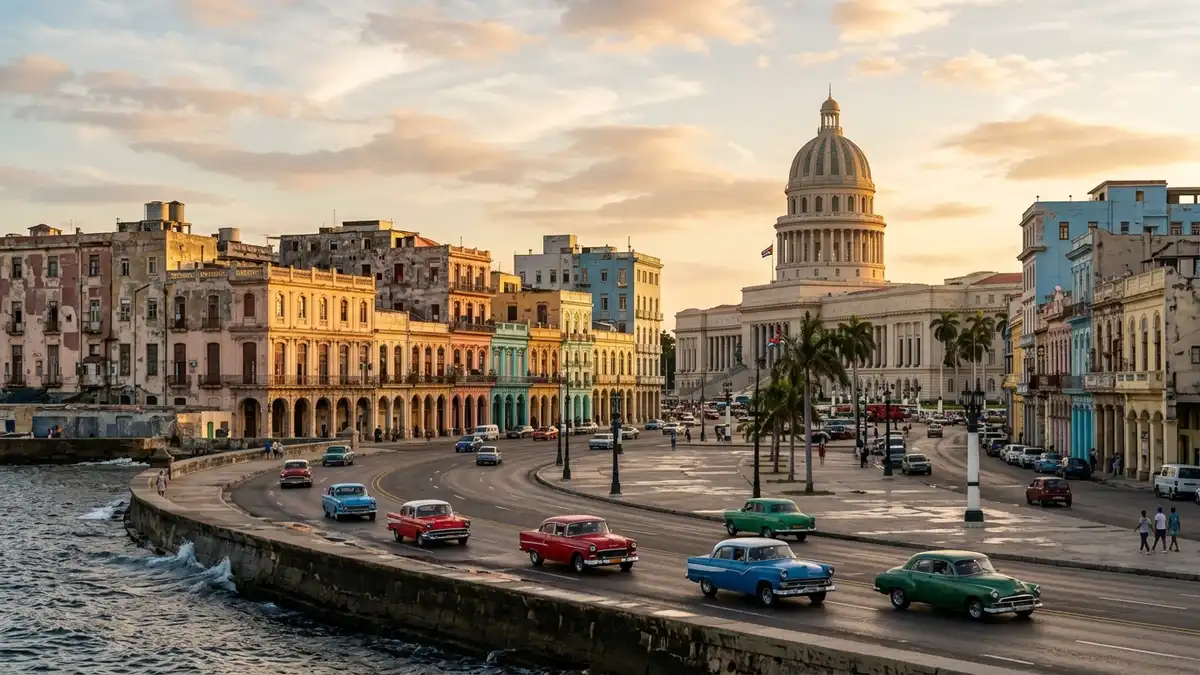
And wandering is exactly what Havana rewards. The city moves at its own unhurried pace, soundtracked by son cubano drifting from open doorways and the low rumble of immaculately maintained 1950s American cars rolling down the Malecón. Old Havana is a UNESCO World Heritage Site, and its colonial plazas, crumbling baroque facades, and pastel Art Deco buildings make it feel like a film set that somehow stayed inhabited. The food scene leans heavily on rice, black beans, slow-roasted pork, and fresh seafood — simple, satisfying, and deeply tied to the culture.
From José Martí International Airport, taxis are the most practical way into the city center, and agreeing on a fare before you get in is standard practice. The drive into Havana proper is relatively short and gives you your first real glimpse of the countryside and the city's outer neighborhoods.
The experience-enhancing tip worth remembering: bring enough cash in a non-US-dollar currency — euros or Canadian dollars convert well — since U.S. bank cards and credit cards generally don't function in Cuba. Arriving financially prepared means you spend your energy on the city, not scrambling for solutions. Havana doesn't ask much of you except presence. Give it that, and it gives back something genuinely unforgettable.