


Route Briefing: Dublin to Seoul
Dublin to Seoul is one of those long-haul routes that genuinely rewards the effort. At around eleven and a half hours with a stop, you're looking at a full day of travel, but what's waiting on the other end makes every hour worthwhile. Seoul is a city that operates at a frequency unlike anywhere else on earth — ancient and ultramodern, chaotic and deeply orderly, all at once.
On the fare front, anything under $700 roundtrip is a genuine win on this route, while standard pricing tends to settle in the $1,000 to $1,400 range. The three main options from Dublin are Finnair via Helsinki, Cathay Pacific via Hong Kong, and Emirates via Dubai. Of these, Finnair via Helsinki is worth a close look — Helsinki is geographically well-positioned for Asia-bound flights from Ireland, connection times tend to be tight and efficient, and the pricing is frequently competitive. Book three to six months ahead and you'll give yourself the best shot at those lower fares.
Timing your trip matters here. July and August bring warm, humid summers and the city is buzzing, but expect crowds and higher prices. Late December into early January has its own magic — Seoul in winter is crisp and atmospheric, with festive energy and far fewer Western tourists than you might expect. If flexibility is on your side, spring and autumn offer arguably the most pleasant conditions, with mild temperatures and the city looking its best.
Once you land at Incheon International Airport, the AREX express train connects directly to central Seoul in around forty minutes, making it one of the smoothest airport-to-city transfers in Asia. Skip the taxi queue on arrival and head straight for the train — it's fast, affordable, and stress-free even with luggage.
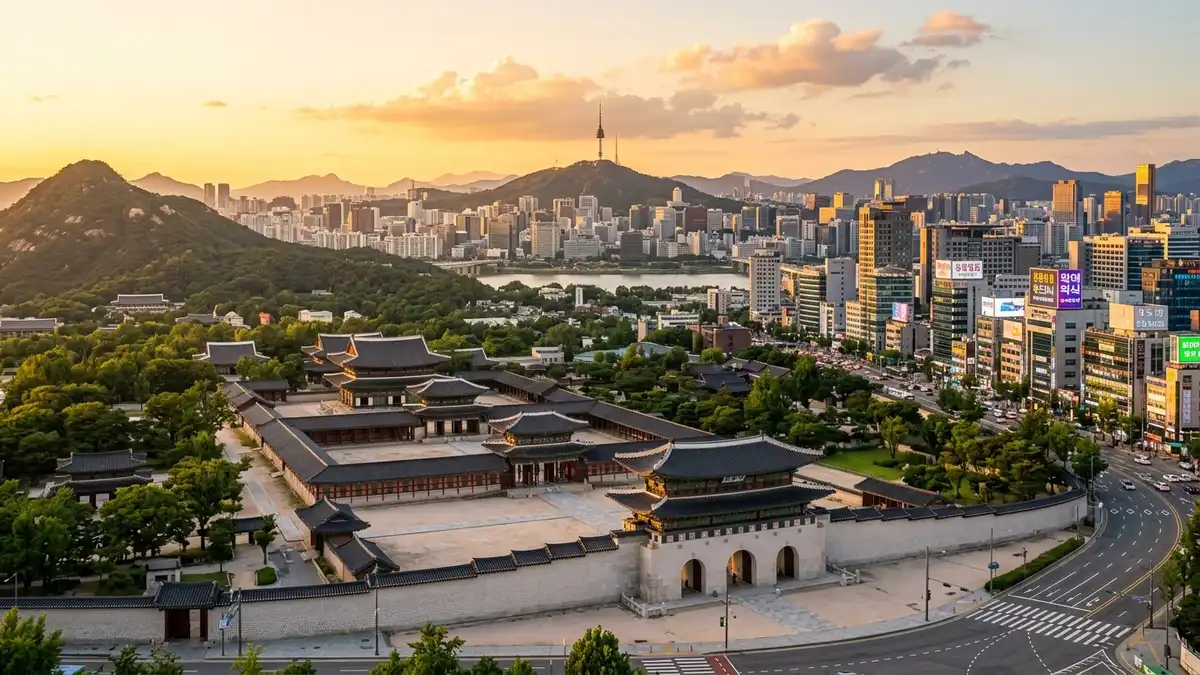
As for the city itself, Seoul delivers on every front. The old royal palaces — Gyeongbokgung being the most iconic — sit in striking contrast to the glass towers of Gangnam and the neon chaos of Hongdae. Street food is a serious pursuit here, not an afterthought, and the neighbourhoods of Myeongdong and Gwangjang Market are essential stops for anyone who eats with genuine curiosity. K-pop culture is woven into the city's fabric in ways that feel organic rather than manufactured, and even if you're not a fan, the energy is infectious.
The one tip worth burning into your memory before you go: get a T-money card at the airport on arrival. It works on the metro, buses, and even some taxis, and navigating Seoul's excellent public transport system becomes effortless the moment you have one in your pocket.