


Route Briefing: Los Angeles to Casablanca
Landing in Casablanca feels like stepping into a city that refuses to be easily defined — part European elegance, part ancient Maghreb soul, all wrapped in the salt air of the Atlantic. For travelers departing Los Angeles, this roughly 14-and-a-half hour journey with one stop opens the door not just to Morocco's largest city, but to an entire continent waiting just beyond it.
The route itself is well-served year-round, with Royal Air Maroc, Air France, and Iberia being your most reliable options. Royal Air Maroc frequently offers the sharpest prices, often routing you through their Casablanca hub in a way that actually minimizes layover friction. If you prefer a European connection, Air France through Paris or Iberia through Madrid are solid alternatives with strong service reputations. A genuinely good deal on this route lands under $700 roundtrip — snag that if you see it. Standard fares run anywhere from $1,000 to $1,400 or more, so booking three to six months ahead is your single most effective strategy for keeping costs down.
Once you land at Mohammed V International Airport, the city center is roughly 30 kilometers away. A train service connects the airport directly to the main Casa Voyageurs station, making it one of the more straightforward airport-to-city transfers on the African continent — no haggling required, which is a welcome relief after a long-haul flight.
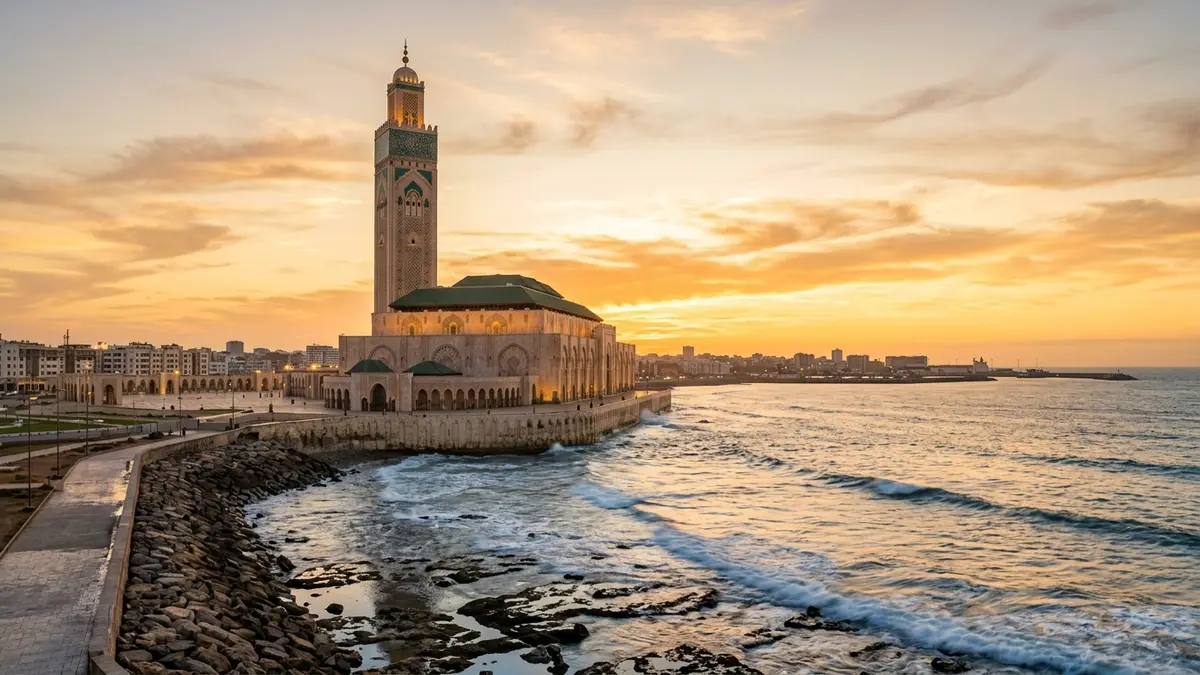
Casablanca itself tends to surprise first-timers. It's less about ancient medinas and more about wide Haussmanian boulevards, buzzing café culture, and a genuinely cosmopolitan energy. That said, the Hassan II Mosque is an absolute non-negotiable — one of the largest mosques in the world, dramatically positioned on a platform extending over the Atlantic Ocean. It's architecturally breathtaking and open to non-Muslim visitors on guided tours, which is relatively rare in Morocco.
The old medina is compact but atmospheric, and the Corniche along the waterfront gives you a completely different, breezy side of the city. Moroccan cuisine here is the real deal — tagines, fresh seafood, and pastilla are worth seeking out at any local restaurant that draws a neighborhood crowd rather than a tourist one.
Peak season runs June through August when the city hums with energy, but shoulder seasons in spring and autumn offer pleasant temperatures and noticeably thinner crowds. Casablanca also works beautifully as a launching pad for Marrakech, Fes, or the Sahara — all accessible by train or domestic flight — so consider building at least a few extra days into your itinerary. The flight is long, but Morocco rewards the effort generously.