


Route Briefing: San Francisco to Casablanca
There's something genuinely thrilling about a transatlantic journey that deposits you not in Europe but in Africa — and the San Francisco to Casablanca route delivers exactly that sense of arrival into somewhere truly different. At around 17 and a half hours with a connection, it's a long haul, but the reward is stepping off the plane into Morocco's most dynamic, cosmopolitan city, a place where Art Deco architecture meets Islamic tradition and the Atlantic breeze carries the scent of the medina.
Royal Air Maroc is the natural choice here, often routing through Casablanca's Mohammed V International Airport as its home hub, while Air France and Iberia offer solid alternatives connecting through Paris Charles de Gaulle or Madrid Barajas respectively. Those European connections are worth paying attention to — routing through CDG or MAD frequently unlocks the most competitive fares on this route, so don't fixate on a single itinerary when searching. A roundtrip under $700 represents a genuinely good deal; standard pricing typically runs $1,000 to $1,400 or more, so booking two to four months ahead is the move, especially since seat availability on this route tightens faster than you'd expect.
Once you land, a train connects Mohammed V Airport directly to the city centre, making it one of the more straightforward airport transfers in North Africa — affordable, reliable, and far less stressful than negotiating a taxi after a long flight.
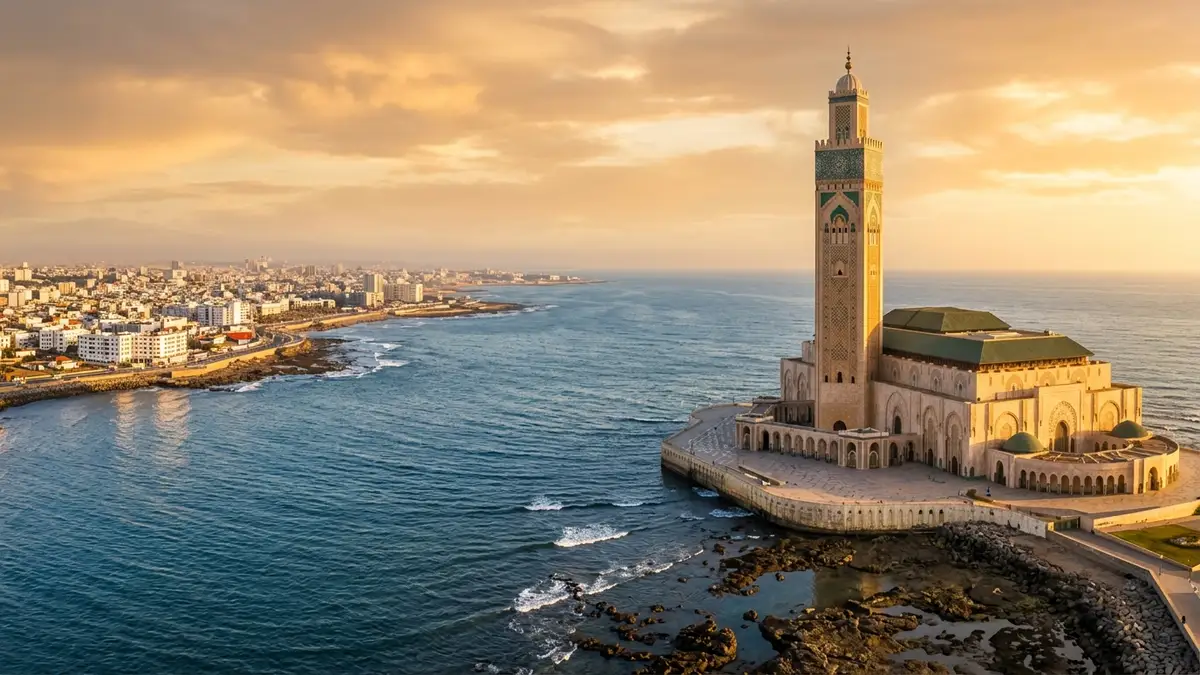
Casablanca itself rewards curiosity. The Hassan II Mosque is one of the most spectacular pieces of religious architecture anywhere in the world, its minaret visible from much of the city and its oceanside position genuinely breathtaking. Beyond that landmark, the city has a lived-in energy that purely touristic destinations lack — bustling corniche promenades, a vibrant café culture, and a food scene built around fresh seafood, slow-cooked tagines, and some of the finest pastries you'll find anywhere. It functions brilliantly as a base for day trips to Rabat, the capital, or as a launching point deeper into Morocco toward Marrakech or Fes.
Peak season runs June through August when the city fills with Moroccan diaspora returning for summer, which means higher prices and a livelier atmosphere. If you prefer a quieter, cooler experience with more room to breathe, the shoulder months of April, May, and October offer pleasant weather and a more relaxed pace. Winter remains mild by European standards and the city never really shuts down.
The single best tip for this route: if your European layover allows it, consider building in a longer stopover in Paris or Madrid on the way home. You've already crossed the Atlantic — you might as well make the connection work for you.