


Route Briefing: Las Vegas to Dakar
Few routes from Las Vegas carry you quite as far from the neon and noise as this one — a 20-plus-hour journey connecting the Nevada desert to the windswept Atlantic shores of West Africa. It's a long haul, no question, but Dakar rewards the effort in ways that are genuinely hard to replicate anywhere else on the continent.
Getting there typically means connecting through either Paris Charles de Gaulle or Casablanca Mohammed V, with Air France, Delta, and Royal Air Maroc handling the bulk of traffic on this route. Both connection cities are solid transit hubs, and if you can snag a roundtrip fare under $900, you're doing well — standard pricing climbs above $1,300, so this is a route where booking three to six months ahead genuinely pays off. Flexibility on your connection city helps too; sometimes Casablanca prices out cheaper, sometimes Paris does, so check both.
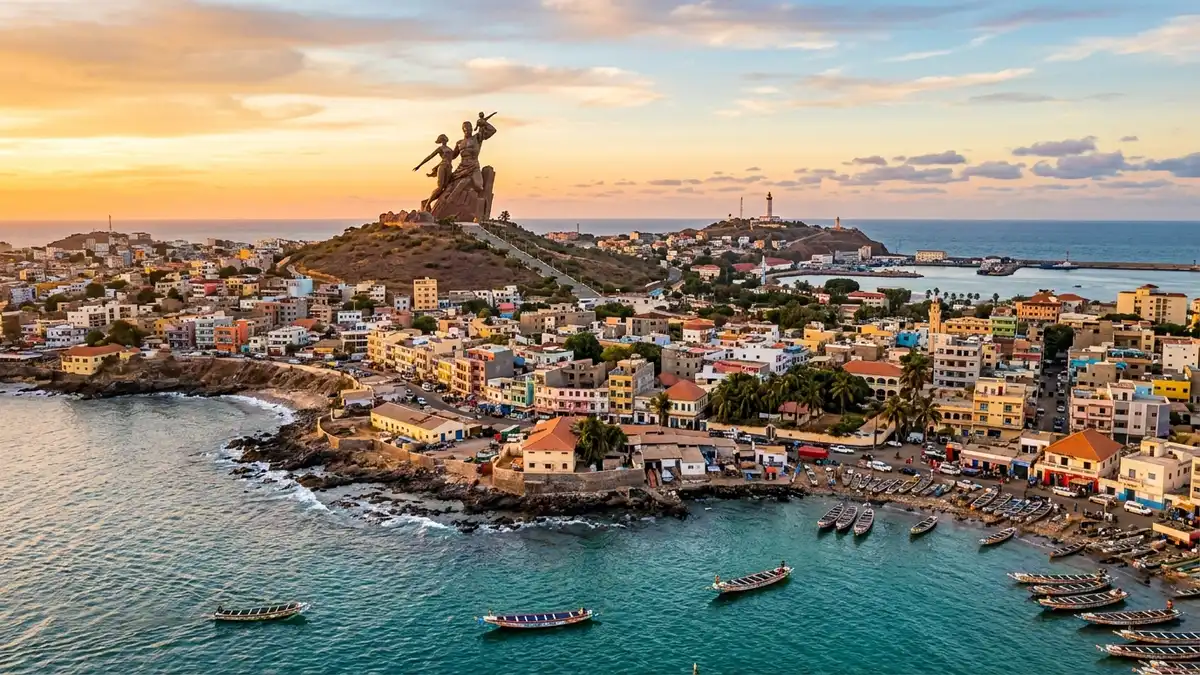
Dakar sits on the Cap-Vert Peninsula, the westernmost point of the African continent, and that geography gives it a personality unlike anywhere else in West Africa. The Atlantic breeze keeps temperatures more manageable than you might expect, and the city hums with an energy rooted in music, art, and trade. Senegal is the birthplace of mbalax, the infectious rhythmic music style associated with the legendary Youssou N'Dour, and live music is woven into the fabric of daily life here. The markets — particularly the sprawling Marché Sandaga and the artisan-focused Marché des HLM — are sensory overload in the best possible way, full of textiles, jewelry, and hand-crafted goods.
The cuisine alone justifies the journey. Thiéboudienne, a slow-cooked rice and fish dish considered Senegal's national meal, is deeply satisfying and found everywhere from family kitchens to neighborhood restaurants. Yassa poulet, chicken marinated in lemon and onion, is another staple worth seeking out repeatedly.
For timing, December through January is peak season, bringing dry, cooler weather and a festive atmosphere — but also higher prices and more competition for seats. If you can travel just outside that window, you'll find the city more relaxed and fares more forgiving.
Léopold Sédar Senghor International Airport sits relatively close to the city center compared to many African capitals, and taxis are the standard way to get into town — agree on a fare before you get in, as metered cabs are not the norm. A useful tip for the long journey itself: if connecting through Paris, even a brief layover gives you a chance to reset before the final leg to Dakar, making the overall travel day feel considerably more human.